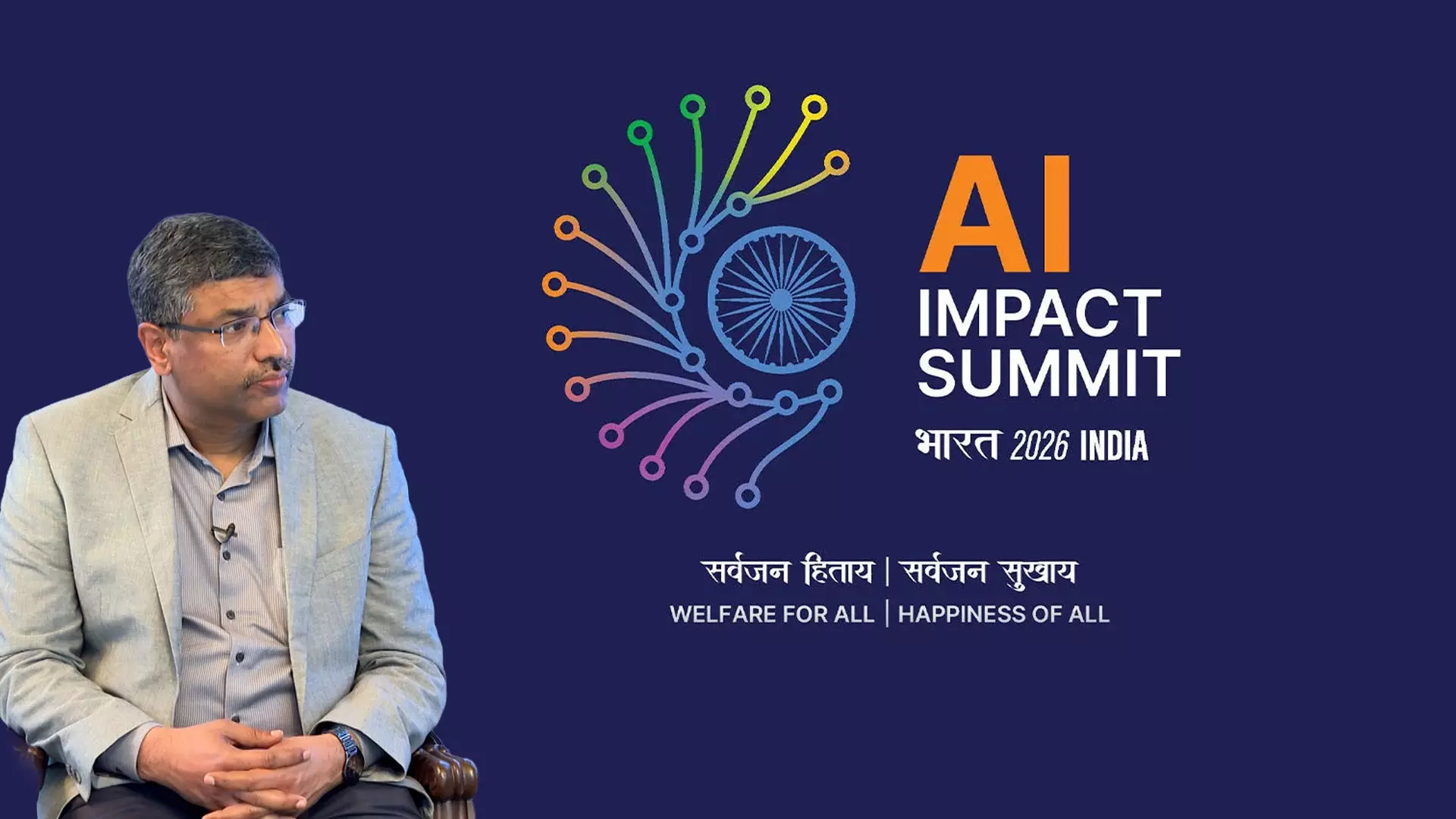
S Krishnan, MeitY secretary talks about India's AI outlook, job creation and global cooperation in New Delhi, ahead of the AI Impact summit
AI Impact Summit: AI will create more jobs than it replaces, says MeitY secretary
MeitY secretary says AI will boost productivity, create new roles, and prioritise innovation over regulation; cites NITI Aayog data to predict 4 million new roles

Even as the debate over the impact of Artificial Intelligence (AI) on jobs, regulation, and global cooperation has intensified in the country, New Delhi is all set to host a major global AI summit. Many countries are expected to participate in this summit.
The Federal spoke to S Krishnan, secretary, ministry of electronics and information technology, (MeitY), on India’s AI outlook, the summit’s core agenda, and how the government plans to balance innovation with safeguards.
Addressing fears that AI could disrupt India's IT sector and lead to loss of jobs, Krishnan assured, "Net-net, more jobs will be created.”
Here are excerpts from the interview:
Artificial intelligence is the talk of the town globally. There is a major summit happening in India with participation from many countries. At one level, there is fear that the IT industry may be affected, but there is also hope of new technologies and jobs. How do you gauge the situation?
I think in the Ministry of Electronics and Information Technology and in the Government of India more widely, we are quite positive about the good and beneficial impact that artificial intelligence will have on the country and on humankind in general.
We believe that human productivity and human capabilities can be considerably enhanced as a result of the use of artificial intelligence. For a country like India to become a developed nation by 2047, this is an important technology which we have to adopt and utilise to move forward. This is the basis on which we are moving forward in this space.
Also read: Elon Musk says Anthropic’s Claude AI is ‘misanthropic and evil’, 'hates men'
There are certain fears, including job losses and other negative aspects of this technology. We have to mitigate them. As far as job losses are concerned, we believe that while jobs may be lost in certain segments, newer jobs will be created in other segments. So net-net, more jobs will be created.
NITI Aayog had already prepared a report that about 2 million jobs may be lost as a result of artificial intelligence, but 4 million new jobs will be created in other segments and other parts for doing different things.
Just to give you an example, while in the IT sector, programmers and coders may no longer be needed, you will need domain experts and others who will create AI-based applications and apply them to real-world situations.
On the whole, through retraining and upskilling the existing workforce, by training those who are newly entering the workforce in artificial intelligence, and by adapting the existing curriculum in our schools and colleges to include artificial intelligence in all departments and in all fields of study as a base technology – and understanding how it affects their particular segment or sector – I think we should be able to ensure that India is in a good position to take advantage of the AI revolution.
Global leaders are arriving in New Delhi for the summit. What kind of impact do you expect and what is the core concept behind this summit?
The core idea behind the summit is to democratise access to AI resources, which includes compute, models, and data.
At the same time, it is to ensure that humans are at the centre of the way AI is rolled out in the world. Enhancing human capability needs to be the primary goal. The whole idea is to focus on the positive impact that AI can have and how we enable it. This is the manner in which we are approaching artificial intelligence and how we believe we can take this forward.
Also read: AI three-hour takedown rule: When speed becomes the censor
Our summit, which is called the AI Impact Summit, is fundamentally oriented towards this. The three broad themes are people, planet, and progress. The idea is to focus on people, ensure that the planet is protected in terms of resilience and sustainability, and make sure that we are able to attain overall growth and development.
We are expecting close to about 20 heads of state and government, about 45 ministers from various countries, and overall delegations from about 100 countries. In addition, more than 100 CEOs, including some of the CEOs of the leading AI companies in the world, will be present.
Also read: Crossing Rs 4-5L a night: AI Impact Summit sends Delhi luxury-hotel fares soaring
More than 2.5 lakh people have already enrolled as delegates. So we expect to see heavy footfall during the summit in the coming days.
What kind of cooperation does India have with other countries in artificial intelligence, including data centres, protocols and safety? Will this conference improve interaction?
Yes, this is the fourth in the series of conferences being held. The first of them was held in Bletchley Park in the UK in November 2023, followed by another in Seoul in 2024. In February last year, the conference was held in France. Now, we are going to be fourth in this series.
In addition, we are also part of the Global Partnership on AI, called GPAI, and we chaired GPAI in 2024. We played an important role in GPAI during that period.
We also collaborate with international organisations including the United Nations and the Global Digital Compact, which deals with AI-related issues. We are working with a number of international organisations to take this forward.
Safe use of artificial intelligence to avoid risks and move forward in a progressive way is a very important focus area all over the world.
There are concerns about social media usage, especially by minors. How are we cooperating with the rest of the world on these issues?
We have extensive discussions with our partner countries elsewhere in the world to understand their approaches to dealing with these same challenges. We learn from their experience and we also share our experience with them, and see how best we can take an approach that works for everybody.
Also read: Zoho’s Sridhar Vembu warns coders to seek alternative careers amid AI boom
In India itself, we have a fairly robust approach to protect against the harms of social media and harmful content. My ministry is extremely alert to ensure that such instances do not happen, and whenever they are brought to our notice, we take action immediately.
You would have noticed that even in the recent Grok case, the ministry acted very rapidly and very quickly. Likewise, whenever these kinds of issues come up, we do take action quickly.
As emerging technologies evolve, how does India’s regulatory framework compare with the rest of the world?
As far as AI is concerned, the government’s policy, clearly articulated by the Prime Minister and my minister, is to make sure that we first realise the positive outcomes of AI. Innovation should be given precedence over regulation.
That is the first aspect—we have to use it for positive purposes and innovate, and take maximum advantage of the positive effect of these technologies.
The next priority is to ensure that it causes no harm. So we take such actions as are necessary to prevent it from causing harm.
We act on both these aspects and try to make sure that, without unnecessarily constraining the positive impact of the technology and while allowing it to be used for various types of innovative purposes, we also ensure that there is enough regulation to make sure that individuals are protected and we are safeguarded from risks.
The content above has been transcribed from video using a fine-tuned AI model. To ensure accuracy, quality, and editorial integrity, we employ a Human-In-The-Loop (HITL) process. While AI assists in creating the initial draft, our experienced editorial team carefully reviews, edits, and refines the content before publication. At The Federal, we combine the efficiency of AI with the expertise of human editors to deliver reliable and insightful journalism.