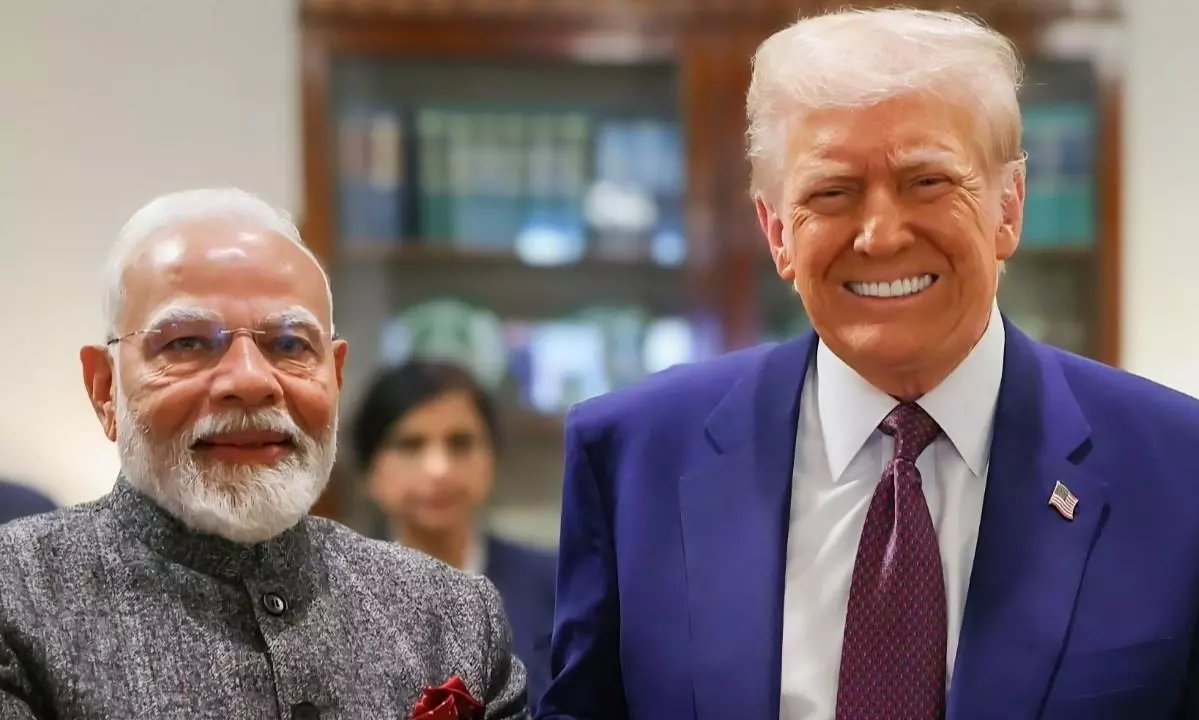
Prime Minister Narendra Modi with US President Donald Trump in a file photo.
Why India-US trade deal raises fears of one-sided concessions
Trump claims 0 tariffs and $500bn buys; India says very little on deal details, sparking concerns over farmers, medicines and limited gains from lower US duties

The details of the trade deal between the US and India announced by US President Donald Trump in the early hours of Tuesday (February 3) remain shrouded in mystery.
While Trump made some explosive declarations, Prime Minister Narendra Modi and his government have maintained near silence. Contrary to expectations, the government made no statement today in Parliament, in the ongoing Budget Session. So far, Modi has welcomed Trump’s trade-related announcements by posting on X that he was “delighted that Made in India products will now have a reduced tariff of 18%” and thanked Trump on behalf of 1.4 billion Indians.
Addressing the media in the evening, Union Commerce Minister Piyush Goyal said Modi used his friendship and personal rapport with Trump to secure the deal, adding that the country’s agriculture and dairy sectors have been safeguarded. However, he did not share more details, saying instead a joint US-India statement would come out later this week.
India conceded a great deal?
In his social media post, Trump clearly stated that Modi had agreed to “zero” tariff and non-tariff barriers for US goods and services, and to buy “over $500 billion of “US energy, technology, agricultural, coal, and many other products”. In return, the US offered to lower tariff from 50 per cent to 18 per cent on some items, not all (which will be clear soon).
Also read: India’s trade deal with the US is not reciprocity, it is submission
Given that Trump included India’s zero tariff for US “agricultural” products, it may be surmised that India has agreed to open up its agricultural and dairy (livestock being part of the agricultural sector), paving the way for a flood of not just soybean, corn and milk but also genetically modified (GM) food (soybean and corn) and GM seeds that may follow.
This is likely to spark a strong protest, particularly since Modi had publicly vowed to not let this happen, no matter what the cost. Last August, he said, “India will never compromise on the well-being of its farmers, dairy (sector) and fishermen. And I know personally I will have to pay a heavy price for it.”
Concerns over IPR
There could be other shocks. For instance, has India agreed to dilute its Intellectual Property Regime (IPR) to allow US Big Pharma to push their high-cost patented drugs by allowing evergreening and data exclusivity and compromising on its compulsory licensing authority? That is not clear yet.
Also read: US-India trade deal | Trump's claim raises doubts over scope and timelines: GTRI
India did dilute its IPR in its free trade agreement (FTA) with European Free Trade Association (EFTA) countries (Switzerland, Iceland, Norway and Liechtenstein) in March 2024 but pulled back in the FTA with the UK due to strong domestic protests.
It has said its FTA with the EU, which has not been made public, doesn't compromise on IPR. The lack of details has heightened concerns of India having been steamrolled by Trump with little gain in return.
High US tariffs still persist
India’s gain is limited given that many of the US tariffs applicable globally remain in force and will not be reduced to 18 per cent. For example:
• 50 per cent US tariff on steel, aluminium, copper etc under Section 232 (globally), which came into effect from June 2025, is applicable to India and others, except the UK.
• 25 per cent US tariff on a few auto components, effective from April 2025, is in force.
• 100 per cent US tariff on branded or patented drugs remains in force from October 1, unless a foreign company is building a factory in the US, along with 25 per cent US global tariff on all heavy-duty trucks and 50 per cent on kitchen and bathroom cabinets.
One-sided deal?
On the other hand, Trump has extracted many concessions that may not go down well in India.
He announced, for the second time early this morning (the first time was on February 1), India will switch to Venezuelan crude – having stopped buying it after the US sanctions a few years ago and having agreed to not buy the heavily discounted Russian crude (by Trump’s posts and repeated announcements).
Also read: US offers Venezuelan oil to India to cut Russian crude imports
India’s commitment to buy “over $500 billion” of US goods and services (declared in a joint statement in February 2025) is a quantum jump from the current level of total trade. The Office of the US Trade Representative says, “US goods and services trade with India totalled an estimated $212.3 billion in 2024...US total goods trade (exports plus imports) with India was an estimated $128.9 billion in 2024.
” India has not only started buying more US crude, but Indian oil PSUs signed a deal last November to import around 2.2 MTPA of LPG from the US Gulf Coast. India has been buying military weapons and aircraft from the US, and this is likely to gather pace.
Marginal gains
The US has been a valued market for India, generating trade surplus. But reducing the tariff from 50 per cent to 18 per cent may not matter much given the relative tariffs with other countries. For example, the US tariffs for several developed nations are far lower than that for India: the UK (10 per cent), the EU, South Korea and Japan (15 per cent). It is only marginally better than Pakistan and Indonesia (19 per cent) and Vietnam (20 per cent).
Given that Indian rupee has fallen more than other Asian currencies against the USD (which itself has fallen by 11 per cent in the past one year against other major currencies), 18 per cent tariff on India means no advantage.
Also read: Kremlin denies Trump’s claim that India will stop buying Russian oil
India has landed here despite being very accommodating of Trump’s threats for over a year.
Trump kept happy
Apart from stopping the cheap Russian crude and agreeing to buy Venezuela crude, India has either cut tariffs to zero or substantially lower levels on several goods and services. In the lastest Budget, India proposed tax holidays for cloud services and eliminated tariffs on aircraft components, nuclear equipment, clean energy equipment, electronics, medical devices, satellite ground installation equipment etc.
In the 2025 Budget, it had cut duty on technology, automobiles, industrial inputs and waste imports that impact the US exports to India: Fish hydrolysate (15% to 5%), motorcycles (50% to 30-40%), ethernet switches (20% to 10%), synthetic flavouring (100% to 20%), ground installation for satellites, including spares and consumables (cut to zero) and specific waste and scrap items (5% to 0%). Outside the budget, India has conceded more grounds.
Also read: US Commerce Secretary slams India-EU trade deal over Russian oil purchases
In February 2025, it cut down the tariff on Bourbon Whisky (in February 2025) originating from the US, from 150 per cent to 50 per cent. In March 2025, it withdrew a 6 per cent equalisation tariff (popularly called Google Tax) to benefit the US tech giants like Google, Meta and Amazon.
In August 2025, it eliminated tariff on cotton to specifically benefit the US. In November 2025, it allowed 100 per cent FDI in the insurance sector, which it had resisted for long in international platforms.