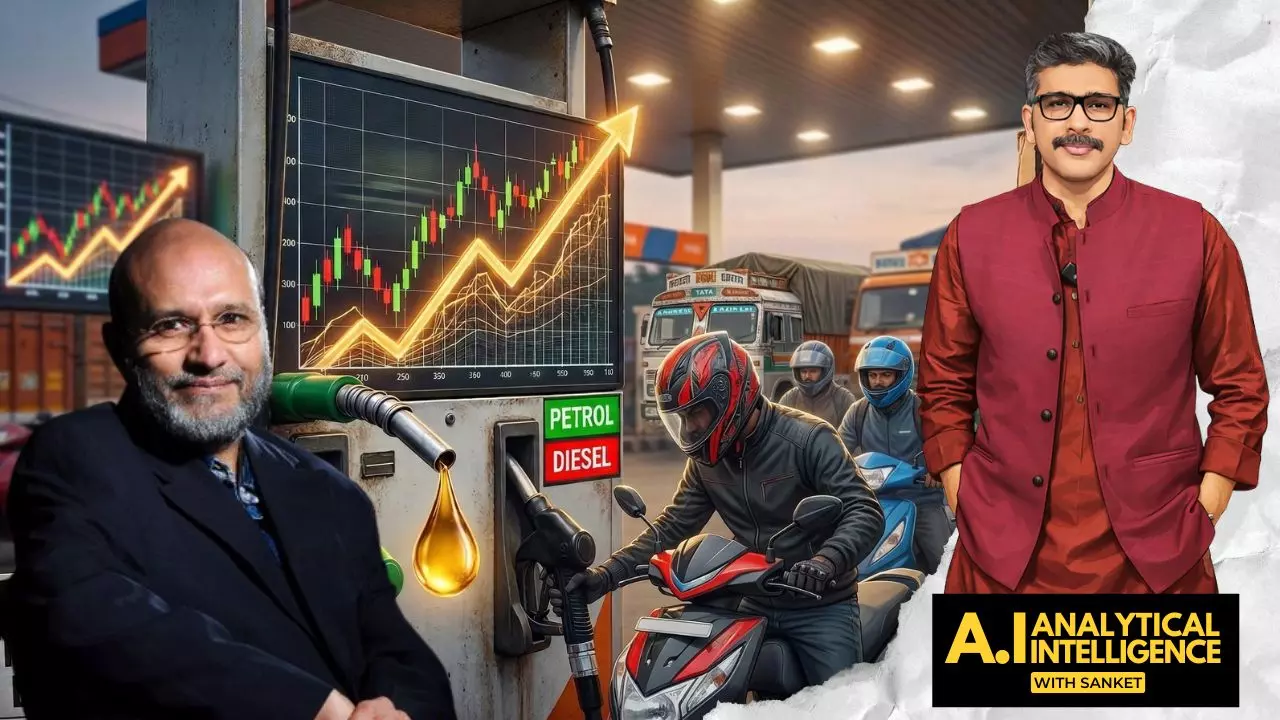
Petrol, diesel excise rate cut breather for oil companies, explained | AI With Sanket
Economist Santosh Mehrotra calls slashing the excise duty a move to back the oil companies' profitability rather than giving consumers relief

As the Narendra Modi government slashed the central excise duty on petrol and diesel each for domestic consumption by Rs 10 a litre in view of the ongoing conflict in West Asia with Union Finance Minister Nirmala Sitharaman claiming that it would shield consumers from a rise in prices, the question which was doing the rounds among commoners most frequently: Will it give them a breathe by bringing down the costs of the critical fuel items?
Also read: Why excise cut on fuel offers relief for oil companies, not necessarily end-users
The Federal spoke to economist Santosh Mehrotra in this episode of AI With Sanket to understand the matter, and he called the move an “intra-governmental transfer”, which does not benefit consumers but merely shifts resources within the government to support oil companies.
With fuel prices remaining unchanged despite the cut, a debate has intensified over relief versus optics amid rising global crude prices.
Here are some excerpts from the interview:
The government has presented the excise duty cut as a major relief for consumers. How do you see it?
No, my understanding initially was that the price for consumers would drop. But if that is not the case, then this is simply transferring money from one hand to another. The oil companies are owned by the government. So, this is essentially an effort to ensure their profitability does not look as bad due to rising international oil prices.
If prices are not falling, who is actually benefiting from this move?
This is an intra-governmental transfer. The government is essentially moving money from the finance ministry to oil companies. It may appear confusing, but there is not much to explain beyond that. It has no real impact on consumers if the benefit is not passed on.
Also read: Iran war: Why have peace efforts not clicked yet?
You’ve mentioned oil companies benefiting. Can you explain the broader context over the last decade?
The government and oil companies have had a significant windfall gain since 2015, when international oil prices collapsed from over $100 per barrel to around $60. Prices fluctuated but largely remained moderate until recently. Now they are back to around $110 per barrel.
During that earlier period, both the government and oil companies benefited significantly, but those gains were not passed on to consumers.
What does this mean for the government’s finances now?
The government’s fiscal deficit will increase because of this transfer. If the benefit is not passed on to consumers, then it has practically no impact on them. The government may be trying to protect the international standing of oil companies so that their stock prices and profitability do not take a hit.
There’s also a question of burden versus benefit. When crude prices were low, why didn’t consumers get relief then?
That is a good question. The government could have passed on the benefits of the sustained windfall gains it received for years. From a macroeconomic perspective, these gains helped the government undertake measures, such as corporate tax cuts and changes in personal income tax.
Also read: India's oil reserves: How long can the country sustain a supply shock?
It has also managed its fiscal position by controlling expenditures in several areas. So, it feels comfortable making such transfers now.
Do you see this as a temporary response to global conditions?
It may be based on the assumption that the current crisis, driven by the war, is temporary. The government could be expecting the situation to stabilise soon. But that is uncertain, and no one really knows how long such geopolitical tensions will last.
You also spoke about alternative policy choices. What could have been done differently?
Under the current circumstances, I would have reduced the fertiliser subsidy. It is extremely high—around Rs 1.8 trillion (Rs 1.8 lakh crore)—and largely driven by urea. The subsidy structure encourages excessive use, which harms soil and reduces yields.
Reducing this burden could have freed up fiscal space instead of transferring funds to the oil companies.
We’ve seen this pattern before—tax cuts when crude rises and increases when crude falls. How do you interpret this?
Yes, that pattern exists. The government reduces taxes to cushion oil companies when crude rises and increases them when crude falls. This creates a situation where consumers neither benefit from low prices nor feel the full burden during high prices.
Also read: What explains gold, silver's USD 2-trillion 'flash crash' despite Iran conflict?
Former Union finance minister P Chidambaram called fuel taxation “lazy taxation”. Do you agree?
Yes, I agree. Fuel taxation is easy to implement because consumption is measurable and demand is inelastic. Unlike other sectors, there is little scope for underreporting.
People cannot drastically cut consumption, especially for commercial use. So, the government can collect revenue quickly and efficiently. That is why it is considered “lazy taxation”.
So, what is the final takeaway for consumers?
Consumers are not being burdened additionally, but they are not benefiting either. If the absence of a burden is being presented as a benefit, then that is a matter of interpretation—or politics.
The content above has been transcribed from video using a fine-tuned AI model. To ensure accuracy, quality, and editorial integrity, we employ a Human-In-The-Loop (HITL) process. While AI assists in creating the initial draft, our experienced editorial team carefully reviews, edits, and refines the content before publication. At The Federal, we combine the efficiency of AI with the expertise of human editors to deliver reliable and insightful journalism.