US trade deal: 'India has accepted opposite of what it fought for at WTO'
Tariff asymmetry, weak competitiveness, erosion of multilateral norms could cost Indian industry and farm sector dear, says eminent economist Biswajit Dhar

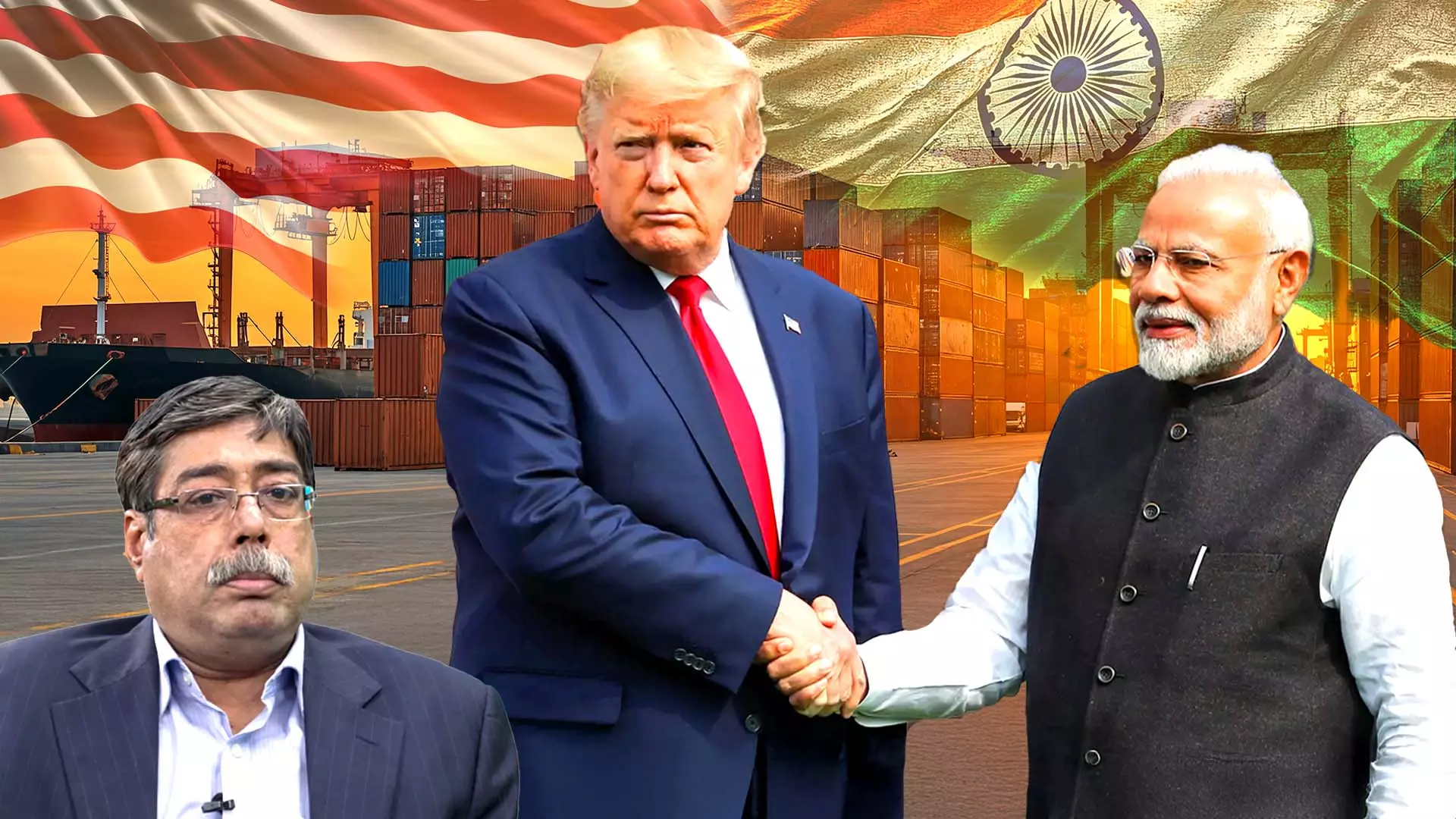
The interim trade agreement between India and the US, announced after a call between Prime Minister Narendra Modi and US President Donald Trump, is being projected as a landmark step in bilateral economic ties.
However, economists warn that the framework, as outlined so far, is heavily skewed in Washington’s favour and could have far-reaching consequences for India’s trade strategy.
Calling the deal “prima facie completely unbalanced”, eminent trade economist Biswajit Dhar, in an interview with The Federal, points to the sharp asymmetry in tariff commitments, with the US set to impose an 18 per cent tariff on Indian exports even as India offers near duty-free access to American goods.
The former JNU professor explains why the agreement departs from India’s long-standing position at the WTO, offers little real advantage to Indian exporters, and risks weakening both domestic industry and the multilateral trading system.
Edited excerpts:
How balanced is this interim trade agreement based on the facts available so far?
I have been saying this since Monday (February 2) night, when Trump tweeted that the deal had been concluded. The difference between the tariffs is stark. The US is going to impose an 18 per cent tariff on Indian exports, while India is giving duty-free access to US exports. That is, prima facie, a completely unbalanced deal.
Before these so-called reciprocal tariffs, the average US tariff on Indian products was about 2.5 per cent. What this agreement does is raise US tariffs on Indian exports nearly sevenfold compared to what prevailed earlier. That is a very strange situation.
Also read | US trade deal and its context strengthen sovereignty, even as internal strife weakens it
India has always maintained that as a developing country it is entitled to special and differential treatment. That principle meant developed countries would impose lower tariffs than developing countries. Here, we have agreed to the opposite: the developed country is imposing higher tariffs, while we are eliminating ours.
The WTO ministerial conference is coming up soon. We should have taken a more proactive stance there rather than accepting this unilateral regime.
For decades, India has fought in the WTO and other forums to preserve this principle because it gives us advantages not just in tariffs, but also in implementation timelines and other areas. This deal goes completely against that philosophy and looks deeply unbalanced.
But aren’t other competing exporters also facing similar tariffs, with India enjoying a marginal advantage?
Let me take the example of clothing. Bangladesh and Vietnam face tariffs of 19 per cent, while India faces 18 per cent. That one-percentage-point difference does not give us any real advantage.
Bangladesh is far more price-competitive, and Vietnam is significantly more efficient. We have already been struggling to compete with them in global markets. Being almost level-pegging on tariffs does not change that reality. If anything, we would have needed a much larger tariff differential to see any meaningful advantage.
Is this also about the breakdown of the multilateral trade order under Trump?
Yes. Trump is clearly trying to upend the global trade order. But India and other countries were trying to join forces to restore the WTO’s relevance. What we are doing now reflects a defeatist attitude—accepting that Trump will do whatever he wants and allowing him to trample over the multilateral system.
Watch/Read | India-US interim trade pact: ‘Reciprocal’ deal or a surrender treaty?
This is not just about trade. It affects finance, climate change, and other multilateral agreements. India, which once provided leadership in these areas, now seems to be capitulating instead of pushing back.
The WTO ministerial conference is coming up soon. We should have taken a more proactive stance there rather than accepting this unilateral regime.
Could opening up trade at this scale push Indian industry to become more efficient?
I don’t think so. India has signed around 22 free trade agreements. With every major economy we have signed FTAs with, our trade deficit has gone up because Indian industry has not been able to compete or export effectively.
There is a serious competitiveness problem in Indian manufacturing and agriculture, and that problem is staring us in the face.
Zero tariffs will not help if we are not competitive in price, quality, and standards. If we are not competitive at home, how can we suddenly become competitive globally?
Moreover, tariffs are no longer the real issue in trade with major economies like the US and EU. These countries rely on non-tariff measures—food safety norms, environmental standards, labour standards—which are all WTO-legal.
Our policymakers still think we live in a world where only tariffs matter. Indermit Gill, the World Bank’s chief economist, recently pointed out that the real barriers to trade today are non-tariff measures. Unfortunately, our policymakers have failed to internalise this.
Can Indian exporters realistically meet these non-tariff standards?
Look at food safety. The levels of chemicals and pesticides in processed food in India are often unacceptable. Consumers are largely unaware, and there is no strong consumer movement demanding safer products.
Businesses have become used to selling substandard products domestically and assume global markets will accept the same. That will not happen.
Also read | Trade boost or strategic retreat? India-US deal beyond the rhetoric
Dropping tariffs alone will not bring competitiveness. We have failed to build manufacturing strength, our dependence on China is soaring, and trade deficits with FTA partners keep rising.
Is the agreement really ‘reciprocal’, as claimed?
Not at all. Trump’s definition of reciprocity is flawed. He believes trade deficits are inherently unfair and must be corrected through tariffs. But trade is driven by market logic.
If the US has lost competitiveness, it will import more and run trade deficits. You cannot turn global integration on its head and call punitive tariffs ‘reciprocal’. This is a misuse of terminology.
The Commerce Minister listed many products with zero tariffs. Will that help exporters?
No. Zero tariffs will not help if we are not competitive in price, quality, and standards.
Take agriculture. It is uncompetitive domestically and heavily subsidised. That was the core reason agriculture became a sticking point even in EU negotiations. If we are not competitive at home, how can we suddenly become competitive globally?
The US will source from the cheapest suppliers. Without competitiveness and compliance with food safety standards, zero tariffs mean nothing.
What about assurances that agriculture and GM crops are protected?
There is no legal clarity. The joint statement says India will eliminate all non-tariff barriers in agriculture. The biggest non-tariff barrier was GM restrictions. If all barriers are removed, the implication is that GM imports will be allowed.
If agriculture is truly excluded, the agreement must say so explicitly. Trump has enormous political stakes in agriculture—over 75 per cent of agricultural states voted for him in 2024, and powerful lobbies are pushing for market access in India. Without clear language, these questions will not go away.
Will technology access and supply-chain cooperation benefit India?
Technology is never transferred; it is sold. Technologies are owned by private firms, not governments. US companies earn massive surpluses from intellectual property payments.
There is no reason to believe American firms will suddenly transfer technology to India. Did that happen under NAFTA or USMCA with Mexico? It did not.
Also read | India-US trade deal raises key questions of diplomacy
The same applies to pharmaceuticals. While generics may be allowed duty-free for now, a Section 232 investigation is underway. Its findings will determine whether Indian pharma truly benefits.
Does this agreement increase uncertainty for Indian businesses?
Yes, because this is not a rule-based trade order. But many non-tariff measures are justified. Businesses must produce goods that are safe and environmentally compliant.
If we cannot manage the risks, we should not sign FTAs and pretend tariff reductions alone will open markets. Policymakers must abandon that mindset and prepare businesses for the real challenges ahead.
We should have started adapting to these standards 20 years ago. Whether it is automobile safety or carbon emissions, our industries must modernise. The 2070 carbon-neutral target is too distant.
Is this comparable to the 1991 reforms in terms of risk?
There are significant risks. But they can be managed if we act proactively at home—by making agriculture and manufacturing competitive and ensuring global standards compliance.
If we cannot do that, we should not sign FTAs and pretend tariff reductions alone will open markets. Policymakers must abandon that mindset and prepare businesses for the real challenges ahead.
So this is essentially a wake-up call?
Absolutely. This is not about tariff lowering alone. India needs to put its own house in order.
The content above has been transcribed from video using a fine-tuned AI model. To ensure accuracy, quality, and editorial integrity, we employ a Human-In-The-Loop (HITL) process. While AI assists in creating the initial draft, our experienced editorial team carefully reviews, edits, and refines the content before publication. At The Federal, we combine the efficiency of AI with the expertise of human editors to deliver reliable and insightful journalism.