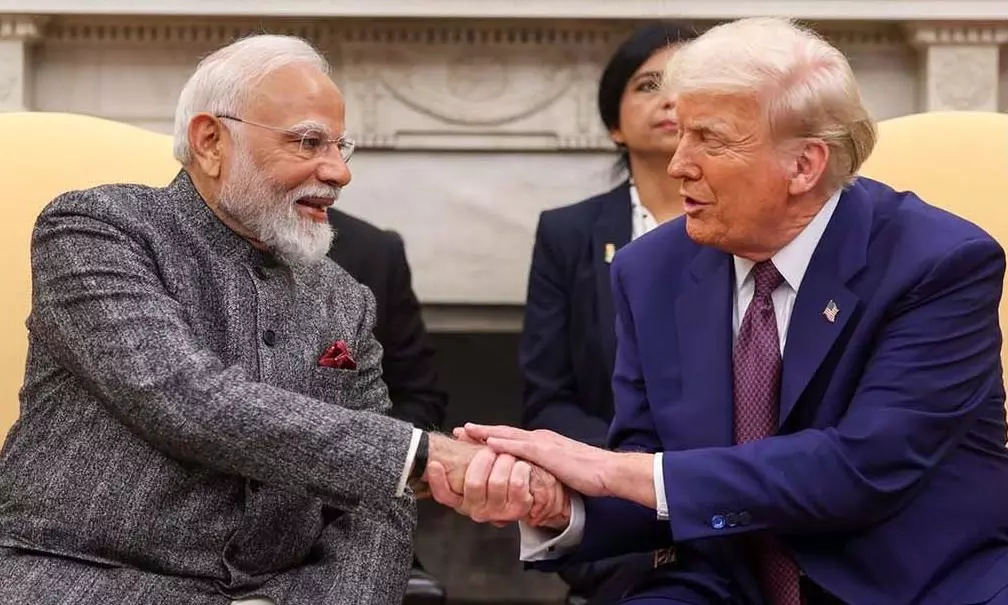
Ritualised claims of victory after trade deals mask the reality that these pacts create clear winners and losers, with serious consequences for lives and livelihoods
“Great news for India and USA! We have agreed on a framework for an Interim Trade Agreement between our two great nations,” Prime Minister Narendra Modi proclaimed from the rooftops on Saturday. He added, with characteristic flourish: “As India moves forward towards building a Viksit Bharat, we remain committed to building global partnerships that are future-oriented, empower our people and contribute to shared prosperity.”
Also read | India’s trade deal with the US is not reciprocity, it is submission
The prime minister’s phrasing is revealing. By stressing that the deal is future-oriented, Modi seems—perhaps unwittingly—to concede that it is not particularly present-oriented. Notably, he stopped short of calling it the “father of all trade deals,” despite claiming that it strengthens Make in India by opening opportunities for “farmers, entrepreneurs, MSMEs, start-up innovators, fishermen and more,” and by generating “large-scale employment for women and youngsters.”
Unequal economies, unequal consequences
Washington, by contrast, had no such hesitation. The US Trade Representative, Ambassador Jamieson Greer, appeared to confer fatherly status on President Donald Trump himself, praising his “dealmaking” prowess for “unlocking one of the largest economies in the world for American workers and producers, lowering tariffs for all US industrial goods and a wide array of agricultural products.”
This ritualised declaration of “victory” is standard practice after trade agreements, designed to appease domestic constituencies. What it conceals, however, is the cold arithmetic of winners and losers—an arithmetic that matters profoundly when trade deals determine livelihoods and survival.
Consider the asymmetry. The United States, with a population of 338 million, posted a per capita income of $76,477 last year. India, home to 1.4 billion people, recorded a per capita income of just $2,940. The US counts roughly 30,000 wealthy farmers; India has close to 800 million farmers living cheek by jowl, many on the brink of subsistence. Treating these two economies as equals in reciprocal liberalisation is not balance—it is distortion.
What the White House fact sheet really says
While India’s loquacious commerce minister has selectively portrayed the framework agreement as a mutual win, the White House fact sheet offers a far clearer—and more sobering—account of what New Delhi has conceded.
“India will eliminate or reduce tariffs on all US industrial goods and a wide range of US food and agricultural products,” the document declares, listing dried distillers’ grains (DDGs that is key ingredient for ethanol), red sorghum for animal feed, tree nuts, fresh and processed fruit, soybean oil, wine and spirits, among others.
In return, the United States “will apply a reciprocal tariff rate of 18 percent” under Executive Order 14257 of April 2, 2025. This tariff will hit Indian exports including “textile and apparel, leather and footwear, plastic and rubber, organic chemicals, home décor, artisanal products, and certain machinery,” subject to the finalisation of the Interim Agreement.
Washington will remove these reciprocal tariffs only on a narrow set of items—“generic pharmaceuticals, gems and diamonds, and aircraft parts”—and may offer limited relief on the 25 per cent sectoral tariffs imposed under Section 232 on steel, aluminium, and auto parts. Even here, concessions are conditional and discretionary. As the fact sheet puts it, outcomes on pharmaceuticals will be “contingent on the findings of the US Section 232 investigation.”
This matters because the 18 percent “reciprocal tariff” is a blatant violation of international trade law. It breaches Article I (Most-Favoured Nation treatment) and Article II (binding tariff commitments) of the GATT/WTO framework. A WTO panel has already ruled that Section 232 measures are permissible only in the presence of a genuine national security threat.
Yet India, like several other countries, has acquiesced. Faced with Trump’s tariff cudgel, governments have folded like a house of cards.
Non-tariff barriers: The real concessions
Tariffs are only part of the story. India has also agreed to dismantle a range of non-tariff barriers (NTBs), a move President Trump has already celebrated.
Also read | Hugs haven’t helped: Congress slams Centre over India-US trade pact
New Delhi will “address long-standing barriers to the trade in US medical devices,” scrap restrictive import licensing for US ICT goods, and review standards and testing requirements to align them with “US-developed or international standards” within six months of the agreement’s entry into force.
More ominously, India has agreed “to address long-standing non-tariff barriers to the trade in US food and agricultural products”—a euphemism for opening the door to genetically modified corn, soy, and other commodities. Under Trump’s Damocles’ sword, such concessions threaten to wreak havoc on India’s fragile rural economy.
The agreement’s provision that “the United States and India intend to discuss their respective standards and conformity assessment procedures” could further undermine domestic industry, effectively outsourcing regulatory sovereignty.
Supply chains, China, and strategic alignment
In language clearly aimed at Beijing, the two sides have pledged to “strengthen economic security alignment” to counter the “non-market policies of third parties,” deepen cooperation on investment reviews, and tighten export controls. India is thus being drawn into a supply-chain realignment strategy designed in Washington, not New Delhi.
The price tag is steep. The US has secured commitments for $500 billion in purchases of American energy, aircraft, precious metals, technology products, and coking coal over the next five years.
The agreement also signals India’s entry into a new phase of data-centre colonisation. “India and the United States will significantly increase trade in technology products, including Graphics Processing Units (GPUs),” the fact sheet notes—an echo, critics argue, of earlier eras when India supplied labour and markets while value accrued elsewhere.
Digital trade and the IT blind spot
Under the banner of “digital trade,” India has agreed “to address discriminatory or burdensome practices” and chart a path towards “robust, ambitious” digital trade rules. In practice, this may mean abandoning its digital services tax and softening its opposition to the WTO moratorium on customs duties for electronic transmissions—a test that will come next month at the WTO’s 14th Ministerial Conference in Yaoundé.
Also read | Why India-US trade deal raises fears of one-sided concessions
Conspicuously absent, however, is any meaningful commitment from Washington on the movement of Indian IT professionals. The framework is silent on easing visa restrictions or curbing the extortionate $100,000 fees imposed on Indian service providers seeking short-term US work permits.
A millstone, not a milestone
The Modi government presents this framework as a leap towards Viksit Bharat. In reality, it risks becoming a millstone around the necks of India’s poorest citizens—those least equipped to absorb job losses, farm distress, and regulatory erosion while waiting for elusive future gains.
As argued in a previous column, India now stands on the cusp of abdicating its sovereignty over tariffs, trade policy, and national pride. In that sense, the prime minister may indeed deserve credit—for overturning the promise of India’s historic “tryst with destiny,” and replacing it with a bargain whose costs are immediate, whose benefits are uncertain, and whose fairness is deeply in doubt.
(The Federal seeks to present views and opinions from all sides of the spectrum. The information, ideas or opinions in the articles are of the author and do not necessarily reflect the views of The Federal.)