As Modi welcomes tariff cut under India-US trade deal, Trump’s claims on Russian oil, diplomacy and peace spark deeper concerns about tone, intent and strategy
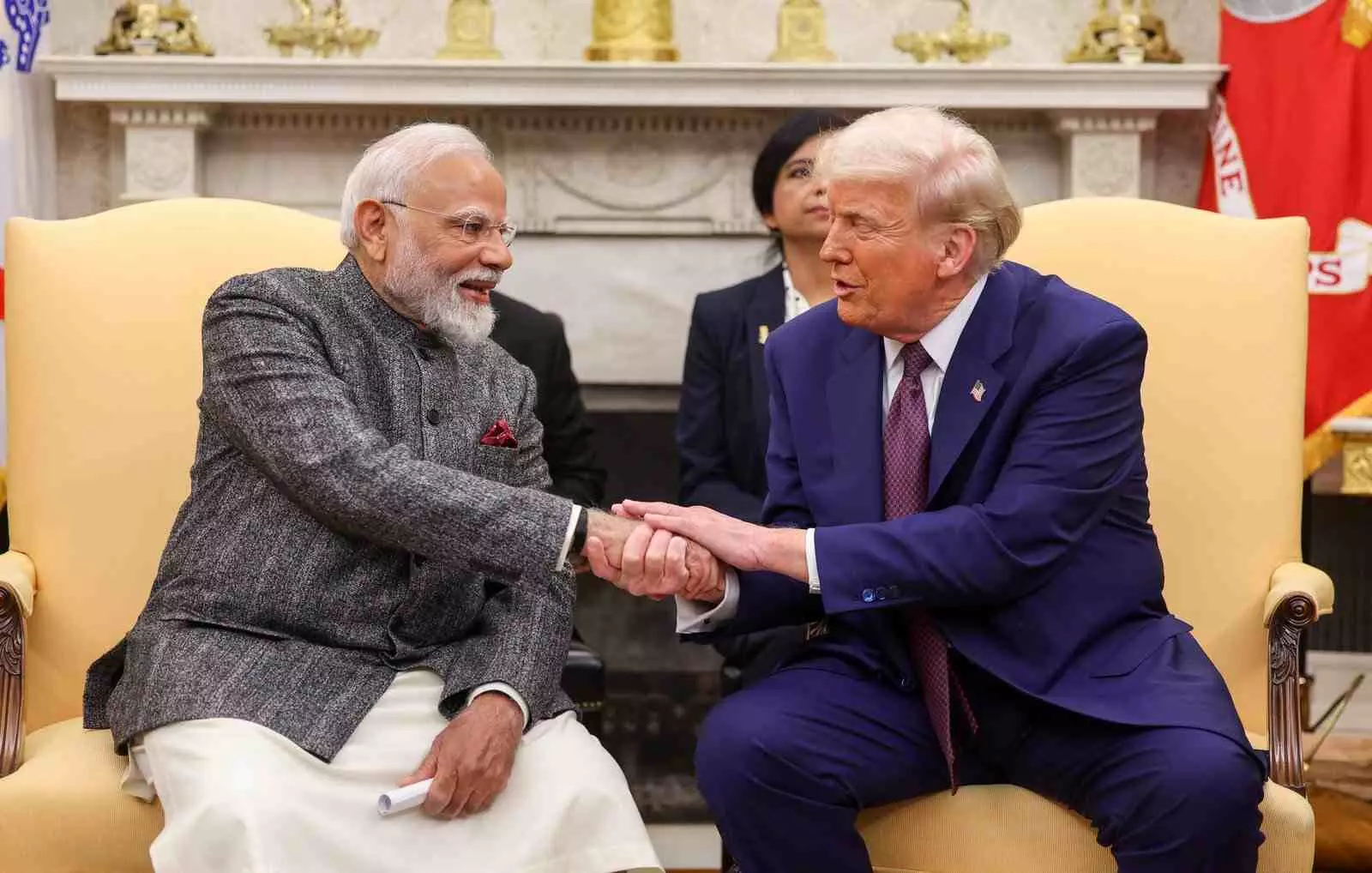
Prime Minister Narendra Modi is delighted that the India-US trade deal has now been agreed upon in principle. In a post on Truth Social on February 2, US President Donald Trump announced that Modi and he had a telephonic conversation in which they discussed various issues, including bilateral trade and the Russia-Ukraine war. Trump asserted that India had agreed to stop buying Russian oil. This, he claimed, would help end the Ukraine conflict.
He went on to write, “Out of friendship and respect for Prime Minister Modi and, as per his request, effective immediately, we agreed to a Trade Deal between the United States and India, whereby the United States will charge a reduced Reciprocal Tariff, lowering it from 25% to 18%. They will likewise move forward to reduce their Tariffs and Non Tariff Barriers against the United States, to ZERO. The Prime Minister also committed to “BUY AMERICAN,” at a much higher level, in addition to over $500 BILLION DOLLARS of U.S. Energy, Technology, Agricultural, Coal, and many other products.”
Modi responds with public gratitude
Responding to Trump’s post, Modi put on the social media platform X that he was “delighted” that he had spoken to his “dear friend”, the American President, who had agreed to reduce the tariff on Indian goods exports to the US to 18 per cent. For this “wonderful announcement”, he thanked Trump on behalf of 1.4 billion people.
Modi went on to express the view that the trade agreement will unlock immense potential for mutually beneficial cooperation. Thereafter, Modi veered far away from trade to state, “President Trump’s leadership is vital for global peace, stability and prosperity. India supports his efforts for peace.”
Goyal urges restraint on assessment
On February 3, Minister of Commerce and Industry Piyush Goyal said in a media conference that the trade agreement would be of immense help to Indian trade and industry in upgrading their operations and in India joining global supply chains. He also assured the country that the interests of the farmers had been fully protected by the government.
Also Read: Agriculture, dairy fully protected in India-US trade deal: Piyush Goyal
An assessment of the trade agreement and its impact on the Indian economy, as a whole, can be made only after it is signed and its details are available in the public domain. That will have to take place because all trade agreements have to be reduced to legal notifications for the purposes of customs duties, non-tariff requirements such as phyto-sanitary standards, and import quotas.
Hence, it would be better to await these details before rushing to comment on the announcements made so far. Yet, one point may be made in this respect. The figure of USD 500 billion mentioned by Trump seems to be highly exaggerated. At some stage, the government will have to find a way to put its version on record.
Gratitude versus national interest
While waiting for the agreement, a few general points can and should be made.
The first relates to Modi’s expression of gratitude to Trump for reducing tariffs. By thanking him on behalf of the Indian people, it would seem that Trump has done them a great favour. This is hardly the case because the imposition of 25 per cent duty and an additional duty of 25 per cent because India was buying Russian oil was unjustified in the first place. If this proposition is accepted, then Modi should not have thanked Trump for something that he should not have undertaken against India at all.
Russia oil position unresolved
It will be recalled that External Affairs Minister S Jaishankar had strongly justified India's purchase of Russian oil in the past. He had taken the position that India was doing so because it was in its interest. He had also pointed out that Europe had continued to import Russian gas as long as it needed to do so. While issues could be taken with the manner in which Jaishankar had presented the Indian case, no one could point to an error in his logic.
Also Read: Why India-US trade deal raises fears of one-sided concessions
Now Modi and Goyal have not only not formally clarified India's position on Russian oil purchases, but the former has gone so far as to applaud Trump for his contribution to world peace, stability and prosperity. He has also said that India supports his “efforts for peace”. Clearly, this is an attempt to pander to Trump’s gargantuan ego which was bruised by India’s consistent refusal to acknowledge that he has played a role in bringing an end to India-Pakistan armed hostilities in May last year. Trump had said more than 60 times over the past seven months that he had brought peace. He had also said occasionally that he had helped save millions of lives. Pakistan had endorsed his views and also nominated him for the Nobel Peace Prize.
India’s diplomatic tradition questioned
Pakistan has a track record of being servile to foreign leaders. On the other hand, India has always maintained its dignity. That is why there was unhappiness in sections of the people when Prime Minister Manmohan Singh had told President George Bush that the Indian people loved him. In Bush’s case, this exuberance was not justified, but certainly, he had assisted in breaking the shackles on tech transfers in the nuclear and dual-use fields that his predecessors had placed on India. This has not been so with Trump.
Also Read: Who is Sergio Gor, the diplomat said to have clinched US-India trade deal?
It will be argued by some “realists” that India does not stand to lose anything if it can get its way by lavishing praise on Trump. That is a point of view, but even if praise is to be made an instrument of diplomacy with Trump, it cannot be by using words that can recoil on India. It is possible that Trump may inform India that he can further the cause of peace, which India has supported his doing by mediating between India and Pakistan. India will naturally have to refuse his offer because of its principle that India-Pakistan differences have to be settled bilaterally. In sum, words which can harm Indian interests in the long term should be avoided.
Friendship claim rings hollow
One final point: Trump’s post emphasises that Modi requested for a reduction in tariffs, and he obliged because of his respect and friendship for the Prime Minister. Naturally, this comment can hardly be taken seriously because if he really had a friendship with Modi, he would not have imposed a 50 per cent tariff at all. This is a strange friendship that initially causes great harm, and then, after a long time, some balm is applied.
India’s dignified diplomacy, in which there was an objective realisation that interstate relations proceeded on the basis of national interests, had many merits. It should not be sought to be replaced.
(The Federal seeks to present views and opinions from all sides of the spectrum. The information, ideas or opinions in the articles are of the author and do not necessarily reflect the views of The Federal.)