



Top things that global leaders said at India AI Impact Summit 2026
From Modi to Pichai to Altman to Ambani, world leaders and tech titans converge urge inclusion, sound alarms, and map AI's trillion-dollar promise

The India AI Impact Summit, which ends tomorrow, drew government heads, policymakers, AI industry experts, academicians, technology innovators and representatives of civil society from across the world to advance discussions on artificial intelligence.
It is the first global AI summit to be hosted in the Global South.
Here is a recap of what major leaders said about the impact of AI and the way forward.
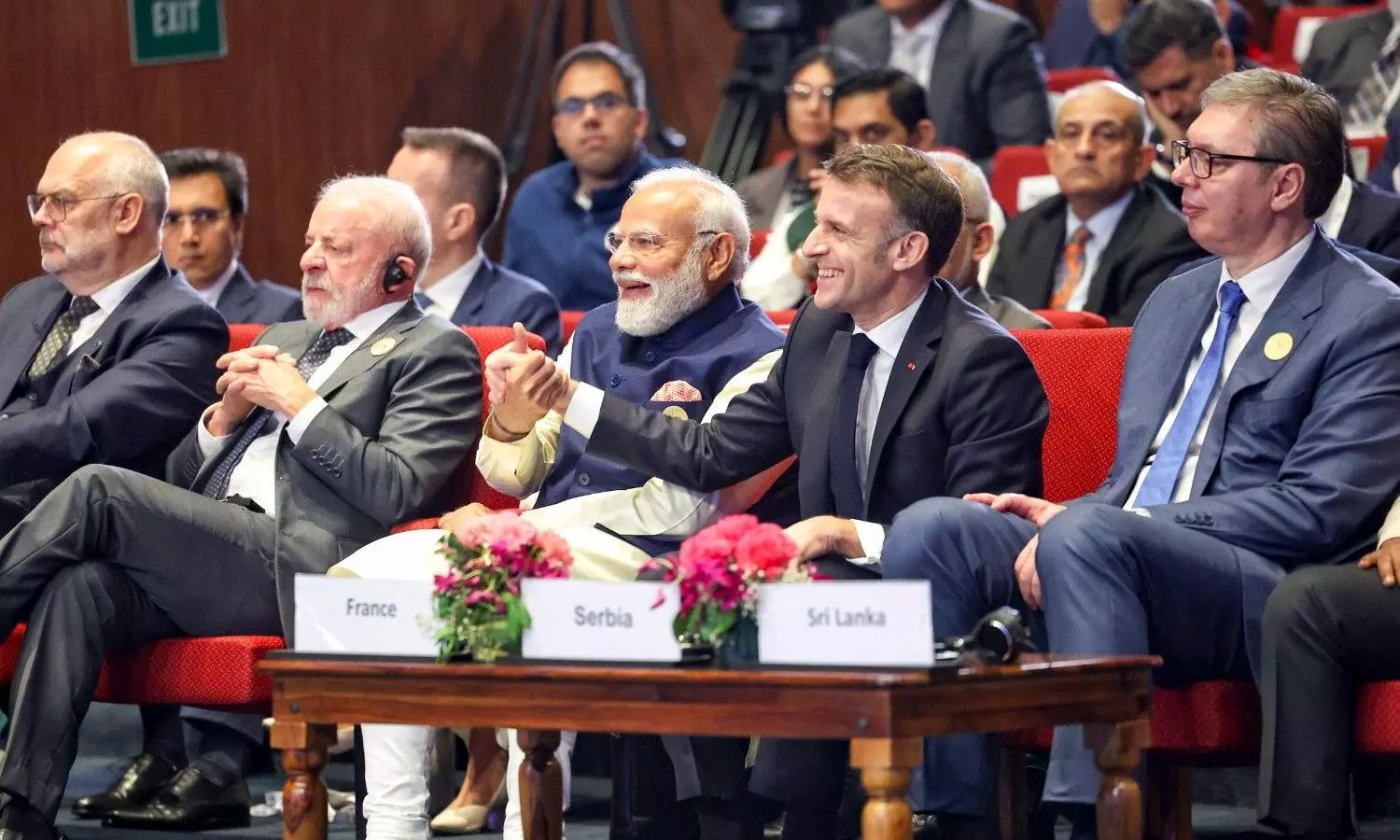
Prime Minister Modi emphasised on the importance of keeping humans at the center of AI, warning against reducing people to mere data points.
“For AI, humans are just data points. To ensure that humans are not reduced to mere raw material, AI must be democratised. It must be made a medium for inclusion and empowerment, especially in the Global South. We must give AI an open sky and also keep the command in our hands. The direction in which we take AI today will determine our future,” he said.
Also read | PM Modi calls for human-centric AI, cautions against 'directionless' use
French President Emmanuel Macron stressed the urgency of building a more inclusive digital future, calling out the growing risk of nations being reduced to mere consumer markets for foreign AI.
“At a time when tensions are rising, there is an increased sense of urgency to direct all our digital tools towards this inclusive approach and in order, indeed, to be strong here in India but to be strong as well on the African continent. No country is bound to serve only as a market where foreign companies sell the models and download the citizens' data,” he added.
OpenAI CEO Sam Altman praised India's rapid AI adoption, calling it one of the company's fastest-growing markets in the world.
He said, “The work happening in India and the adoption of AI is leading the world, and I can't wait to see what goes next. This will be one of the biggest markets for AI in the world, and I think India will have a huge amount of influence. This is one of our fastest-growing markets in the world. Maybe it's the fastest at this point. It's certainly the fastest for OpenAI Codex.”
Microsoft President Brad Smith highlighted the need to direct AI towards solving real problems in the Global South, while announcing a new initiative focused on food security across Africa.
“We need to leverage AI in the Global South to address the problems that matter most to them, such as improving agriculture. Microsoft is launching a new initiative this week to address food security across Africa. If we build infrastructure, invest in skills, and address real-world problems, we create a foundation for the future,” he said.
Also read | Why should we not say 'thanks' and 'please' to ChatGPT? Rishi Sunak explains
Reliance Industries Chairman Mukesh Ambani made a strong declaration, vowing to bring India into the intelligence era and pledging to slash the cost of AI dramatically.
“Jio connected India to the internet era. Jio will now connect India to the intelligence era. India cannot afford to rent intelligence. Therefore, we will reduce the cost of intelligence as dramatically as we did with the cost of data,” he announced.
Tata Sons Chairman N Chandrasekaran said that AI tools must be in the hands of the last person in the country.
“Our mission should be to make AI work for every individual and every citizen in this country. We should put the AI tools in the hands of the last person in the country, and in fact on the earth. That's the vision that we should all work towards,” he said
Alphabet CEO Sundar Pichai cautioned against the growing AI divide.
He said “We cannot allow the digital divide to become an AI divide. Responsibility also means navigating profound economic shifts. AI will undeniably reshape the workforce, automating some roles, evolving others, and creating entirely new careers. 20 years ago, the concept of a professional YouTube creator didn't exist. Today, there are millions around the world.”
Also read | India AI Summit: 10 things that Google’s Sundar Pichai said
Anthropic CEO Dario Amodei offered a two-sided view of AI's trajectory - celebrating its potential to transform human health and end poverty, while soberly flagging the risks of autonomous behaviour and misuse.
“On the positive side, we have the potential to cure diseases that have been incurable for thousands of years, to radically improve human health, and to lift billions out of poverty, including the global south, and create a better world for everyone. On the side of risks, I'm concerned about the autonomous behaviour of AI models, their potential for misuse by individuals and governments, and their potential for economic displacement,” he added.
DeepMind CEO Demis Hassabis claimed that artificial general intelligence will deliver an impact ten times greater than the Industrial Revolution, within a single decade.
“In 2026, we’re at the threshold moment where artificial general intelligence (AGI), is on the horizon. We’re seeing these general purpose systems, foundational model systems becoming increasingly capable week by week. AGI will be one of the most momentous periods in human history, like the advent of fire or electricity. It’s gonna have 10 times the impact of the Industrial Revolution, but happening at 10 times the speed, probably unfolding in a decade rather than a century, “he claimed.
Also read | Chinese robodog, theft, chaos: 6 things that went wrong at AI Impact Summit
India’s IT big fours also shared their perspectives on how AI is shaping the country’s digital and economic future.
Wipro's Executive Chairperson Rishad Premji positioned India as the world's premier destination for AI talent.
He said “India has the opportunity to become one of the world's consequential environments for application of AI, not just a builder of technology but a place where AI is tested against real world complexities and made to work at scale. We are truly the AI talent destination of the world. Approximately 60,000 professionals in India work in AI related roles today and this number will double by 2027.”
Infosys co-founder Nandan Nilekani said that the relationship between India and AI is mutually dependent and that India's scale makes it the ideal proving ground for AI-led economic growth.
“It’s not just India needs - but AI also needs India. India is almost a perfect case study to prove AI can accelerate economic growth; there is great technical potential and eagerness around AI. It may sound absurd, but AI can even help India in a standout 25% economic growth; it can be one of the countries in the world that most embodies it,” he said.
HCLTech Chairperson Roshni Nadar Malhotra shed light on the gender gap in AI and STEM, arguing that the underrepresentation of women is not merely a diversity issue but a fundamental innovation gap.
“Today we are celebrating women who are building AI that matters, not AI for speed or scale alone but AI with purpose, with context, with human outcomes as its core. Globally, women account for less than a third of the overall STEM workforce. In India, we actually fare slightly better, but this picture changes dramatically when you look at middle management, and of course, when you look it up. It’s not just a representation gap, it’s also an innovation gap where important perspectives are absent,” she explained.
Also read | AI Impact Summit: AI will create more jobs than it replaces, says MeitY secretary
TCS CEO K Krithivasan, speaking to CNBC-TV18 at the sidelines of the India AI Impact Summit, expressed his views on AI's impact on jobs and business models.
He said “While AI may bring productivity gains of 20-30% in traditional IT services work, enterprises are unlikely to reduce headcount, instead they would use efficiency gains to address backlogs and accelerate adoption. The industry must pivot towards outcome-based pricing models rather than labour-linked billing. It’s not a challenge, It’s the way the industry is moving towards, and we ought to adapt.”