



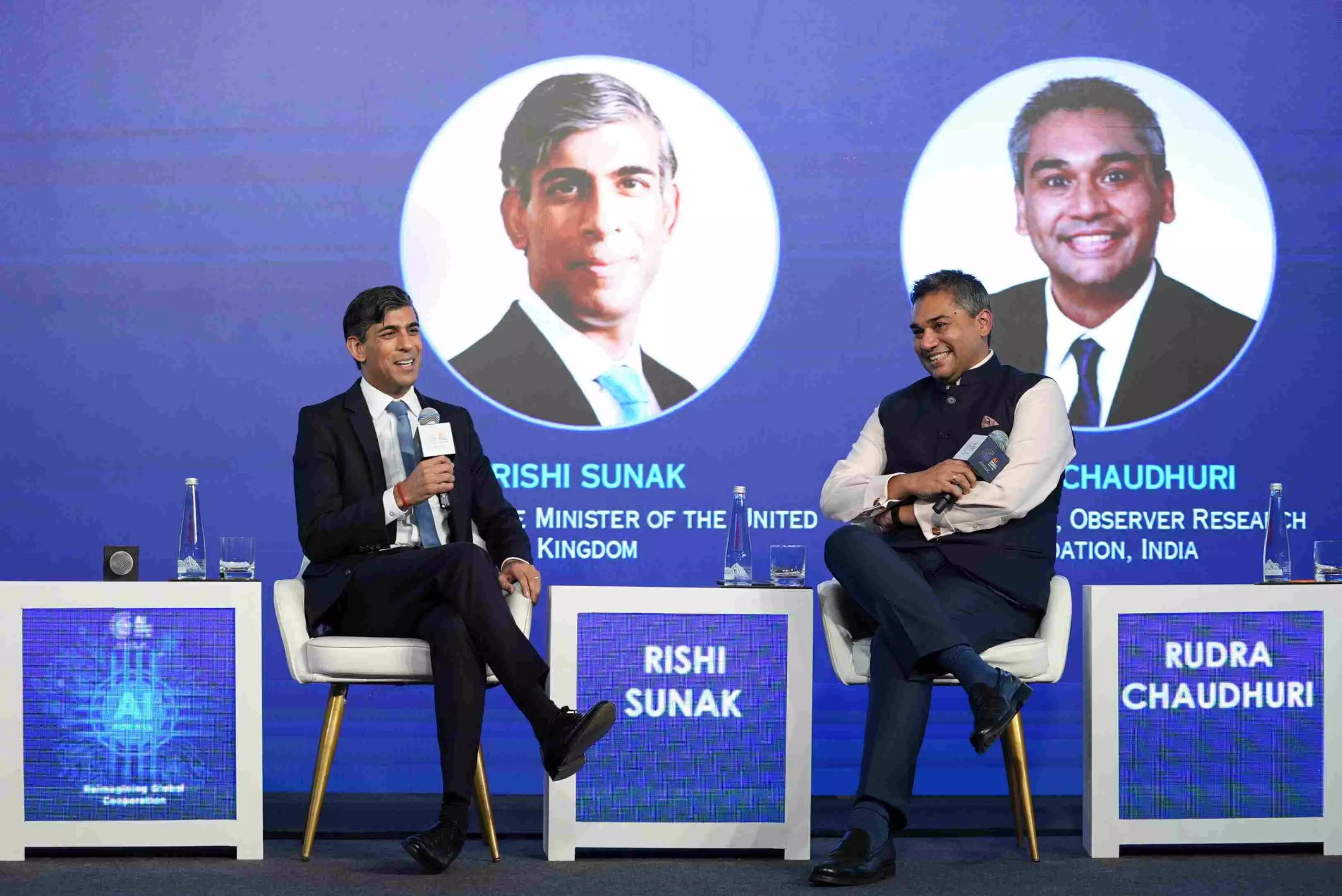
Former UK prime minister Rishi Sunak, left, during a session at the India AI Impact Summit 2026, in New Delhi. Photo: X |@RishiSunak via PTI
Why should we not say 'thanks' and 'please' to ChatGPT? Rishi Sunak explains
Sunak’s comments come amid wider debate over the hidden costs of AI interactions

Should you be polite to your AI chatbot? Former UK Prime Minister Rishi Sunak has an answer to this question.
Talking at the NDTV AI Summit, Sunak shared that his daughters often say “please” and “thank you”, when interacting with chatbots like OpenAI’s ChatGPT. He admitted that he advised them not to, since they are not dealing with a person and this additional conversation just ends up consuming a lot of computing power.
Polite to AI
“It's polite, but it's not a person. And, by the way, it, it takes up a lot of compute power, so better if you don't,” Sunak told his daughters, said the ex-PM and current Conservative Party MP.
His daughters, however, were one step ahead of him. Disagreeing with him, they argued that when AI takes over the world, “we want to have been polite to the AI”. Sunak added humourously that he thought this was "a good insurance policy".
Hidden costs of politeness
Sunak’s comments come amid wider debate over the hidden costs of AI interactions.
Last year, OpenAI CEO Sam Altman noted in a post on X that the company spends “tens of millions of dollars” in electricity on polite exchanges with users. However, he described the expense as “well spent,” arguing that such interactions help make AI systems feel more human-like.
Also read: Sundar Pichai quips about driverless cars in India: 'Still working on that, Dad'
Recent findings suggest that how we talk to machines, and the physical cost of those conversations, is shaping the future of the industry.
Politeness paradox
A 2025 survey revealed that 69 per cent of Gen Z users consistently use courteous language with chatbots. While it might seem unnecessary, some experts argue that kindness yields better data.
Microsoft design manager Kurtis Beavers noted that generative AI is designed to mirror the user's tone. A professional, respectful prompt often triggers a more "collaborative" and high-quality response.
Using "please" often aligns with clearer, more structured language, which helps the model understand intent more effectively than blunt, fragmented commands.
Environmental toll
Beyond the social implications, there is a massive disparity in the "energy footprint" of our digital habits.
According to a 2024 Goldman Sachs report, the power required to process an AI query is nearly 10 times higher than a traditional search.
AI safeguards
The summit also featured a sobering perspective from AI pioneer Stuart Russell. Often referred to as one of the "godfathers of AI", Russell warned that the technology carries a risk of causing human extinction if left unchecked.
Also read: PM Modi calls for human-centric AI, cautions against 'directionless' use
Russel, therefore, suggested some safeguards such as mandatory registration of AI systems, which should be officially tracked by regulators.
He also spoke of the "Kill Switch", a physical or digital mechanism to shut down harmful systems immediately. Russell expressed specific concern over AI systems "replicating themselves", a move that would allow them to bypass human oversight entirely.
"Once systems start replicating themselves, that's a way of escaping human control," warned Stuart Russell, a warning that technical oversight will be critical as AI capabilities expand.