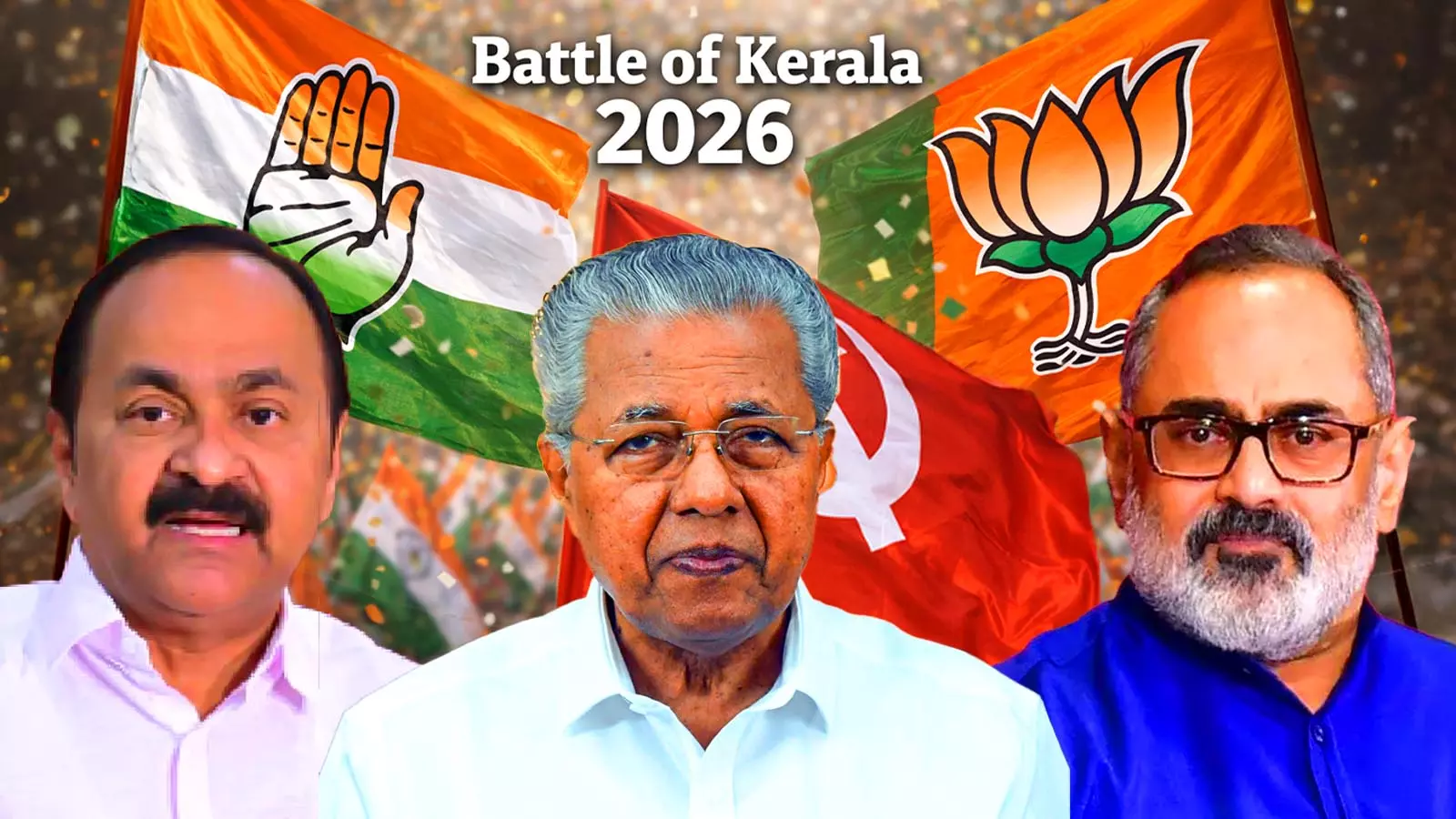
Kerala is set to witness a fierce three-pronged contest in its Assembly elections 2026, with the ruling LDF, led by CM Pinarayi Vijayan, challenged by the UDF and the BJP-led NDA.
2026 elections: LDF, UDF and BJP enter election mode in Kerala
While the UDF gains momentum ahead of Assembly polls as ruling LDF introspects over local contests; BJP targets breakthrough in at least 10 key seats

It’s 2026, and Kerala has unmistakably entered the election mode ahead of its much-awaited battle of the ballots, with all three major rival political fronts recalibrating strategy, leadership, and messaging after the recent local self-government (LSG) elections.
The verdict in the grassroots polls has acted as both a warning and an opportunity, pushing the ruling Left Democratic Front (LDF) into a phase of introspection and course correction, energising an upbeat United Democratic Front (UDF), and prompting the Bharatiya Janata Party (BJP), which dominates the National Democratic Alliance (NDA) in the state, to narrow its focus to a limited set of constituencies where it believes a breakthrough is possible.
UDF gained in 2025 local body polls
In the recently concluded LSG elections, the LDF suffered a sharp setback as the UDF consolidated its position in several of its former strongholds that it had lost to the Left after 2016, including constituencies where minority votes play a decisive role.
Also read: 2026 Assembly polls: BJP’s long march meets its first major test
The NDA also improved its overall tally, though its performance was marginally lower than that in the 2024 Lok Sabha elections.
An aggregate analysis of the LSG voting patterns indicates that the UDF is ahead in 76 of Kerala’s 140 Assembly segments. The LDF, facing anti-incumbency after a decade in power, follows closely with leads in 62 segments, while the NDA is leading in two constituencies.
While the UDF and the BJP seek to sharpen their attack on the government by capitalising on the Sabarimala gold-theft case, the LDF government is expected to use the upcoming budget as a counterweight. The budget is likely to feature a series of populist announcements aimed at regaining public goodwill.
For the LDF, the local body election outcome was a sobering moment. Senior leaders have privately conceded that governance fatigue, economic stress, and complaints of arrogance at the local level contributed to voter disenchantment.
CPI(M) underplays anti-incumbency
However, the Communist Party of India (Marxist) or CPI(M), the leading ally of the ruling alliance, has not fully acknowledged the anti-incumbency factor, even as its junior ally, the Communist Party of India, has expressed a different assessment.
“If anti-incumbency were a decisive factor, the LDF would not have retained its base in the three-tier panchayat system and municipal corporations. Even in Thiruvananthapuram and Kollam, where we lost the corporations, we continued to hold the upper hand in rural areas,” said M V Govindan, the CPI(M)’s Kerala state secretary.
Also read: How voting patterns undid LDF dominance in Mattathur; BJP gained at Congress' expense
Though the party has not publicly acknowledged anti-government sentiment, its internal messaging to the cadre tells a different story. The leadership has decided to return to full grassroots mode and has already begun house-to-house campaigns to assess the setback at the ground level.
The government’s citizens’ response programme for a New Kerala initiative has also emerged as a platform through which the CPI(M)'s local workers are formally engaging with residents and gathering feedback.
Simultaneously, the front is preparing to move into an agitation mode against the Union government, making Centre-State relations a central theme of its campaign. The LDF plans to highlight what it describes as the Centre’s neglect of Kerala in fund allocation, fiscal restrictions, and politically motivated interventions.
This confrontational approach is expected to frame much of the Left’s campaign narrative in the run-up to the 2026 polls.
Will CPI(M) relax two-term policy?
A key internal debate within the CPI(M) is the possible relaxation of its two-term policy, which limits legislators to two consecutive Assembly terms. While the policy has been projected as a hallmark of internal democracy, it has also resulted in the exit of experienced leaders. With the 2026 election approaching, sections of the leadership argue that retaining seasoned legislators is crucial.
Also read: Yelahanka razing: Relocation row deepens as Kerala politics enters the frame
Though no formal announcement has been made, the issue is expected to be resolved before the selection of candidates begins.
As part of its public outreach, the LDF is planning three region-wise marches across Kerala in February, covering the northern, central, and southern regions. These marches are intended to re-energise the cadre, present a self-correcting image, and sharpen the campaign against the Union government. Welfare achievements and development projects will form the core of the messaging.
UDF to go to polls with confidence
On the other hand, the UDF enters the pre-election phase with confidence following its strong performance in the local body elections. Congress leaders view the results as evidence of growing anti-incumbency sentiment and a revival of the front’s grassroots organisation.
Determined to avoid past mistakes, the UDF is moving towards early finalisation of seat-sharing arrangements. Internal discussions have already begun among alliance partners, with an emphasis on unity and clarity well ahead of the election schedule.
The Congress is also signalling that senior leaders will be fielded in key constituencies to reinforce leadership credibility and governance readiness. This marks a shift from the earlier tendency to reserve prominent leaders for parliamentary contests.
Also read: Congress left red-faced in Kerala as internal feud helps rival BJP in local bodies
At the same time, the UDF is attempting to project renewal. Leader of the Opposition V D Satheesan has said the front aims to ensure that 50 per cent of its candidates are women and youth. While achieving this target across the alliance may pose challenges, the statement reflects a conscious effort to address representation and generational change.
“At this stage, we can clearly say that the UDF has an advantage. The anti-incumbency against the LDF will be far more pronounced in the Assembly elections, where state-level issues take centre stage. We are fully prepared and confident, and our target is to win at least 100 of the 140 seats,” said Satheesan.
“Over the past four-and-a-half years, the UDF has won every by-election with increased margins. Even in CPI(M) strongholds, we brought down the LDF’s victory margin by tens of thousands. This pro-UDF trend is steadily building and is expected to peak in the Assembly elections,” he added.
UDF also plans state-wide campaign in Feb
To sustain its momentum, the UDF is also planning a Kerala-wide campaign march in February led by the Leader of the Opposition. The initiative is expected to focus on price rise, unemployment, alleged corruption, and what the UDF describes as governance failures under the Left government.
BJP is focusing on moderate target
The BJP, which has struggled to convert vote-share into Assembly seats in Kerala, is adopting a more focused strategy for 2026. Party sources say the saffron party is concentrating on around 10 constituencies where it sees realistic prospects based on organisational strength and local dynamics.
Also read: Xmas outreach, silence on attacks: PM’s maiden service ahead of Kerala polls
The party is investing in booth-level consolidation, targeted outreach, and the deployment of senior national leaders in these constituencies. While Hindutva themes spearheaded by the Sabarimala agitation and the Narendra Modi government’s welfare initiatives will remain central, the BJP is also attempting to localise its campaign to suit Kerala’s political context.
“We have a clear and realistic target before us. It would not be surprising if we win 10 to 15 seats in the state, and we could well emerge as a game changer in Kerala politics. That is the objective we are working towards,” a BJP functionary told The Federal.
With all three fronts preparing major mobilisations in February, Kerala is set for an extended political season. The LDF is attempting to transform introspection into resurgence; the UDF is seeking to convert local body gains into an Assembly victory; while the BJP is pushing for a limited but significant breakthrough.
Sabarimala gold case, budget
With the UDF and the BJP seeking to sharpen their attack on the government by keeping the Sabarimala gold-theft case at the centre of political discourse, the Left government is expected to use the upcoming budget as a counterweight. The budget is likely to feature a series of populist announcements aimed at regaining public goodwill and reframing the narrative ahead of the Assembly election year.
Also read: UDF recalibrates strategy for Kerala polls as CM race intensifies
As campaign marches begin and strategies take clearer shape, the coming few months will test whether the ruling front can recover lost ground, whether the Opposition can sustain its momentum, and whether the BJP can finally establish a firm legislative presence in the state.