Yelahanka razing: Relocation row deepens as Kerala politics enters the frame
What began as a civic dispute over “unauthorised constructions” has evolved into a larger political narrative cutting across state borders and minority politics

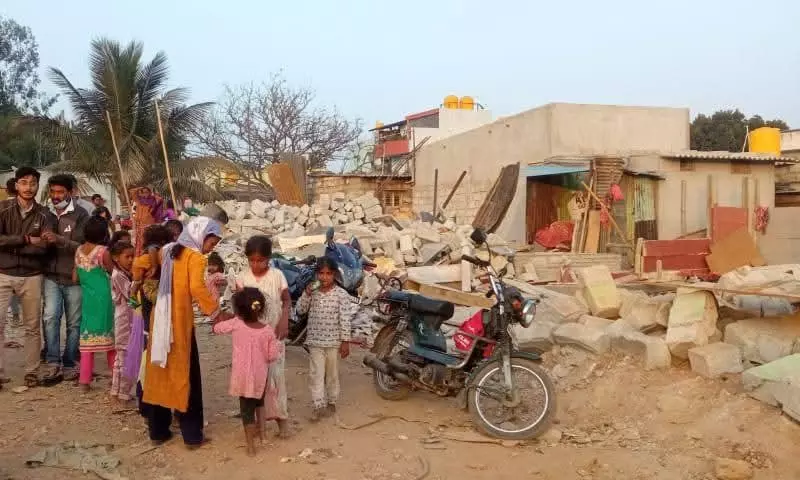
The political and humanitarian fallout of the demolition drive at Kogilu village in Bengaluru’s Yelahanka continues to widen, with the Karnataka government’s rehabilitation plan itself becoming the centre of a fresh controversy.
Even as the Congress-led government insists it is offering a lawful and structured resettlement package, affected families and opposition parties have questioned a key condition that 180 displaced families have to pay Rs 2.5 to 5 lakh each for the allotment of rehabilitation flats.
“About 1,087 government-built houses are available there (Baiyappanahalli, around 7 km from Kogilu). Each house costs around Rs 11.20 lakh. Beneficiaries will receive substantial state and Central subsidies. General category families will receive subsidies up to Rs 8.70 lakh, and SC/ST families up to Rs 9.50 lakh. The remaining amount will be provided as a small, verified loan,” explained Karnataka Chief Minister Siddaramaiah.
Also read: Yelahanka eviction row: Karnataka govt mulls rehabilitation of genuine locals
“Housing Minister Zameer Ahmed Khan has been entrusted with completing the verification and ensuring that these families can occupy their homes from January 1. Let me be clear: though the sheds were illegal, alternative housing is being provided purely on humanitarian grounds,” he added.
Karnataka’s rehabilitation proposal
According to the Karnataka government, the rehabilitation proposal involves relocating eligible families to apartment complexes constructed under a state housing scheme. Officials argue that the proposed contribution is a subsidised amount meant to cover part of the construction cost and ensure legal ownership rather than a commercial sale. However, residents and activists contend that the sum is unaffordable for daily-wage earners and informal workers who formed the bulk of those displaced.
Many families say they were living in the area for decades and accuse the government of converting a humanitarian obligation into a financial burden. Civil society groups have pointed out that the demolition itself was carried out with limited notice, leaving families scrambling for temporary shelter. Against this backdrop, the payment clause has become the most contentious element of the rehabilitation package.
The Congress government, already under pressure from minority groups and urban poor constituencies, now finds itself defending a policy that critics say contradicts its stated commitment to social justice.
Inter-state politics
The issue, initially confined to Karnataka’s capital region, has now acquired an unmistakable inter-state political dimension following the intervention of Kerala Chief Minister Pinarayi Vijayan and the subsequent visit of CPI(M) leaders from Kerala. What began as a civic dispute over “unauthorised constructions” has evolved into a larger political narrative cutting across state borders, minority politics, and competing claims of welfare governance.
Also read: Amid Yelahanka demolition row, BJP slams Congress over Delhi ‘remote control’ politics
The controversy escalated after Kerala Chief Minister Pinarayi Vijayan publicly raised concerns over the demolition and the treatment of residents, following representations from political and community organisations. Pinarayi’s intervention ensured that the issue reverberated well beyond Karnataka, particularly in Kerala.
Soon after, CPI(M) leaders AA Rahim, Rajya Sabha MP, and former Kerala minister KT Jaleel, now an MLA, visited Yelahanka to meet displaced families. Their visit was framed by the CPI(M) as a solidarity gesture and an attempt to highlight what it termed “anti-poor urban policies” pursued even by non-BJP governments.
Rahim and Jaleel alleged that the demolition and the conditional rehabilitation reflected structural injustice rather than an isolated administrative action. They also used the occasion to criticise the Congress, arguing that its promises of minority protection and inclusive governance rang hollow when tested on the ground.
“We went there to witness the reality of state violence. What we saw were nearly a thousand vulnerable people who had lost everything and were left without a voice. I still feel proud of that journey. Today, their voices are being carried by all sections of the media. Scenes that could have gone unnoticed are now visible to the world. You are now forced to talk about rehabilitation,” said Rahim.
Congress-IUML in a spot
The episode has placed both the Congress and the Indian Union Muslim League in a difficult position, particularly in Kerala. While the Karnataka Congress government maintains that the demolition followed court orders and municipal laws, its Kerala unit has been forced into a defensive posture as the CPI(M) aggressively frames the issue as a failure of Congress governance.
The IUML, a key ally of the Congress-led UDF in Kerala and traditionally influential among minority voters, has also faced uncomfortable questions. Critics within the Left argue that the League’s response has been muted despite the impact on Muslim families in Yelahanka, exposing what they describe as the limits of its political leverage within the Congress alliance.
UDF leaders have countered by accusing the CPI(M) of politicising an administrative matter and practising “selective outrage”, pointing out that demolitions of unauthorised structures have occurred in Left-ruled states as well. However, this argument has struggled to gain traction amid emotionally charged visuals and personal testimonies from displaced families.
Undue interference?
The principal criticism levelled against the Kerala Left is that it is interfering in the affairs of another state and politicising the issue, a charge that Karnataka Deputy Chief Minister DK Shivakumar has stated openly. There were also reports suggesting that the CPI(M) in Karnataka was unhappy with the intervention, though the party’s state unit dismissed these reports as false.
Also read: How Yelahanka slum razing snowballed into an inter-state political storm
The Left, however, maintains that its intervention is justified, arguing that the matter is both political and humanitarian in nature. It insists that such engagement has been consistent, whether in cases of lynching, attacks on minorities in northern states, or what it describes as bulldozer rule in Delhi.
The visit by Rahim also triggered an unexpected side controversy, with social media backlash over his spoken English during interactions with residents and the media. Clips of his remarks circulated widely, drawing criticism and ridicule from political opponents.
While CPI(M) leaders dismissed the attacks as elitist and diversionary, the episode nonetheless became part of the larger political churn around the Yelahanka issue. Supporters argued that the focus on language was an attempt to distract from substantive questions about rehabilitation and displacement.
LDF’s opportunity
Politically, the controversy appears to have given the LDF an opportunity to sharpen its critique of the Congress ahead of a crucial electoral period in Kerala. By projecting itself as responsive and interventionist, even beyond state boundaries, the Left is seeking to reinforce its image as a principled defender of the poor and minorities.
Also read: Yelahanka eviction unavoidable, displaced families to be rehabilitated: Siddaramaiah
For the Congress and the UDF, the challenge lies in balancing the defence of a Congress government in Karnataka with the need to address genuine concerns raised by minority communities in Kerala. The contributory rehabilitation has become a symbolic fault line, making that task significantly harder.
Whether the Karnataka government revisits its rehabilitation terms may ultimately determine if the controversy de-escalates or remains a potent political weapon across state lines.