UDF recalibrates strategy for Kerala polls as CM race intensifies
Leaders VD Satheesan, KC Venugopal, and Ramesh Chennithala project themselves as contenders while the front seeks to expand its alliance before 2026

Buoyed by its improved performance in the recent local self-government (LSG) elections, the Congress led United Democratic Front (UDF) has entered a phase of renewed confidence and cautious recalibration as it looks ahead to the Kerala Assembly elections next year.
The LSG outcome has given the UDF a psychological edge after years of electoral setbacks, but within the front, there is a clear recognition that local body success does not automatically translate into Assembly victories.
This awareness is shaping both its political strategy and its internal dynamics, including an intense, though largely understated, contest over leadership and the chief ministerial face.
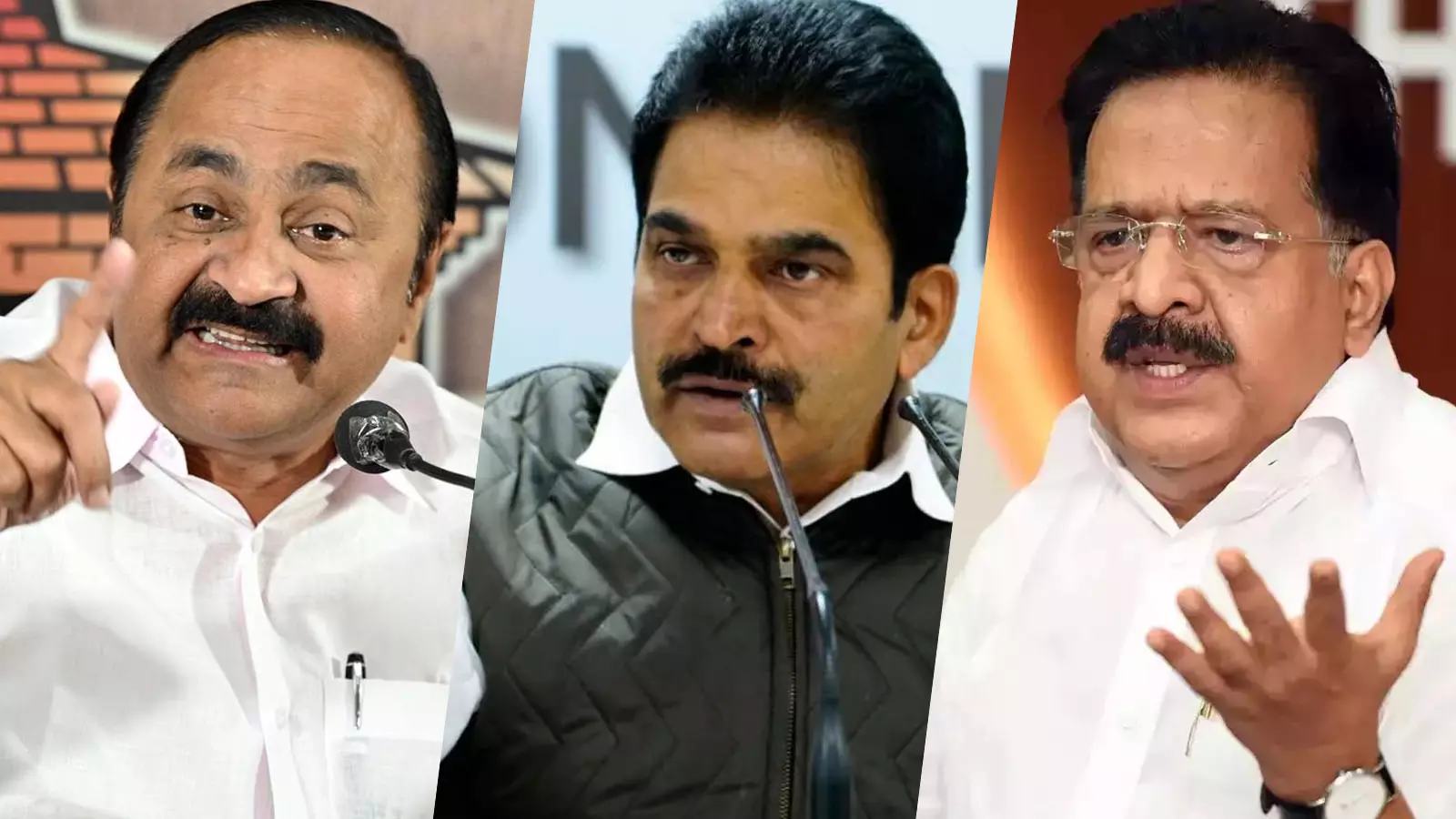
Three CM contenders
Only last week, a photograph of Leader of the Opposition VD Satheesan having lunch on a train went viral on social media. The image was accompanied by an interesting box item claiming that he shared the packed meal he had brought for his gunman, who did not turn up, with a fellow passenger, a woman.
Days later, it was the turn of AICC general secretary KC Venugopal, with photographs circulating widely on social media showing him sharing a meal on a plantain leaf with MGNREGA workers. While critics, pointing to the cluster of lapel microphones on his shirt, noted that the images appeared carefully choreographed, the exercise did underline his effort to stamp his presence in the state.
Also read: BJP's 2024 LS poll show in Kerala under lens as SIR exposes shocking ASD entries
Ramesh Chennithala, rather old-fashioned, has been engaged in hurling fresh allegations against the government over the Sabarimala gold scam, which the party believes was a key factor behind its strong performance in the LSG elections.
All three have been carefully projecting themselves as potential chief ministerial contenders, even though each of them publicly insists that the question of the CM post is not a concern and that the party’s victory remains their sole objective.
The associate members
However, the UDF is not content with its victory and is moving to widen the base of the front. It has already announced that the PV Anvar-led TMC and tribal leader CK Janu’s outfit will be taken in as associate members.
At the same time, the Kerala Kamaraj Congress, an NDA ally with a vote base among the Nadar community in the Tamil Nadu-bordering districts of southern Kerala, publicly declined the UDF’s offer, dealing a setback to the front’s outreach efforts.
Associate membership for leaders like PV Anvar and CK Janu reflects a strategic calculation that the UDF must tap into emerging social currents and discontent outside its traditional base. Anvar’s influence in Malabar and Janu’s appeal among Adivasi communities are seen as potential assets in closely contested constituencies.
Broadening the alliance
For the UDF leadership, the message is clear that broadening the alliance is not a luxury but a necessity if the front is to counter the organisational strength and incumbency advantages of the LDF.
Also read: Kerala elections: UDF ropes in new allies, faces pushback from one partner
A section within the Congress and the UDF, particularly the IUML, is keen on bringing the Kerala Congress (M) out of the LDF, believing that its induction could help cement a victory in the 2026 Assembly elections. KCM has since reiterated that they would stay with the LDF, but it is learned that there are dissenting voiced in their party itself.
“There are several leaders and workers within the LDF who are dissatisfied. Those who are ideologically compatible are likely to join our front. I am not referring to anyone in particular. The UDF needs to be expanded and its base further strengthened,” said IUML leader PK Kunhalikutty.
Neck and neck
Even though the UDF emerged victorious in the LSG elections, many leaders feel the margin is far from comfortable. They point out that despite enjoying a bigger advantage in the 2010 local body polls, the front managed to scrape through the 2011 Assembly elections with only a wafer-thin majority.
“On the face of it, we could tap into the anti-incumbency sentiment and counter the damage caused by the Rahul Mamkootathil sex scandal through issues like Sabarimala and other controversies. But we must also learn from the past. We had all the ingredients in 2020 and 2021 and were confident enough to even announce a chief ministership-sharing arrangement between Oommen Chandy and Ramesh Chennithala, only to see how that ended. We were handed our biggest defeat in 2021,” said a senior Congress leader.
Also read: After LSG debacle, Left front to launch mass protests against Centre's new Bills
“The reality now is that the LDF is not far behind us, so we need to be extremely cautious. Chief ministerial aspirations should be pushed to the back burner and all leaders must fall in line with the party. In this regard, we should take a cue from our junior partner, the IUML,” he added.
Statewide campaign march
This caution has translated into an insistence on sustained grassroots engagement, sharper messaging on governance failures, and a visible effort to project unity even as internal competition intensifies.
The UDF is planning to launch a statewide campaign march aimed at building momentum for the forthcoming Assembly elections, with the front setting itself the target of winning more than 100 seats. The march will be formally inaugurated in February and will span the length and breadth of the state. The leadership is mulling over the possibility of finalising the candidates by the time.
Satheesan said the front is focusing on expanding its political and social base as part of its election strategy, adding that the campaign march is intended to consolidate the gains from the local body polls and translate them into an Assembly victory.
Internal contest threatens balance
The CM race, though still informal, has already begun to influence the internal balance within the UDF. District-level leaders and affiliated organisations are quietly aligning themselves, weighing factors such as winnability, acceptability to coalition partners, and the likely response of the high command. At the same time, there is an acute awareness that an overt leadership battle could damage the front’s image of unity, something the LDF has successfully exploited in the past.
Also read: IUML open to India Bloc 'arrangement' in Palakkad against BJP
As the UDF navigates this complex terrain, one thing is evident: the front is no longer content with merely reacting to the LDF’s moves. It is attempting to craft a proactive narrative, one that combines organisational expansion, leadership projection, and a renewed emphasis on people-centric politics. The LSG victory has provided momentum, but it has also raised expectations within the front.
Whether the UDF can convert this moment into an Assembly triumph will depend on its ability to manage internal competition without fragmentation, expand its alliance without alienation, and balance symbolism with substance. The unfolding CM race between Satheesan, Chennithala, and Venugopal is not just about individual ambition; it is a test of the UDF’s capacity to present a cohesive, credible alternative to the electorate. In the months ahead, how the front resolves these questions may well determine the course of Kerala’s next political chapter.