Women's reservation is finally coming, but the formula carries its own tension
Legal Lens | Centre's plan to expand Lok Sabha to 816 seats sidesteps North-South seat war, but builds historic constitutional exercise on 18-year-old census data

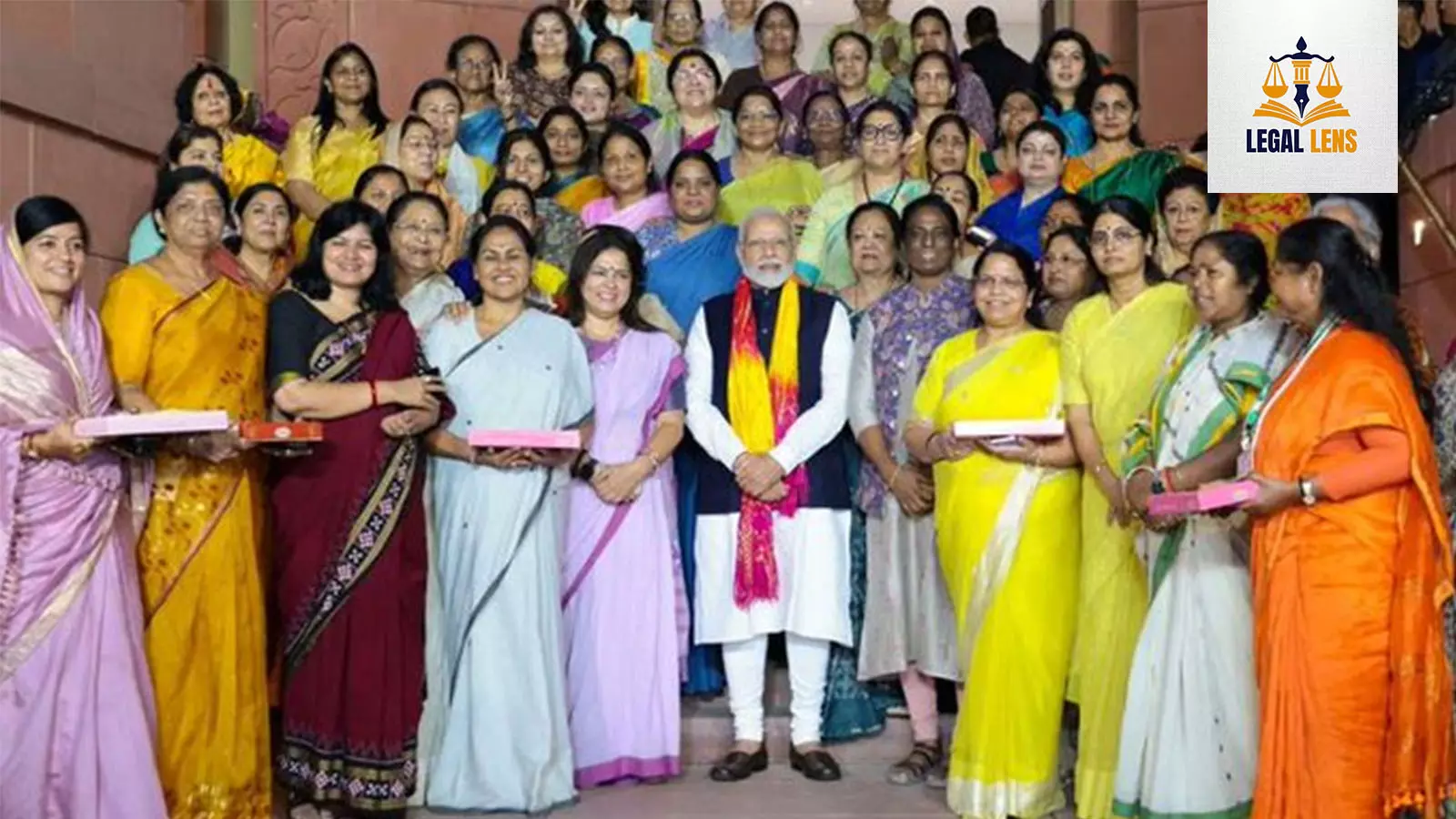
The Union government is all set to introduce two constitutional amendment bills in the ongoing Budget session of Parliament, which ends on April 2. Together, they would expand the Lok Sabha from 543 to 816 members, with one-third of all seats reserved for women. State assemblies would also see a corresponding expansion.
Neither bill has been made public or cleared by the Union Cabinet. This account is based on government briefings to Opposition leaders and media reports. The details may change when the pieces of legislation are tabled.
A key problem
In September 2023, Parliament passed the Nari Shakti Vandan Adhiniyam, or the Constitution (106th Amendment) Act. The law provides 33 per cent reservation for women in the Lok Sabha, state legislative assemblies, and the Delhi Assembly, including sub-reservation for Scheduled Caste and Scheduled Tribe women.
Its difficulty lies in the commencement clause. The reservation can take effect only after the relevant figures for the first census taken after the Act came into force are published, followed by delimitation to identify the seats to be reserved for women.
Watch/Read: TN politicians 'worship' women on stage, and demean them at the same mic
The 2021 census was postponed, no fresh census data is available, and a new census may not be completed before the 2029 general elections. The result is a law on the statute book that cannot yet operate.
What government proposes
The workaround involves two pieces of legislation. The first would amend the 106th Amendment by removing the requirement that a post-2023 census must precede the operationalisation of women's reservation. In its place, the 2011 census would be substituted as the legal trigger.
The second would be a Delimitation Bill authorising a fresh delimitation exercise.
The 2011 census appears to serve two functions. It would replace the reference to “the first census taken after the commencement of this Act”, thereby removing the obstacle that currently prevents the 106th Amendment from coming into force. It would also provide the population data a delimitation commission could use to draw the boundaries of newly- created constituencies within each state.
The 2011 census
The inter-state distribution of the additional seats does not appear to follow 2011 population ratios. The proposal involves a flat increase of roughly 50 per cent across states. This preserves the existing seat ratios among states, which still reflect the 1971 census. In substance, the 2011 census is being used as the legal and operational basis for delimitation, while the political allocation of seats continues to track a much older formula.
Also read | Equal on paper, denied in reality: Why many Indian women still lack property rights
An 816-member House would make 272 seats an exact one-third; the reported figure of 273 reflects the “as nearly as may be” language in the 106th Amendment. The majority mark would shift from 272 to 409.
The political logic is clear. The 273 reserved seats would come from newly-created constituencies rather than from existing ones. No sitting MP would need to give up a constituency to the women's quota. That substantially reduces the resistance that has long accompanied women's reservation proposals.
Why expansion, not redistribution?
This is the most consequential design choice in the proposal. A delimitation exercise within the existing 543 seats, based on recent population data, would sharply alter the parliamentary representation of southern states, while states such as Uttar Pradesh and Bihar have seen faster population growth.
A 2019 study projected that if the House remained at 543 and seats were redistributed by population, Bihar and Uttar Pradesh together would gain 21 seats while Kerala and Tamil Nadu together would lose 16. Kerala faced a potential 30 per cent reduction in parliamentary strength.
Also read: Elections 2026: Despite its progressive image, Kerala lags in women’s representation
Tamil Nadu Chief Minister MK Stalin has described population-based delimitation as a “sword of Damocles” over the southern states.
The flat 50 per cent expansion avoids that confrontation by ensuring that no state loses an existing seat.
Northern heft
Yet, the formula carries its own tension. A genuinely population-based redistribution using 2011 data, even within an expanded House, would still shift proportional weight northward. The flat 50 per cent formula instead treats expansion as a political compromise: it enlarges the House enough to accommodate a women's quota without reopening the question of how seats are divided among states.
It is delimitation in name, but not in the sense of Article 81(2) (a), which requires the ratio of seats to population to be, as far as practicable, the same for all states.
The freeze on inter-state seat reallocation has deep roots. The 42nd Amendment of 1976 froze the allocation of Lok Sabha seats to states on the basis of the 1971 census. The 84th Amendment extended that freeze until after the first census taken after 2026.
The 87th Amendment later allowed constituency boundaries to be redrawn within states based on the 2001 census while keeping state-wise seat totals unchanged.
Constitutional provisions
An expansion to 816 seats would require amendments to multiple constitutional provisions. Article 81(1) currently caps the Lok Sabha at 550 members.
The provisos to Articles 82 and 170 would also need amendment to substitute a reference to the 2011 census for the existing post-2026 reference. And, the 106th Amendment's own commencement clause would need rewriting.
All this falls within Article 368. It requires a special majority in each House: a majority of the total membership and two-thirds of those present and voting. Because the 106th Amendment applies to state legislative assemblies through Article 332A, any amendment altering its operative provisions would almost certainly require ratification by at least half the state legislatures under Article 368(2).
What proposal does not address
The most politically charged omission is the absence of any reservation for Other Backward Classes within the women's quota. There is also no proposal to extend reservation to the Rajya Sabha or state legislative councils.
Also read: Jhansi Rani to Kanimozhi to Kalpana Soren, Indian women leaders are rarely Plan A
Then there is the question of the data itself. By 2029, the 2011 census figures will be 18 years old. They predate major demographic and urbanisation shifts. Building the largest expansion of India's Parliament since independence on data of that vintage may be pragmatically necessary. Whether it is an adequate basis for drawing hundreds of new constituency boundaries is another matter.
What happens next?
If Parliament passes both bills with the required supermajority, state ratification would follow. The government's aim is to have women's reservation operational for the 2029 general elections, which would then be contested on 816 Lok Sabha seats.
The 27-year legislative journey of women's reservation, first proposed in 1996, may be approaching its conclusion. But the constitutional vehicle chosen to get there will invite scrutiny of its own: a 50 per cent expansion of the Lok Sabha, based on the 2011 census, using a formula that preserves seat ratios rooted in the 1971 census.