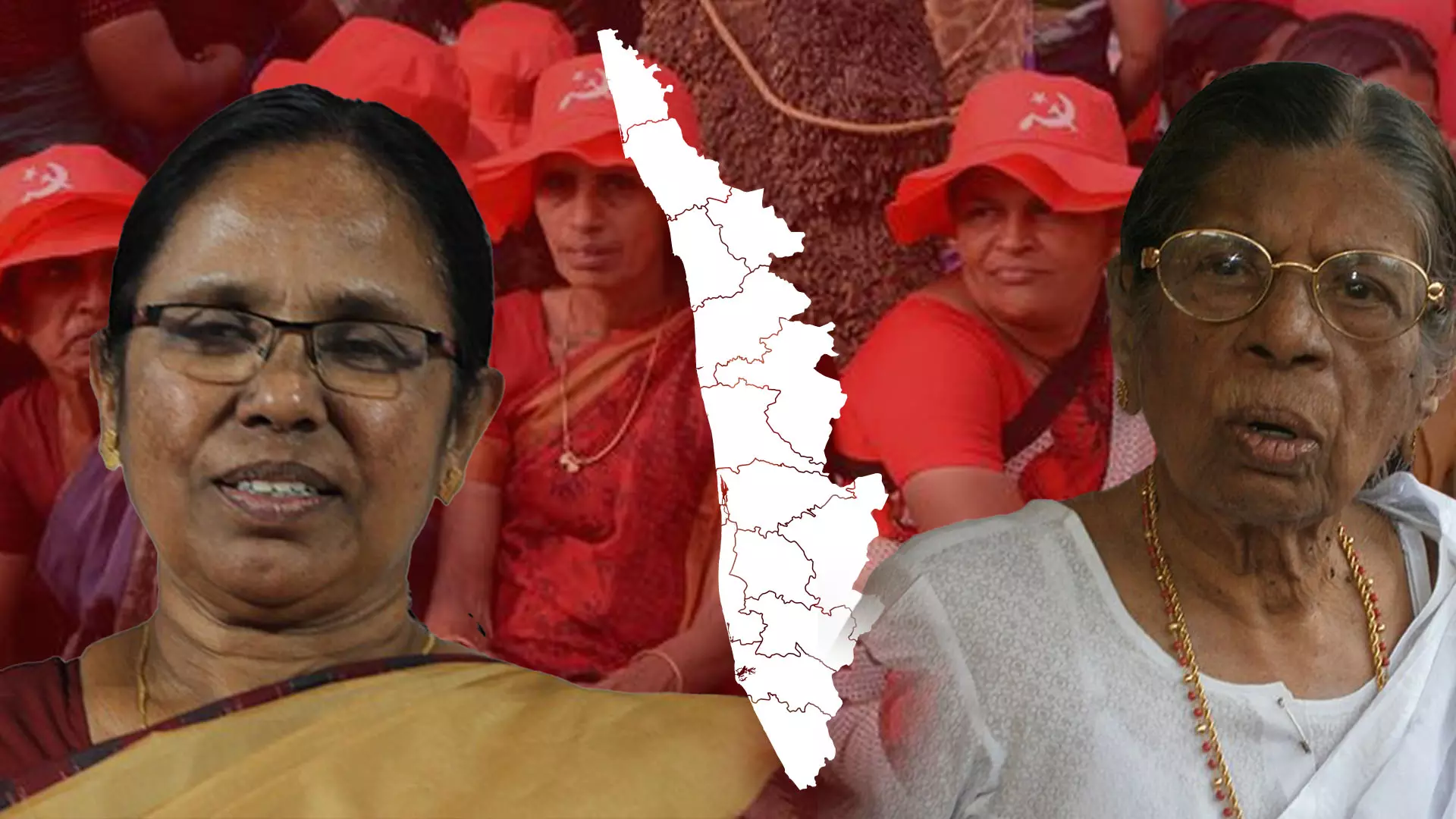
From K R Gowri Amma (right) to KK Shailaja (left), a familiar story: Even as Kerala produces high-profile women leaders, their presence remains episodic rather than systemic.
Elections 2026: Despite its progressive image, Kerala lags in women’s representation
From Gowri Amma to Shailaja, prominent women leaders have emerged in Kerala, but their rise remains sporadic rather than structural

Kerala’s political history has never been short of strong women leaders. K R Gowri Amma was part of the first Communist ministry in Kerala in 1957, held cabinet positions again in 1967, and by 1987 was widely seen as chief ministerial material. Yet, that moment never came. In her autobiography, she would later reflect on the entrenched patriarchy and caste hierarchies that operated even within a party that claimed ideological commitment to equality.
Decades later, the story appears to echo in different forms. K K Shailaja emerged as the standout face of the Pinarayi Vijayan government in 2016, celebrated nationally for her handling of crises. Yet in 2021, she was left out of the cabinet under a party policy that denied second terms to ministers, a rule that notably exempted the chief minister. This time, she has been tasked with a tough electoral battle in Peravoor against Congress state chief Sunny Joseph.
Gender parity in politics
These anecdotes are not just about individual careers, but they reveal a deeper structural pattern. Even as Kerala produces high-profile women leaders, their presence remains episodic rather than systemic. The current Assembly election underlines this contradiction.
Also read: TN politicians 'worship' women on stage, and demean them at the same mic
The Left Democratic Front has fielded around 18 women candidates in a list of 140 (CPI(M) 12, CPI 5, KCM 1), an improvement but still far from parity. The UDF has named 12 women (INC 9, IUML 2, RMPI 1) among its candidates so far. While the NDA’s numbers are marginally higher at 18, with a few seats yet to be announced, they remain largely insignificant, as most of their candidates are not expected to be in winning positions. Across fronts, representation continues to hover at the margins.
Historically too, the numbers tell a consistent story of underrepresentation. Since 1957, women’s presence in the Kerala Assembly has rarely crossed 10 per cent. In the current Assembly, it stands at roughly 8 per cent. This is in sharp contrast to Kerala’s social indicators, where women outperform national averages in literacy, health, and life expectancy. The disconnect between social progress and political representation is stark.
‘Winnability’ approach
Women’s organisations and civil society groups have increasingly begun to challenge this status quo. Their argument is straightforward: representation cannot be deferred indefinitely in the name of political expediency.
The Equal Representation Movement, which campaigns for 33 per cent reservation for women, has urged voters to choose NOTA in seats where the LDF and UDF have not fielded women candidates, while making clear it does not support the NDA.
Kerala Elections 2026: Women in the fray
Left Democratic Front (LDF): Around 18 women candidates out of 140
CPI(M): 12
CPI: 5
KCM: 1
United Democratic Front (UDF): 12 women candidates so far
INC: 9
IUML: 2
RMPI: 1
National Democratic Alliance (NDA): Around 18 women candidates so far
“To register their protest against a Union government that passed the law only to delay its implementation and mislead the public, both political fronts could have fielded women in 33 per cent of the seats. The parties in the LDF had demanded that the law be implemented without conditions when it was passed with riders. If that demand had been sincere, they could have ensured 33 per cent representation by fielding women candidates. All those who oppose patriarchy should raise their voice against it in this election”, says Rema K, Thrissur-based lawyer and a prominent voice in the Equal representation movement.
Also read: Jhansi Rani to Kanimozhi to Kalpana Soren, Indian women leaders are rarely Plan A
Political parties continue to rely on “winnability” as a key criterion, often favouring established male leaders. This creates a cycle where women are denied opportunities to build electoral capital, which in turn is used to justify their exclusion. At another level, there are deeper cultural and organisational barriers. As K R Gowri Amma pointed out decades ago, ideological commitments do not automatically dismantle entrenched hierarchies.
Limited power to women leaders
Within the Left, which has historically claimed a progressive stance on gender, the contradiction is particularly visible. The party has produced prominent women leaders and has a strong base of women cadres through mass organisations. Yet, when it comes to legislative representation and positions of power, the numbers remain modest. The case of K K Shailaja is illustrative. Despite her popularity and administrative record, institutional rules and internal dynamics have limited her trajectory. Even her candidature in a high-stakes, difficult seat this time is being seen as a test of her political capital, with some viewing it as a deliberate attempt to sideline her.
Women and gender minorities remain underrepresented not because of a lack of participation, but due to structural barriers within political institutions
The Congress presents a different but related picture. It has a pool of second-rung women leaders, many of whom are active at the organisational level. However, the party has struggled to project a towering woman leader with statewide appeal. Candidate selection often reflects internal factional balances, where women are accommodated but rarely prioritised. The result is a steady but limited presence that does not fundamentally alter the gender balance in representation.
Also read: Kerala elections | Unusual dissent rattles IUML over candidate list
The Indian Union Muslim League (IUML), a key ally in the United Democratic Front, reflects another dimension of the issue. Historically, the party has not fielded women candidates, shaped in part by its conservative social base. In 2021, it broke that pattern by fielding a woman candidate for the first time, though she lost. This time, the party has two women in the fray, signalling a cautious shift. Yet, the numbers remain small, and the broader question of representation within community-based politics continues to be contested.
Congress spokesperson Shama Mohamed did not hide her disappointment. Taking to social media, she wrote: “Rejected, but not defeated. I respectfully urge my leader Rahul Gandhi to support Congress women in Kerala. Out of 92 tickets, only 9 have been given to women. In the Lok Sabha elections, just 1 out of 16 tickets went to a woman. If this is the state even when women are capable, it is deeply disappointing.”
Need for structural changes
For years, demands for 33 per cent reservation in legislatures have been met with tactical arguments like fear of vote division, concerns about electoral outcomes, or the need to prioritise other battles. Each election cycle has seen the issue pushed to the background.
“Women and gender minorities remain underrepresented not because of a lack of participation, but due to structural barriers within political institutions. Correcting this imbalance requires more than incremental increases; it demands systemic changes, including quotas, internal party reforms, and a rethinking of electoral strategies,” argues Seethal Sathyanadhan, a research scholar in Political Science based in Kozhikode.
Also read: Kerala polls 2026: Left faces wave of defections as familiar faces cross over
Kerala’s case is particularly significant because of its self-image as a progressive society. The persistence of low political representation for women challenges that narrative. It suggests that gains in education and social development do not automatically translate into political empowerment.