



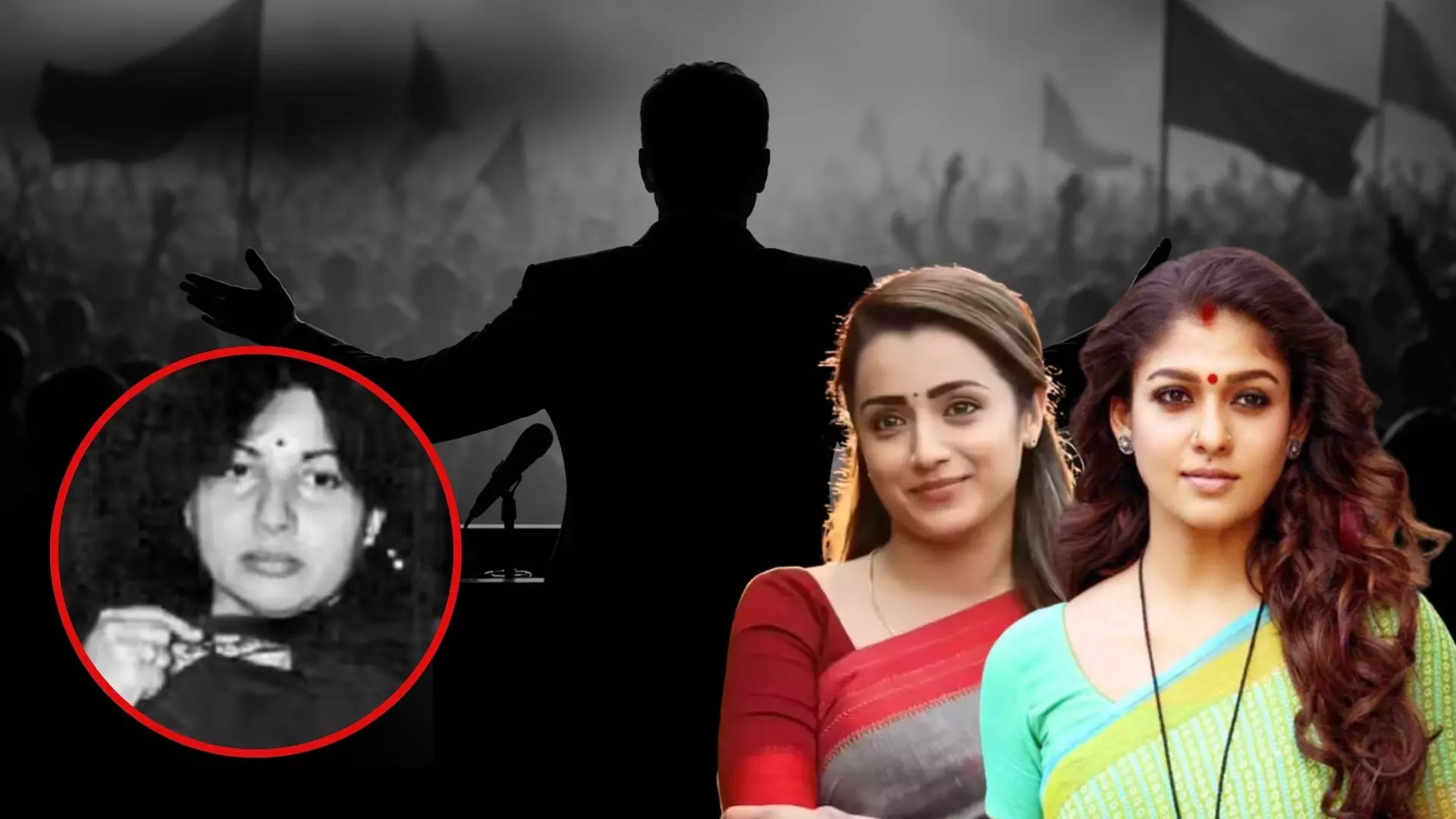
TN politicians 'worship' women on stage, and demean them at the same mic
From AIADMK to BJP to DMK, male leaders have often displayed a familiar pattern: sexist remarks, some laughter, half-hearted apologies, then silence

“Dear elders and mothers.”
“My sisters and brothers.”
“Dear strong women.”
These are the words Tamil Nadu’s top leaders use on stage. Words of respect. Words meant to connect with women.
Suddenly, the tone shifts.
“I want Nayanthara. Will he fulfil my wish?”
“(DMK) gave saree… how to wear it without the petticoat?”
“Come out of Trisha’s house first.”
Same state. Same politics. Often, the same men. But two very different vocabularies.
Tamil Nadu 'worships' women. Goddesses are everywhere — in temples, in homes, in politics. Nearly half the state’s voters are women. Respecting women is every party’s campaign promise. But demeaning women? That, too, seems to be a political habit.
No party has clean hands here — DMK, AIADMK, BJP... The faces change. The microphone stays. And so does the problem.
Recent remarks
The latest controversy began with a protest in Villupuram. The AIADMK and its allies were targeting the DMK government on women’s safety — a serious and politically potent issue.
But the message derailed. Rajya Sabha MP C Ve Shanmugam took the mic and criticised Chief Minister MK Stalin’s “Tell us your Dream” initiative. Stalin had launched the initiative in January, promising to shift governance from executing government-designed schemes to fulfilling individual aspirations.
“Stalin is asking us to share our dreams… I want Nayanthara. Will he fulfil it?” quipped Shanmugam. There was laughter. There was applause.
Also read | Vijay faces fresh trouble as TVK leader Aadhav Arjuna’s comment infuriates Rajini fans
Then came Dindigul C Sreenivasan, a former minister. “(DMK) gave saree… women are asking how to wear it without the petticoat.”
The outrage was immediate. Apologies were demanded. And just like that, a protest meant to highlight women’s safety ended up doing the opposite.
Across parties
The controversy did not stop there. Tamil Nadu BJP chief Nainar Nagendran made his own remark, targeting actor-turned-politician Vijay. “He should first come out of Trisha’s house [before thinking of ruling the state],” he remarked. When questioned later, his response was: “I said it only once.”
He apologised later, but the damage was truly done.
Different leaders, different parties, different targets, but the same method — using women to score political points.
This is not a slip of the tongue. It is a pattern. Every few months, a similar cycle plays out. A remark. Laughter. Outrage. Half-hearted apology, that too only sometimes. Then silence.
DMK’s at it, too
The ruling DMK is not untouched by this pattern. Former minister K Ponmudi once began a speech with: “Women, please don’t misunderstand this...” He then went on to narrate a joke using religious references in a sexual context.
The video went viral. Party MP Kanimozhi publicly condemned it. The party acted, but the damage was done.
Actor and DMK functionary Radha Ravi publicly slut-shamed Nayanthara — not once, but twice, on stage.
Even Udhayanidhi Stalin, while campaigning, called a party candidate “beautiful.” A compliment, perhaps, but one that reduced a woman politician to her appearance.
Old pattern
This behaviour hardly new. Way back in March 1989, inside the Tamil Nadu Assembly, chaos broke out between DMK and AIADMK members. In that chaos, J Jayalalithaa — then Leader of Opposition — was attacked. Her saree was torn. She walked out shaken.
What exactly happened that day is still debated. But one thing is not.
She walked out a different leader. She vowed not to return until the DMK was out of power. Two years later, she came back as Chief Minister.
Analysts say that the incident reshaped her political image — more guarded, more controlled, more formidable. Because she understood something many still ignore: in politics, women often have to be twice as strong to be taken half as seriously.
Political culture
So why does this keep happening? The answer lies in political culture.
For decades, Tamil Nadu’s political meetings were male-dominated spaces. Men in the audience. Men on the stage. Double-meaning jokes were not scandals. They were entertainment. They drew laughter. They drew applause and bonhomie.
Also read | Jhansi Rani to Kanimozhi to Kalpana Soren, Indian women leaders are rarely Plan A
DMK patriarch M Karunanidhi, one of the state’s greatest orators, was also known for speeches layered with wordplay and double meanings. The crowd loved it.
Because the audience was different. Women were not the voters that mattered.
What changed now
But that has changed. Women now vote in large numbers. They contest elections, win and shape outcomes.
While the stage has changed, the microphone hasn't.
That is the contradiction Tamil Nadu politics continues to struggle with — a state that celebrates women, elects women, empowers women… yet repeatedly disrespects them in public discourse.
The promises will continue. The schemes will continue. The speeches will continue. And somewhere, on some stage, another remark will be made — one that should never have been said.
Tamil Nadu deserves better. Its women certainly do.
The content above has been transcribed from video using a fine-tuned AI model. To ensure accuracy, quality, and editorial integrity, we employ a Human-In-The-Loop (HITL) process. While AI assists in creating the initial draft, our experienced editorial team carefully reviews, edits, and refines the content before publication. At The Federal, we combine the efficiency of AI with the expertise of human editors to deliver reliable and insightful journalism.


