Uneven reality of Yogi’s UP growth story: Proposals aplenty, delivery patchy
Final part of our fact-check series shows that beneath UP’s growth story lie patchy industrialisation, low incomes and a wide gap between promise and outcome

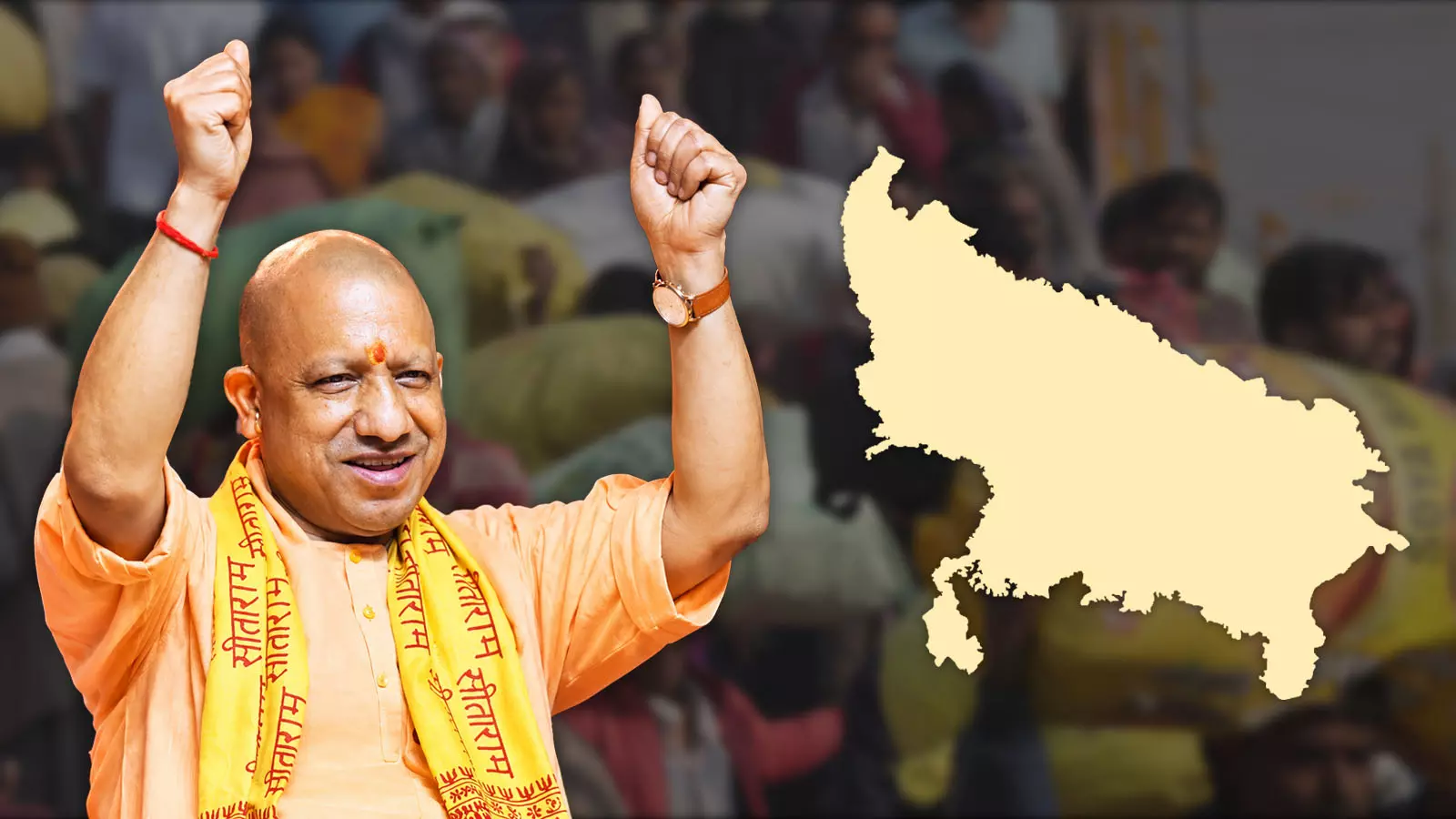
After nearly a decade in office, Uttar Pradesh Chief Minister Yogi Adityanath has projected the state as one of India’s leading growth stories, citing rapid economic expansion, rising incomes, infrastructure development, job creation, and improved law and order.
In Part 1 of this two-part series, we ran a reality check of these claims Adityanath made at an event in Lucknow on October 2, comparing official data against his assertions on GSDP growth, per-capita income, expressway expansion, crime trends, industrial growth, start-ups, employment, semiconductor and AI ambitions, and the defence corridor, and found that several headline claims are either overstated, unsupported by official figures, or require greater context than presented in political speeches.
In Part 2, we will examine his claims on agricultural growth, women’s participation in the labour force, and investment, versus reality.
Agricultural development
The share of agriculture in UP’s GSDP is 27% and the share of manufacturing is 26%. Services account for the remaining 47%.
In contrast, the share of agriculture in Tamil Nadu’s GSDP was 13% in 2025-26. Though it cannot be said that UP remains a predominantly agricultural state, agriculture still has a marginal edge over the state’s manufacturing.
Also read: Ayodhya showdown? Yogi counters Akhilesh’s dare with a face-off challenge
Adityanath also asserted that the state’s agricultural growth rate has reportedly risen from 8% to 18%, supported by major irrigation projects like Arjun Sahayak, Bansagar, and Saryu Canal projects. But he did not mention this rise was in which period.
But indeed, UP has been witnessing fairly high agricultural growth during the past 10 years.
But this fairly high agricultural growth in UP, and the consequent growth in agricultural incomes, are not fuelling corresponding industrial growth in UP except for promoting unorganised industrial clusters like metalware and brass handicrafts in Moradabad, wood carving products cluster in Sahranpur, cane and wood crafts clusters in Nagina, zari works, embroidery and decorative crafts cluster in Bareilly, chikankari and zardozi cluster in Lucknow, silk, carpets, and handicraft-related crafts in Varanasi, sports goods and some craft-linked manufacturing in Meerut, and decorative and glass-based craft activities in Agra and Firozabad.
Why the abundant agricultural surplus in UP is not getting channelised into large industries or even into MSMEs in the factory sector needs to be examined.
Female labour force participation
Adityanath also claimed a rise in female labour force participation from 12% to over 36% in Uttar Pradesh but he has not given the official source for this data. From 12% to 36% is an enormous jump. Such a broad claim about the state’s overall female LFPR is hard to accept without the exact source, survey year, and definition.
Also read: Purvanchal’s restless politics tests BJP’s hold on UP before 2027 polls
Even if we were to assume that UP’s female labour force participation has grown significantly, its claimed rate of 32.1% remains below the broader all-India female labour force participation average, which reached approximately 40.0% to 40.5%, according to the recent nationwide Periodic Labour Force Survey (PLFS) reports.
Moreover, UP’s claimed 32.1% growth in female labour force participation also includes 1 crore self-help group (SHG) women and schemes like PM SVANidhi, which are not regular and quality employment. Hence, we get this inflated figure.
Some reports like Annual Survey of Industries indicate that the share of women in regular wage or salaried jobs has seen a modest increase, rising to 18.2% from 16.6% in recent periods. Similarly, the share of women in casual labour increased slightly to 17.6% from 16.9%. In total they come to 35.8%.
Even if we assume that under Adityanath, female labour force participation in UP increased to 35.8%, the figure of women’s wage employment for Tamil Nadu is 43.2% and for Maharashtra it is 40.1%.
Adityanath claims that during his nine years, 65 lakh youth have been provided employment. But even almost after nine and a half years of his rule and providing employment to 65 lakh youth, the number unemployed in UP is 31.96 lakh, according to CMIE data. Adityanath has no concrete plan or offers no specific promise on providing them employment.
UP has a huge bureaucracy comprising 17.8 lakh government employees. Instead of downsizing this huge bureaucracy, which is a major drain on state’s resources, Adityanath claims he added 65 lakhs to this number in his 9 years!
Investment under Adityanath
Over the past five years, Uttar Pradesh has attracted investment proposals worth over Rs 45 lakh crore, but only Rs 15 lakh crore could be implemented on the ground, according to a report in NDTV on June 4.
Also read: Caste maths, fluid allies: What will decide Purvanchal in 2027 UP election
Uttar Pradesh held sessions of the UP-Japan Investment Meet from August 18 to August 23 in Greater Noida and Noida. Additionally, the state organized a Global Capability Centre Roundtable Discussion in Noida on September 25, 2025, and UP also holds major trade and investment networking events such as the Uttar Pradesh International Trade Show (UPITS) annually at the India Expo Mart in Greater Noida (most recently held September 25–29, 2026).
From proposals made in these events, Adityanath has now declared that UP has received investment proposals to the tune of Rs 50 lakh crore. How many of these proposals would actually turn into actual investment and how much investment that would be is anybody’s guess. Going by the past record, the gap between the proposals made in such meets and the MoUs signed, and the actual money invested on the ground is huge.
In fact, UP was targeting only Rs 3 lakh crore in manufacturing investments for 2025–26 through the institution of “Invest UP”. For 2026 as a whole, UP has claimed there would only be Rs 7.55 lakh crore in estimated investments across nearly 7,000 projects in the state. These, too, are proposals only, and we will have to wait and see how much of this actually materialises.
Regarding MSMEs, UP has launched a scheme called Sardar Vallabh Bhai Patel Employment and Industrial Zone to develop MSMEs there and has allocated only a meagre amount of Rs 575 crore for 2026-27. How many MSMEs can be promoted or assisted with this meagre amount?
Uneven development and exaggerated claims
It is not our case that UP is not developing. UP is developing but the claims of its leaders about its development appear to be highly exaggerated.
Also read: Banking on women: Welfare turns into a BJP-SP cash-promise war ahead of UP polls
We have seen that per-capita income remains low and agriculture still remains marginally dominant over manufacturing in the state. Urbanisation in UP is weak. The industrial proposals mooted are many but there is a huge implementation gap.
UP’s economy has many other shortcomings, like concentration of industries in NOIDA-Greater Noida. The earlier industrial town of Kanpur has de-industrialised following closure of major textile mills.
Moreover, UP is characterised by uneven development of industries. There is huge power shortage. And, there is a skills mismatch vis-à-vis the semiconductor and AI industries, which Adityanath is now prioritising.
Read Part 1 | Yogi’s ‘tripled’ economy comes up short of 3x: What the data shows