Purvanchal’s restless politics tests BJP’s hold on UP before 2027 polls
Ground report: After its 2024 Lok Sabha slide, BJP in UP faces an eastern belt where no caste rules and no mandate lasts. First of a 2-part series

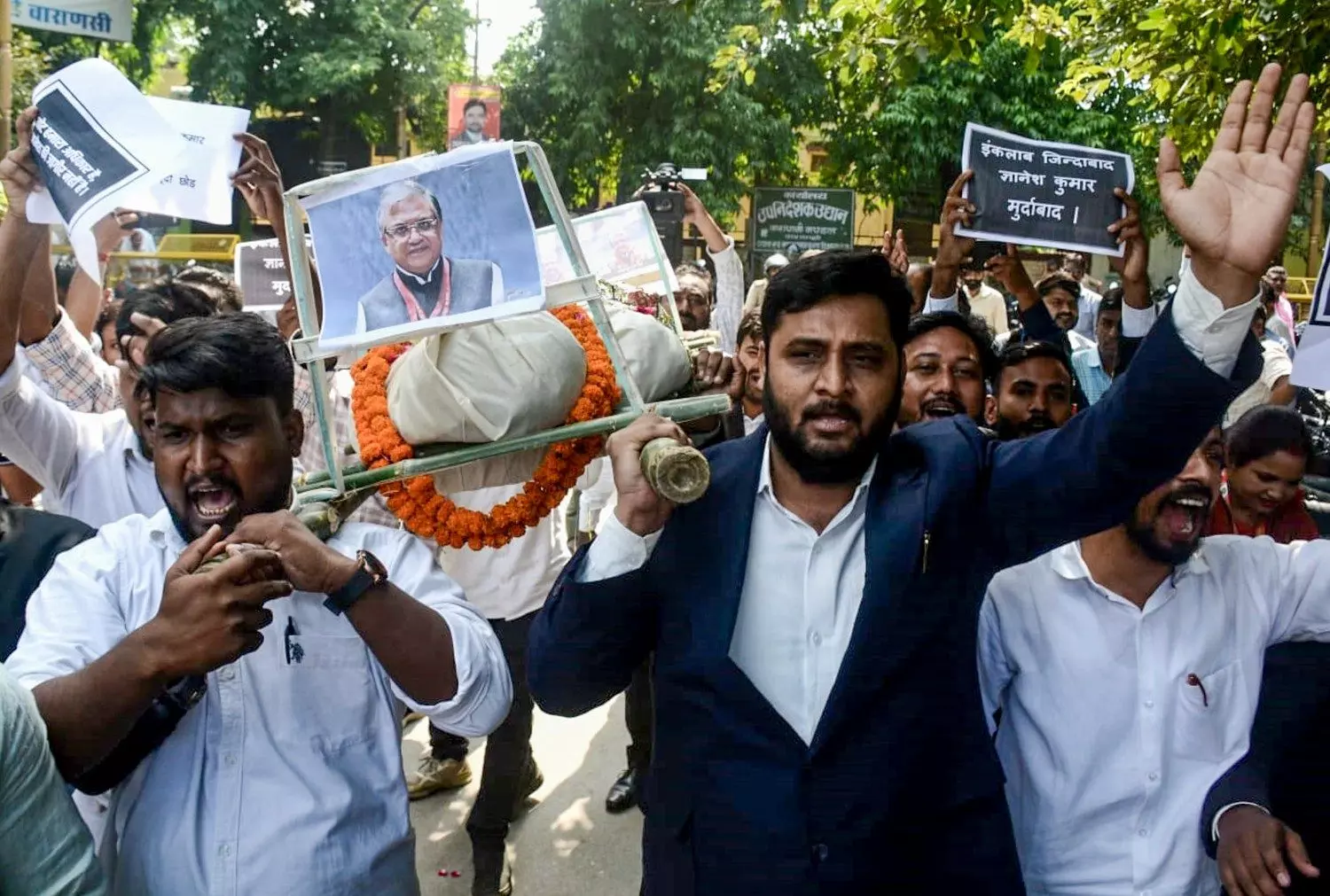
Purvanchal has long shaped Uttar Pradesh’s politics, with shifting caste equations and the rise of Hindutva redrawing its electoral map. Ahead of the 2027 Assembly polls, this two-part series examines the BJP’s bid to retain dominance and the Opposition’s fight to regain ground.
The BJP’s setback in the 2024 Lok Sabha elections has brought Uttar Pradesh’s politically volatile eastern belt, Purvanchal, into focus ahead of the 2027 Assembly polls. Despite Prime Minister Narendra Modi’s stronghold in Varanasi and Chief Minister Yogi Adityanath’s roots in Gorakhpur, the BJP won just 10 of the region’s 26 Lok Sabha seats, while the Samajwadi Party bagged 14.
Political loyalties in Uttar Pradesh’s sprawling eastern belt, colloquially known as Purvanchal, have rarely been permanent. The region, which is culturally vibrant, demographically fragmented and economically underdeveloped, has repeatedly reshaped the state’s political fortunes.
Why Purvanchal matters in 2027
Historically, its political landscape has shifted: from Congress dominance to socialist mobilisation, Jana Sangh expansion to the Janata Party experiment, and the BJP’s rise through the Sangh and Ram Janmabhoomi movement to Mulayam Singh Yadav’s SP and the BSP’s social engineering.
Also read | Why UP BJP is banking on ‘sangathan shilpi’ Sunil Bansal for 2027 election
Purvanchal, therefore, is seen as Uttar Pradesh’s political weather vane, where anti-incumbency often takes root early and unsettles the calculations of ruling parties, as the BJP experienced in the 2024 Lok Sabha elections.
Not surprisingly, ahead of the 2027 Assembly elections, Purvanchal is once again emerging as the epicentre of a fierce political contest, not only for dominance and resurgence but also for survival and relevance.
While the BJP is seeking to defend its decade-long dominance in the state, a resurgent SP sees an opening to regain the power it lost in 2017. For the BSP, Purvanchal offers hope of reversing its precipitous decline. For the Congress, meanwhile, the brewing anti-incumbency offers an opportunity to regain relevance in the region it once dominated.
“One-fourth of Uttar Pradesh’s Assembly seats come from Purvanchal. It is home to the BJP’s cultural-nationalist core, Ayodhya, Kashi and Prayagraj, as well as Yogi Adityanath’s Gorakhpur stronghold. For the BJP, it is the heartland, while for the SP and other opposition parties, it is the biggest stepping stone to a 202-seat majority,” pointed out political commentator and Deen Dayal Upadhyaya Gorakhpur University professor Harsh Sinha.
The centre stage of anti-incumbency
Speaking to The Federal, political observers and scholars argue that Purvanchal’s volatility stems from a deep-rooted culture of dissent and a fragmented social landscape that makes caste arithmetic both indispensable and precarious.
Purvanchal, experts say, has no single caste that can dominate the region. Any party seeking dominance here needs Yadavs, Kurmis, Mauryas, Rajbhars and Nishads to rally behind it, alongside upper castes, Dalits and Muslims.
Purvanchal is seen as UP's political weather vane, where anti-incumbency often takes root early and unsettles the calculations of ruling parties.
The BJP’s rise after 2014 rested partly on drawing non-Yadav OBCs and non-Jatav Dalits into a broader coalition built around Hindutva, welfare and alliances with caste-based parties.
Ahead of the 2022 Assembly elections, Akhilesh Yadav sought to prise open that coalition by bringing leaders such as Swami Prasad Maurya, Dara Singh Chauhan and Dharam Singh Saini into the SP camp. Their defections exposed the BJP’s vulnerabilities among sections of the non-Yadav OBC electorate, even as it retained power statewide.
“In Purvanchal, therefore, caste mobilisation is not merely about winning communities over; it is about giving them representation, leadership and a stake in power,” said Varanasi-based Dalit political activist Lenin Raghuvanshi.
This is also what makes the region an exposed flank for incumbents and a potential battering ram for the Opposition.
Also read | Why Yogi's Ram temple theft crackdown has Sangh, BJP shaken | Capital Beat
For veteran political observer and scholar Surendra Dubey, this volatility also reflects a longstanding culture of dissent. “Purvanchal is a curious land. It is the seat of Hinduism, but also the land that gave us one of its biggest critics, Buddha. It is also where Kabir challenged religious orthodoxy among both Hindus and Muslims. Dissent and an inherent undercurrent against hegemony have always been embedded in its collective memory,” Dubey told The Federal. “Perhaps that is why all parties remain uneasy about this region,” he added.
Frequent political transitions
For much of the post-Independence period, Congress dominated Uttar Pradesh politics, drawing support from upper castes, Muslims and sections of the backward classes. Eastern Uttar Pradesh produced influential Congress leaders such as Kamalapati Tripathi and Vir Bahadur Singh, both of whom became chief ministers.
A party does not need to abandon its core constituency to expand. It needs to convince other communities that their interests can coexist within a larger political bargain: Lenin Raghuvanshi
Around the same time, Purvanchal also became a crucible of socialist politics, where the fight against Congress dominance converged with agrarian distress and demands for social justice. Ram Manohar Lohia gave the movement its ideological edge, placing caste inequality at the heart of the struggle for political and economic equality.
Moreover, socialist leaders such as Ashok Nandlal Mehta became prominent faces of the anti-Indira camp in the region. The socialist churn ultimately decimated Congress in 1967. Mulayam Singh Yadav entered the Assembly that year on a Samyukta Socialist Party ticket, as backward-caste assertion and social justice became enduring themes in the state’s politics.
“This churn also strengthened the Jan Sangh and led to the Janata Party experiment, a precursor to the BJP,” Dubey pointed out.
Political laboratory
According to Dubey, the Mandal-Kamandal churn in the late 1980s further upended the socialist base. The region became a political laboratory for caste-based parties. Mulayam Singh Yadav floated his own Samajwadi Party, blending socialism with a Yadav-Muslim coalition, while Kanshi Ram built the BSP to consolidate Dalits and marginalised communities.
“The RSS and the Sangh Parivar, meanwhile, started laying the foundation of the Ram Mandir movement. Gorakhnath Math’s head priest (Peethadheeshwar), Mahant Avaidyanath, emerged as a central leader in the Ram Janmabhoomi movement,” Dubey added.
Mayawati’s bargain, Akhilesh’s promise
The BSP had shown how caste coalitions could upend Purvanchal’s political order. As the SP consolidated its Muslim-Yadav base and the BJP expanded among non-Yadav OBCs and non-Jatav Dalits, Mayawati and Satish Chandra Mishra reached out to Brahmins and other upper castes.
In 2007, the BSP won 206 Assembly seats and formed a majority government for the first time in the state after 15 years of political instability.
“The lesson was quintessentially Purvanchali. A party does not need to abandon its core constituency to expand. It needs to convince other communities that their interests can coexist within a larger political bargain,” Raghuvanshi said.
Silver lining for SP
Akhilesh Yadav attempted a similar expansion in 2012, when the SP swept Uttar Pradesh with 224 seats, including 85 in eastern UP. He projected the image of a young and educated leader who promised to build on the legacy of Mulayam Singh Yadav while distancing the party from its criminal associations.
Also read | 'BJP keeping its options open, not committing Yogi for another term'
“The family feud that broke out disillusioned the electorate. The stage was set for the BJP’s Modi-led wave, and the nationalist agenda orchestrated around that time helped the saffron party inherit political dominance in the region,” Dubey added.
In 2022, Akhilesh rebuilt his coalition through alliances with smaller caste-based parties. Defections from the BJP further boosted his attempt to expand the party’s footprint in the region. Consequently, the SP’s tally in Purvanchal rose from 17 to 48 seats. The BJP, however, retained power in the state but lost seats in the region.
For Raghuvanshi, the result reflected the fact that Akhilesh Yadav still enjoys a good reputation in the region and that his PDA strategy is earning him dividends.
Coming soon | Part 2: Purvanchal’s caste equations and shifting alliances shape 2027 battle