Yogi’s ‘tripled’ economy comes up short of three: What the data shows
CM says UP’s economy tripled since 2017, but data shows just 2.4x growth, with per-capita income, factories and start-ups also short. Part 1 of our fact-check

Nine and a half years, one big claim.
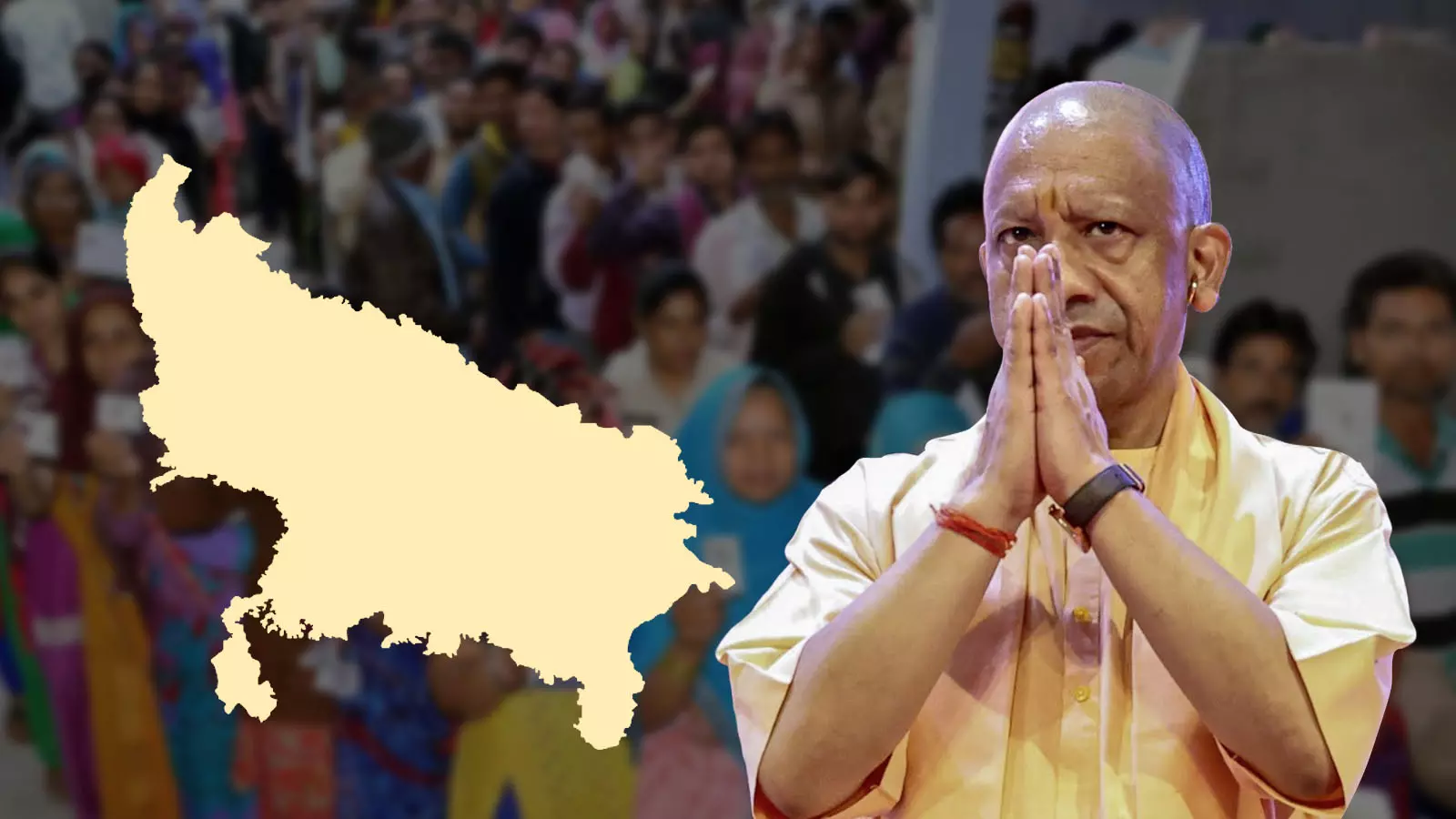
Since taking oath as Uttar Pradesh’s Chief Minister on March 19, 2017, Yogi Adityanath has made the state’s transformation the centrepiece of his pitch. On October 2, at an appointment-letter ceremony in Lucknow for 1,375 newly selected Gram Panchayat Officers, he made it again: a state once ranked among India’s five least-developed is now, he said, among the country’s top three economies.
The economy, per-capita income and budget size have all tripled, he said, and the list of claims did not stop there. But do the numbers hold up?
Let us check.
Reality check
First, has UP’s economy indeed trebled under Yogi?
In 2016-17, the state's GSDP was Rs 12.89 lakh crore at current prices. In 2024-25, it was Rs 30.25 lakh crore at current prices (see table below). In 2025-26 (budget figures), it was Rs 30.8 lakh crore at current prices.
Had UP’s economy indeed trebled under Adityanath in nine years, it should have been Rs 38.67 lakh crore. But it is only Rs.30.80 lakh crore.
Next, let us take a look at UP’s growth performance year-wise over the past nine years.
As the table illustrates, the growth rate of Uttar Pradesh’s economy has been steadily declining during Adityanath’s years as the chief minister.
UP’s GSDP increased by about Rs 1.99 lakh crore per year on average. Or, the compound annual growth rate (CAGR) of UP’s economy was 10.16% per year between 2016-17 and 2025-26.
This figure looks reasonably good but not as much as Yogi claims.
Next, let us examine UP’s performance in terms of growth of per-capita income.
Claim vs fact
Per-capita income and per-capita GSDP are not the same and they come under different categories. So, let us examine UP’s per-capita GSDP in relative terms in comparison with some major states.
UP’s per-capita GSDP in 2025-26 was Rs 1.16 lakh. In contrast, Tamil Nadu’s was Rs 3.62 lakh, Gujarat’s Rs 3.37 lakh, and Maharashtra’s Rs 3.19 lakh.
It is evident that UP does not figure among the top three states as far as per-capita GSDP is concerned.
Adityanath claimed the state’s significant transformation since 2017, citing a tripling of GSDP and per-capita income, massive expressway expansion, a strict zero-tolerance policy on crime, and a rise in female workforce participation to over 36% from 12%.
Also read: UP Legislative Council polls: BJP wins big, but SP wins where it matters
Had per-capita income trebled in nine years between 2016-17 and 2025-26, it should have reached Rs 148,023. But from the above table, we can make out that the estimated per-capita income of UP in 2025-26 was only Rs 1,20,000.
Expressway expansion
Next, let us consider Adityanath’s claim on massive expressway expansion in UP. The following table shows that UP doesn’t top the states either in terms of total length of expressways or the length of expressways per lakh of population. In terms of length of expressways per lakh of population, UP ranks last among the top four states.
Other areas of building industrial infrastructure, like assured power supply, roads building, transport and storage facilities or social infrastructure like schools and hospitals etc., get neglected.
Curbing crime in UP
Additionally, Adityanath also claims a strict zero-tolerance policy on crime, and a rise in female workforce participation from 12% to over 36% in UP. Let us verify these claims too.
True, Adityanath has curbed the activities of “bahubalis” (mafia dons) to some extent. But has he brought down the incidence of crime in UP? Let us take a look at the National Crime Records Bureau data, including IPC/BNS and Special and Local Laws (SLL), on crimes in UP.
The percentage increase of cognizable crime incidents in UP from 2016 (5,61,605) to 2023 (793,000) is 41.2%.
However, the crime rate drastically came down to 4,30,552 in 2024. It is somewhat inexplicable why the incidence of cognizable crimes steadily increased from 2016 to 2023 and suddenly decreased sharply to 4,30,552 in 2024. Going by the 2024 figures alone, Yogi can claim that the crime rate in UP is declining. But during other years of his tenure incidence of crime steadily went up.
Industrial growth
Adityanath also claimed that “large factories grew from 14,000 to 35,000, startups expanded from 120 to over 24,000, and more than 65 lakh youth gained employment. The state aims to become a USD 1 trillion economy”.
But a Business Standard report on April 6 carried a story with the headline Factories’ tally in Uttar Pradesh jumps 17% to cross 32,000 mark. Only Adityanath can explain this anomaly and show how the figure reached 35,000!
Also read: Banking on women: Welfare turns into a BJP-SP cash-promise war ahead of UP polls
UP came up with a start-up policy in 2026. Adityanath also claimed that the number of start-ups in UP expanded to 24,000. But a Press Information Bureau report on April 17 gives the official start-ups data as follows: The number of start-ups in Maharashtra is 38,660, in Karnataka 22,600, and then comes UP with 21,960.
Adityanath’s figure on start-ups in UP is also higher compared to the official figures from the Centre. Could the number of start-ups have gone up so much between April 17 and October 2 when Yogi made this claim?
For 2026, the Adityanath government claims there would be Rs 7.55 lakh crore in estimated investments across nearly 7,000 projects, according to a report in The Economic Times on October 9. Going by the past record, this too could well be an inflated figure.
Semiconductor and AI ‘hub’
Adityanath also claims that he would make UP a semiconductor and AI hub. The so-called semiconductor “hub” has so far received only one proposal. The Union Cabinet approved a joint venture between India’s HCL Group and Taiwan’s Foxconn to set up an Outsourced Semiconductor Assembly and Test (OSAT)/display driver chip unit near the Noida International Airport in the Yamuna Expressway Industrial Development Authority (YEIDA) region.
In contrast, there are 420 semiconductor-related units in the National Capital Region (NCR), including component units. Karnataka houses 81 semiconductor units, and Tamil Nadu 12.
Also read: UP polls: Bargaining chip or overreach? Why Congress is asking for so many seats
Regarding Artificial Intelligence-related industries, under the Uttar Pradesh Artificial Intelligence Mission (UP-AIM) and the national India AI Mission, the state is building a network of 65 Data and AI Labs. In contrast, Karnataka has 3,484 total AI organizations and companies, while there are 1,851 organizations tagged under AI in Tamil Nadu. Despite UP taking only baby steps in AI, the UP CM calls it an “AI hub”!
Tom-tomming the defence ‘corridor’
Yogi has also declared a vast area spanning from Lucknow to Chitrakoot covering Aligarh, Agra, Jhansi and Kanpur as a defence corridor. But in concrete terms, the Uttar Pradesh Defence Industrial Corridor was set up in 2018-19 in a limited area, acquiring 2,095 hectares of which 1,141 hectares have already been allotted to private and government-owned defence companies.
As usual, investment proposals were mooted for this corridor in UP to the tune of Rs 39,500 crore. Of these, approximately Rs 28,809 crore had been invested in specific projects as of June 2025. Adityanath even boasted that the BrahMos missiles used in Operation Sindoor were manufactured in his state!
The corridor is supposed to span six strategic nodes across the state:
Lucknow: Aerospace systems, missile integration (such as BrahMos facilities), and drone research;
Kanpur: Small arms, specialised textiles, leather gear, and cyber security tech;
Also read: Factionalism, ticket wars and poor turnout: Why Akhilesh’s Kannauj stronghold is fraying
Jhansi: Heavy engineering, land systems, artillery, and armoured vehicle production;
Agra: Technical textiles, personal protective gear, and aviation components;
Aligarh: Precision manufacturing, small arms, metalwork, and drone production and
Chitrakoot: Advanced ammunition manufacturing and regional testing ranges.
In the coming years, this corridor could well emerge as a major military-industrial complex in India. But it is still in its very early stage and many “nodes” have seen no new defence industries. Yet, Adityanath is thumping his chest claiming this corridor as his personal achievement.
(Coming soon, Part 2: Agriculture, investment, and female workforce participation.)