




Banking on women: Welfare turns into a BJP-SP cash-promise war ahead of UP polls
As the BJP and SP compete with financial promises for women, immediate cash benefits are taking precedence in the campaign over longer-term welfare guarantees

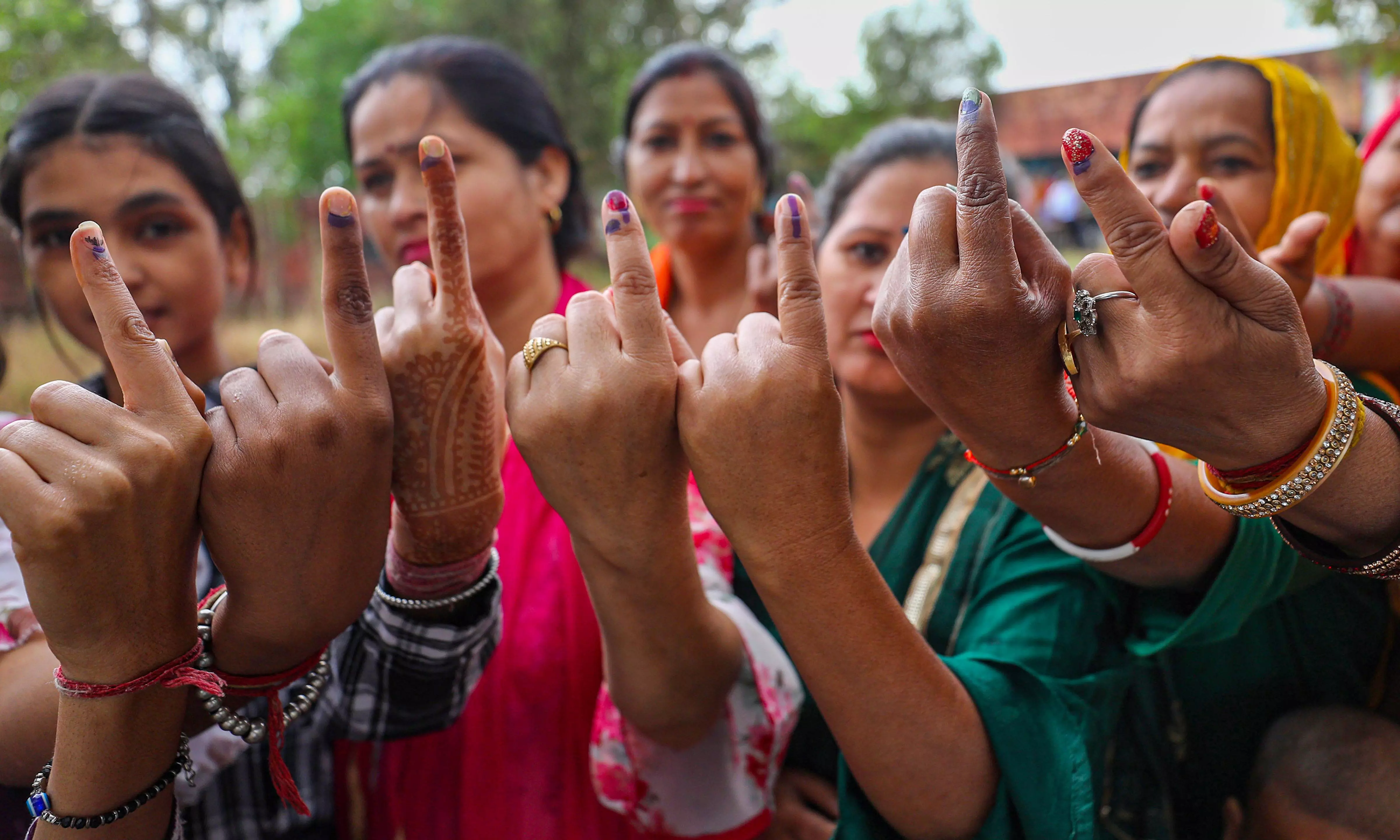
The one issue that is increasingly becoming the defining political narrative in Uttar Pradesh ahead of the 2027 Assembly elections is the intense competition for women voters between the ruling Bharatiya Janata Party (BJP) and its principal challenger, the Samajwadi Party (SP).
Behind the smokescreen of women empowerment, the contest is increasingly hinged on which party can put more money directly into women’s bank accounts. Long-term welfare guarantees, including access to better healthcare and education, come much later in the scheme, almost as supplementary material sops in a political contest increasingly driven by immediate financial incentives.
Doles for votes
The ruling BJP, drawing from its recent success in the neighbouring Bihar, is considering to offer annual financial assistance of more than Rs 50,000 to women. This is in addition to a flurry of schemes the state government and the Narendra Modi government at the Centre have launched to retain their stronghold over women voters, often described by political analysts as the Labharthi constituency.
The SP, too, is matching dole for dole. It has assured women voters of an annual cash transfer of Rs 40,000 under its proposed Stree Samman Samriddhi Yojana, should there be a transfer of power next year.
Also read: UP polls: Bargaining chip or overreach? Why Congress is asking for so many seats
The uncanny similarity of these pitches is not accidental. In a state where women account for over 45 per cent of the electorate, the cash transfers, however meagre that may be, have proved instrumental in winning over the aadhi abadi (half the population) — as the popular political lexicon goes.
“The BJP first experimented with this in Madhya Pradesh with the Ladli scheme and reaped benefits. Then they tested it again in Maharashtra and there too they tasted success. In Uttar Pradesh, too, this helped them tremendously in shoring up their support among women. Since then, cash transfers have increasingly become a mainstay for political campaigning,” Lucknow-based senior journalist and political commentator Sunita Aaron told The Federal.
Different parties, similar pitches
The BJP, which credits women voters for its rise in the state, has claimed to raise the stakes this time to retain that stronghold in the ensuing elections. Apart from the Rs 50,000 financial assistance Chief Minister Yogi Adityanath has said the party is mulling, the BJP has also promised free scooters to over 50,000 girl students under its Rani Lakshmibai Scooty Yojana.
This, Adityanath has maintained, will be in addition to the Mukhyamantri Kanya Sumangala Yojana, which provides financial assistance of up to Rs 25,000 to eligible girls in different stages of their lives, and the Nirashrit Mahila Pension Yojana for destitute women, including widows.
“We have also created around 28 lakh Lakhpati Didis who are now self-employed and financially empowered. Moreover, through schemes like the Banking Correspondent (BC) Sakhi and Vidyut Sakhi programmes, we have created livelihood opportunities for millions of women in the state,” said BJP’s state vice-president Dr Kritika Agarwal.
Also read: Caste maths, fluid allies: What will decide Purvanchal in 2027 UP election
The Samajwadi Party, too, has made a fervent pitch to court the women voters. With the Rs 40,000 annual cash transfer promise under Stree Samman Samriddhi Yojana by party chief Akhilesh Yadav, the party is also considering to revive previous schemes.
“We will also revive previous schemes of distributing laptops and cycles to girls, alongside free bus and Metro travel for female students and hostels for working women. Additionally, we will relaunch the 1090 helpline and Asha Jyoti Kendras to help fight crime against women,” SP’s women wing national president Juhie Singh told The Federal.
Centrality of cash transfers
Uttar Pradesh is not new to populist announcements ahead of elections. Assurances of subsidised food grains, better prices for crops, and cheaper public transport, among others, have long been part of the political vocabulary here. The distribution of laptops and bicycles to women was a striking accomplishment of Akhilesh Yadav’s regime, turning welfare into a potent instrument of political mobilisation.
Yet, the SP’s bet on these material sops failed to secure women’s enduring allegiance when the BJP came up with something more radical — cash transfers, however modest, deposited straight into women’s bank accounts. The results that followed were monumental. Women voters shifted their allegiance to the BJP lock, stock and barrel.
“What was envisioned as a method to check the pilferage of welfare delivery under the Manmohan Singh’s regime at the Centre was weaponised into a potent political tool by the saffron party,” noted Lucknow-based political commentator Shahira Naim.
According to CSDS-Lokniti data, these cash transfers, among other things, helped the BJP leverage a 13-percentage-point lead over the Samajwadi Party among women in the 2022 Assembly elections, compared with a five-point lead among men.
Also read: Vote magnet to political liability: BJP’s Ram Mandir dilemma in UP
Speaking to The Federal, political analysts and veteran journalists underscored the distinct advantage that cash-in-hand sops hold over long-term material sops and welfare guarantees.
‘Votes follow when money speaks’
Cash transfers, experts say, offer political parties an immediate, tangible and personally identifiable benefit for a large section of the electorate.
For the voters, cash-in-hand provides them relief, though paltry, from the punishing poverty and acute economic distress that has become inextricably intertwined with their lived realities in the state where the per-capita income is less than Rs 10,000 per month.
“People in the state are reeling under abject poverty. Rising unemployment and skyrocketing prices of daily essentials are breaking the back of millions. Therefore, even a meagre amount for women is seen as an added income for the family that can be used to manage household expenses, month-on-month,” argued Aaron.
Material sops versus direct cash transfer
Material sops like laptops and cycles do not translate into better economic status and much is left to the whims of market forces. Cash transfers, on the other hand, translate into tangible month-on-month gains, political observers have maintained.
And the gender factor adds to the benefits. Cash transfers, experts argue, also help provide women better financial autonomy and standing in the patriarchal setup of the Hindi heartland. “By depositing money directly into their bank accounts, governments give women access to a source of income that they can exercise greater control over,” pointed former vice-chancellor of Lucknow University and political activist Roop Rekha Verma.
Besides, direct cash transfers also offer parties a way to establish a more immediate relationship with women voters. “When payments are made regularly, the scheme becomes part of household budgeting, creating a recurring reminder of the government’s intervention. This visibility has helped the BJP convert welfare delivery into political dividends,” posited Aaron.
Where BJP holds an edge
Experts say the timing of assurances and the party making them matter. Across recent elections, opposition parties have tried to match the BJP’s doles. Yet, the saffron party has often emerged with electoral gains.
“Since the BJP controls the entire state machinery, they deliver these cash transfers just before polling begins despite the model code of conduct. Naturally, women would go for what they are actually getting rather than what is being promised,” Aaron pointed out.
Also read: Factionalism, ticket wars and poor turnout: Why Akhilesh’s Kannauj stronghold is fraying
Verma alleged that the BJP cadre also stokes fears among women that they could lose benefits if the party is voted out. “Even in 2022, these rumours were floated that if BJP loses, women will no longer get subsidised gas. So, it’s not just about giving cash-in-hand but also creating a perception that no other party would fulfil their promises like they are,” Verma added.
The safety narrative
The race is not confined to the cash transfers. Both parties have wrapped their financial promises in a broader vocabulary of women’s safety, dignity, education and economic independence.
The BJP invokes the so-called “mafia culture” under the SP regime and highlights initiatives such as Mission Shakti and Pink Police Booths. The SP, meanwhile, has pledged to revive its 1090 helpline and Asha Jyoti Kendras to combat crimes against women.
Here, too, experts say, the BJP enjoys a perceived advantage despite little evidence that women are safer today than they were a decade ago. According to the NCRB data, registered crimes against women in UP rose from 35,527 in 2015 to around 65,743 in 2022.
For experts, perception management has helped the saffron party build a narrative of the BJP being a party that promises better safety to women. “After all, they exercise greater control over media today. A journalist reporting on the Hathras rape is jailed, a family seeking justice in Unnao rape case is practically wiped out without the media finding courage to report it as aggressively as we did during Ashiayana rape case during Mulayam Singh Yadav’s regime,” contested Verma.
Role of the caste factor
The caste factor and the perception reinforcing prejudices also play a major role, experts have contested. “Yadavs have long been relegated to a caste engaging in petty crimes and hooliganism. The BJP has added to the narrative by projecting Muslims as the militant class as well. And since M-Y has been the core vote bank of SP, the party struggles to fight off that prejudice,” Aaron added.
Despite the BJP’s perceived advantage, some experts caution against treating women as a monolithic voting bloc. They argue that the anti-SIR wave and Gen-Z protests over paper leaks could significantly influence voting patterns.
Also read: Why UP’s Brahmins are the eye of 2027 electoral storm
“This is lazy analysis of women’s voting patterns. The BJP has pushed it to obscure the micro-management of booths and the Election Commission that actually underpins its rise. Recent protests and unrest could burst that bubble this time,” argued political activist Shabnam Hashmi.