Can the Lok Sabha Speaker truly be neutral?
In the past, Neelam Sanjiva Reddy quit his party after holding the noble chair to uphold neutrality. But structural loopholes ail the post more than individual failings

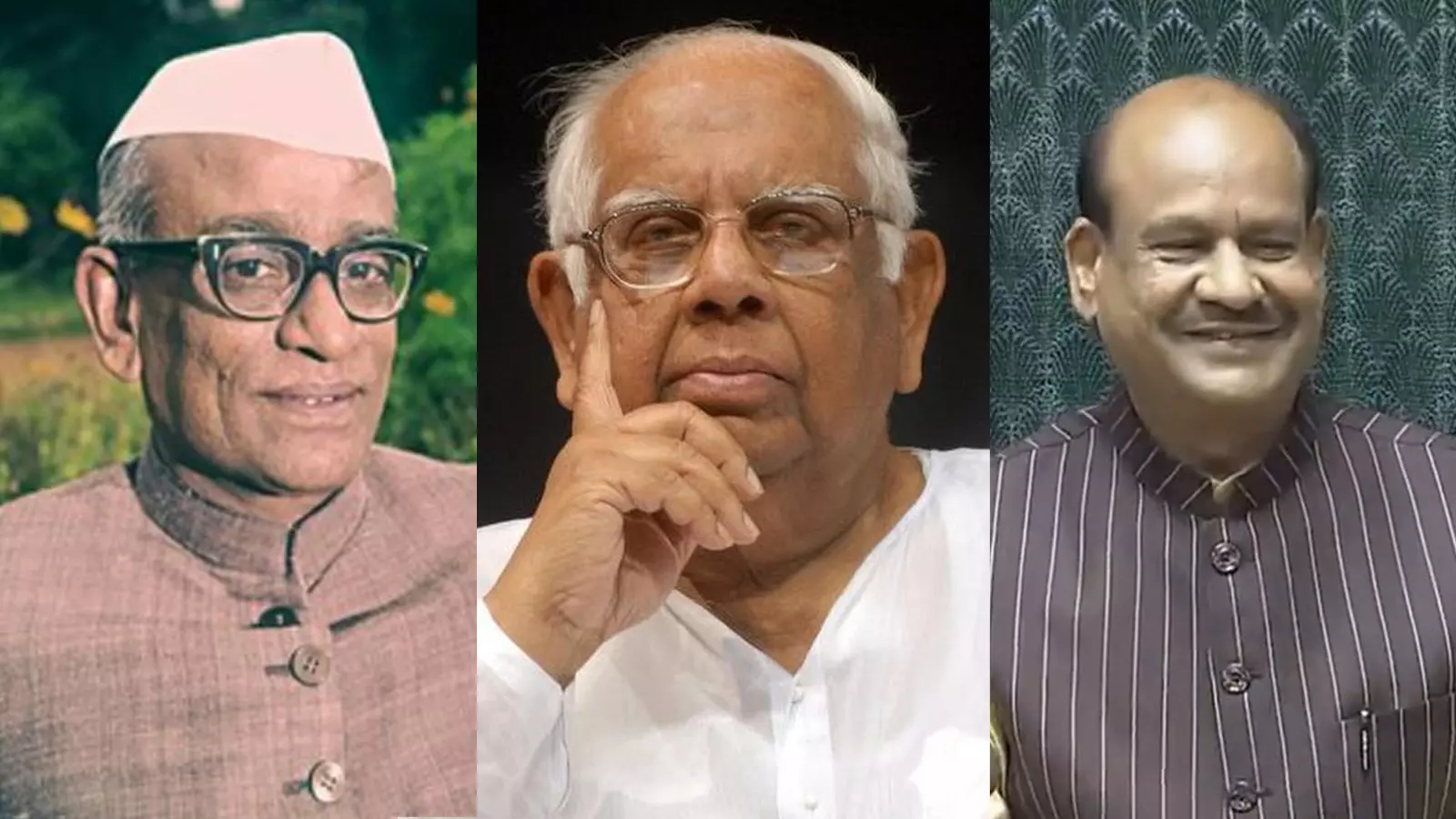
From Neelam Sanjiva Reddy (left) to Somnath Chatterjee (centre) to incumbent Om Birla, the story of the Lok Sabha Speaker has come a long way.
The recent submission of a no-confidence motion against Lok Sabha Speaker Om Birla by 118 Opposition members has thrust the question of the Speaker's neutrality into sharp focus. Allegations of "blatantly partisan" conduct and denial of speaking opportunities to Opposition leaders underscore a structural tension in Indian parliamentary democracy: can a Speaker elected on a party ticket genuinely function as an impartial arbiter?
Also read: INDIA bloc offers hard-to-accept truce to Speaker Birla amid no-confidence talk
As presiding officer, the Speaker wields considerable powers — from deciding admissibility of motions to determining disqualification under the anti-defection law. The office demands not only impartiality in practice but also the appearance of impartiality—a standard difficult to maintain in India's hyper-partisan environment.
An unused safety valve
The Indian Constitution itself provides a mechanism to address this dilemma, though it remains largely unutilised. Paragraph 5 of the Tenth Schedule, inserted through the Fifty-Second Amendment Act, 1985, explicitly exempts presiding officers from disqualification on grounds of defection if they voluntarily give up party membership upon election and do not rejoin any party while holding office.
A Speaker who severs party ties may find themselves politically isolated when seeking re-election. Without guarantees about post-Speaker electoral prospects, the constitutional provision becomes practically untenable.
This provision enables Speakers to establish institutional distance from their parties, reinforcing the office's neutrality. Yet in nearly four decades since enactment, no Speaker has availed themselves of it — a striking gap between constitutional design and political practice.
Sanjiva Reddy: One who set a benchmark
The practice of a Speaker resigning from party membership predates the Tenth Schedule. When Neelam Sanjiva Reddy was elected Speaker of the Fourth Lok Sabha on March 17, 1967, he took the extraordinary step of formally resigning from the Indian National Congress — an act not mandated by any provision but driven by principled conviction.
Also read: No-confidence motion against Speaker Birla: Will INDIA bloc unite? | Capital Beat
Reddy's resignation was a powerful symbolic statement about the independence the Speaker's office demanded. His speakership established that neutrality required demonstrating that the Speaker belonged to the House as a whole, not to any political party. Remarkably, he remains the only Speaker since Independence to have formally resigned from his party upon assuming office.
The path not taken
The failure of Speakers to resign from their parties post-1985 speaks to an evolved political culture. Why has no Speaker used this provision? The answer lies in structural vulnerabilities. Unlike in Britain, where the convention of "once a Speaker, always a Speaker" ensures continuity — with major parties refraining from contesting against sitting Speakers — Indian Speakers must return to their constituencies and contest elections afresh, usually on a party ticket.
This creates fundamental conflict. A Speaker who severs party ties may find themselves politically isolated when seeking re-election. Without guarantees about post-Speaker electoral prospects, the constitutional provision becomes practically untenable. Speakers thus remain formally affiliated with their parties while being expected to discharge duties impartially.
Somnath Chatterjee's constitutional conscience
The tension between party loyalty and institutional duty came to a head in July 2008, when Speaker Somnath Chatterjee refused to resign or vote against the then United Progressive Alliance (UPA) government during a confidence motion, despite a whip from the Communist Party of India (Marxist) to which he belonged.
Also read: UP follows 'Karnataka model' as Mysuru-crafted Speaker's chair reaches Lucknow
The CPI(M) withdrew support from the Manmohan Singh-led UPA government over the Indo-US nuclear deal. When the Opposition moved a no-confidence motion, the party leadership expected Chatterjee to step down as Speaker to vote against the government in accordance with the party whip. But he refused, arguing that the Speaker's role demanded strict impartiality.
The Birla case is significant given the context of a coalition government with a working majority facing a numerically stronger Opposition. Importantly, he has stepped aside from presiding until the motion is disposed of, citing "moral grounds" — a tacit acknowledgement that questions of impartiality, once raised, cannot be easily dismissed.
Chatterjee's stance was constitutionally sound. Article 100 specifies that the Speaker shall not vote in the first instance, exercising a casting vote only in the event of a tie. The CPI(M)'s response was swift: on 23 July 2008, it expelled Chatterjee "for seriously compromising the position of the party".
The expulsion was a poignant reminder of institutional pressures Speakers face.
While the anti-defection law empowered Speakers to disqualify members who defied party whips, it placed Speakers themselves in an impossible position when institutional role conflicted with party expectations.
Chatterjee's case highlighted ambiguity surrounding Paragraph 5 of the Tenth Schedule. Though he had not formally resigned from the CPI(M) upon becoming Speaker, his refusal to toe the party line four years into tenure raised questions about whether his conduct amounted to having "voluntarily given up" membership in spirit, if not form.
Contemporary relevance: The Om Birla row
The current controversy demonstrates that the fundamental tension identified in 2008 remains unresolved. Opposition allegations that Birla has conducted proceedings in a partisan manner — curtailing debates, disallowing adjournment motions, selectively permitting interventions — are not new. Similar charges had been levelled against previous Speakers, reflecting systemic problems rather than individual failings.
Also read: Cong says ‘wait for action’ amid reports of no-trust motion against Lok Sabha Speaker
The Birla case is significant given the context of a coalition government with a working majority facing a numerically stronger Opposition than in recent years. The decision by 118 MPs to move a removal motion signals deep dissatisfaction with how the office is being conducted.
Importantly, Birla has stepped aside from presiding until the motion is disposed of, citing "moral grounds" — a tacit acknowledgement that questions of impartiality, once raised, cannot be easily dismissed.
The way forward
Recurring crises around the Speaker's neutrality point to the need for structural reforms. Simply exhorting him/her to be impartial is insufficient when political incentives work against neutrality.
First, serious consideration should be given to making it mandatory for Speakers to resign from their parties upon assuming office, through constitutional amendment or parliamentary convention.
Also read: Rahul's speech: Brutal truth or 'bundle of lies'?
Second, the British practice of providing electoral security to sitting Speakers merits adoption. Major parties could agree not to contest against incumbent Speakers, ensuring continuity and reducing dependence on party support.
Third, greater transparency in the Speaker's exercise of discretionary powers — through publication of reasoned orders — would enhance accountability.
The question of the Lok Sabha Speaker's neutrality is ultimately about the maturity of India's parliamentary democracy. Sanjiva Reddy showed in 1967 that a Speaker could transcend party lines through principled action.
Somnath Chatterjee demonstrated in 2008 that such stands exact a heavy personal cost in a system that privileges party loyalty over institutional integrity.
The Tenth Schedule provides a constitutional pathway to neutrality that remains tragically underutilised. Until political parties decide that institutional integrity matters more than partisan advantage, and unless Speakers find both courage and structural support to prioritise their institutional role over party affiliation, the office will remain vulnerable to charges of bias.
The Birla controversy is unlikely to be the last. But it offers yet another opportunity for political leaders to reflect on whether current arrangements serve parliamentary democracy well, or whether it is time to embrace reforms that would make the Speaker's neutrality a reality rather than a rhetorical aspiration. The constitutional tools exist; what is required is the political will to use them.