India’s nuclear triad goes deep as INS Aridhaman inducted but missiles yet to catch up
The vessel's commissioning marks a generational leap in India's undersea deterrence, yet the gap between submarine capability and operational missile readiness remains

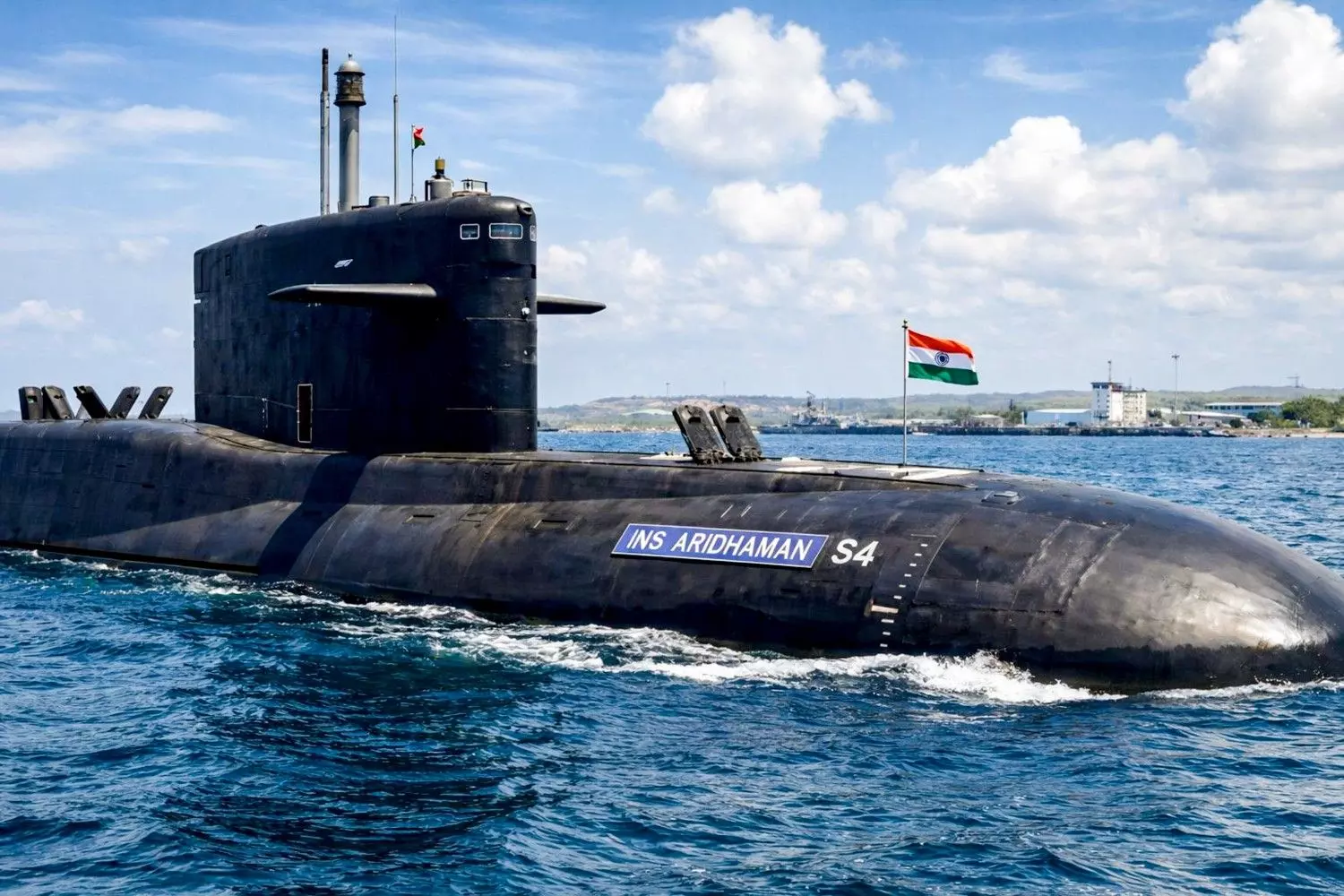
Indian Navy's INS Aridhaman, the third indigenously built nuclear-powered ballistic missile submarine. Photo: X/@JM_Scindia via PTI
India's nuclear deterrence entered a new era on Friday (April 3) with the commissioning of INS Aridhaman, its third nuclear-powered ballistic missile submarine (SSBN or ship submersible ballistic nuclear), deepening the underwater leg of its nuclear weapons triad: the capability to launch nukes from land, air and sea.
Also read: Integrated Rocket Force: India’s missing piece in conventional deterrence
The induction ceremony of the lethal "boomer" in Visakhapatnam, Andhra Pradesh, significantly bolstered the country's retaliatory capability against any adversary planning to conduct a first strike.
INS Aridhaman more potent than predecessors
INS Aridhaman, with a 125-metre length and 7,000-tonne displacement, is larger and capable of carrying more long-range nuclear-tipped ballistic missiles than her predecessors, the 6,000-tonne INS Arihant and INS Arighaat, which were commissioned in 2016 and 2024, respectively.
The fourth SSBN, currently codenamed S-4*, is slated to be commissioned next year. While 83 MW pressurised light-water reactors power these initial four boats, India has also begun constructing the larger S-5 class SSBNs, conveying the message that it has a comprehensive vision to upgrade its nuclear-capable sea power.
The first such 13,500-tonne submarine, with a 190 MW reactor for significantly greater endurance and strike power, is expected to be ready by 2030.
India’s long pursuit for SSBNs began in the late 1990s under the secretive Advanced Technology Vessel (ATV) project, with collaboration among the Defence Research and Development Organisation (DRDO), the Bhabha Atomic Research Centre and others, along with some technical assistance from Russia.
INS Aridhaman represents the ATV project at its most mature—more capable than her predecessors, built with nearly 90 per cent indigenous components, and incorporating significant engineering advances. A room for development, however, remains in her arsenal: the long-range submarine-launched ballistic missiles (SLBMs) she is meant to carry still need further development before they can be considered truly combat-ready.
Capable of carrying K-4 missiles
The gap between the submarines' potential and their actual strike range is stark. INS Arihant, the oldest of the three, is limited to the K-15 missile with a range of just 750 kilometres. Her younger sisters, INS Arighaat and INS Aridhaman, are built to carry the far more consequential K-4, an intermediate-range ballistic missile capable of reaching targets 3,500 kilometres away.
But the K-4 is not yet fully operational. Though tested from INS Arighaat in November 2024 and again in December 2025, the two-stage solid-fuelled missile needs further trials before it can be reliably deployed on SSBNs for deterrent patrols.
Also read: What is the ‘doomsday missile’ that US tested amid Iran war escalation?
Looking further ahead, the DRDO is already developing the K-5 and K-6 variants, with ranges of 5,000 kilometres and 6,000 kilometres, respectively.
China, Russia and US
Countries such as China, Russia and the US operate larger SSBNs armed with intercontinental ballistic missiles (ICBMs) with ranges well over 5,500 kilometres and are also developing more powerful variants.
China, for instance, has six Jin-class SSBNs armed with 7,400-kilometres range JL-2 and 10,000-kilometres range JL-3 missiles as well as six nuclear-powered attack submarines (SSNs or submersible ship nuclear) meant for conventional warfare. The US, in turn, operates 14 Ohio-class SSBNs and 53 SSNs. Underscoring the reach of these assets, it was apparently the American SSN USS Charlotte that sank the Iranian frigate IRIS Dena off Sri Lanka last month.
Nuclear deterrence, of course, remains the ultimate deterrent. While nuclear weapons are not meant for active combat, their strategic utility in deterring adversaries is inescapable. It is widely argued that Russia might not have invaded Ukraine in February 2022 had Kyiv not relinquished its nuclear stockpile after the Budapest Memorandum on Security Assurances in 1994.
India's nuclear deterrence
For India, a more robust sea-based leg of the nuclear triad is vital because it’s the most secure, survivable and potent platform for retaliatory strikes in line with the country’s “no first use” nuclear doctrine.
India’s doctrine clearly mandates that “nuclear retaliation to a first strike will be massive and designed to inflict unacceptable damage”. This requires a credible second-strike or counter-strike capability in the shape of SSBNs, which can silently stay submerged and undetected in deep waters for months on end.
Also read: Why Iran's ballistic missiles could shift power balance in West Asia
China, with an expansive nuclear weapons triad already in place, is also fast expanding its arsenal, adding around 100 warheads to its existing stockpile of 600 every year, as well as developing far deadlier ICBMs. Estimates suggest it will touch 1,500 warheads by 2035.
Pakistan, on the other hand, remains “neck-and-neck” with India, with both nations having around 170-180 nuclear warheads each. Islamabad is also trying to develop its own triad by fitting the nuclear-capable Babur-3 cruise missiles onto its diesel-electric submarines.
India's other nuclear arms
While India’s sea-based nuclear deterrence matures, the other two legs of the triad have become robust. The air vector leg relies on fighter jets such as Rafales, Sukhoi-30MKIs and Mirage-2000s to deliver nuclear gravity bombs.
The Agni and Prithvi series of ballistic missiles, in turn, constitute the land-based vector. The Prithvi-2 (350-kilometre range), Agni-I (700-kilometre range), Agni-2 (2,000-kilometre range), Agni-3 (3,000-kilometre range), Agni-4 (4,000-kilometre range) and Agni-5 (over 5,000-kilometre range) ballistic missiles have already been inducted into the tri-service Strategic Forces Command, which was created in 2003 to handle the country’s nuclear arsenal.
Also read: What is Blue Sparrow, the missile that 'came from space' to kill Khamenei?
India is also fine-tuning new-generation missiles such as the Agni-Prime, with a strike range of 2,000 kilometres, which was test-fired from a rail-based launcher last September. Advanced missiles such as the Agni-5 and Agni-Prime are deployed in hermetically sealed canisters, with pre-mated warheads in ready-to-fire configurations, to ensure the requisite operational flexibility and manageability in transporting them swiftly by road or rail.
Such missiles, however, need to be produced in larger numbers.
The Agni-5, incidentally, was also tested for the first time with multiple independently targetable re-entry vehicles in March 2024, which ensures a single missile can carry three to four nuclear warheads that can hit different targets hundreds of kilometres apart. But this technology will take a few more years to become fully operational.
To deter its two nuclear-armed adversaries, India requires a fully realised and credible triad, resilient command, control and communication systems, and a stockpile exceeding 200 warheads. The strategic collusion between China and Pakistan cannot be ignored either.