







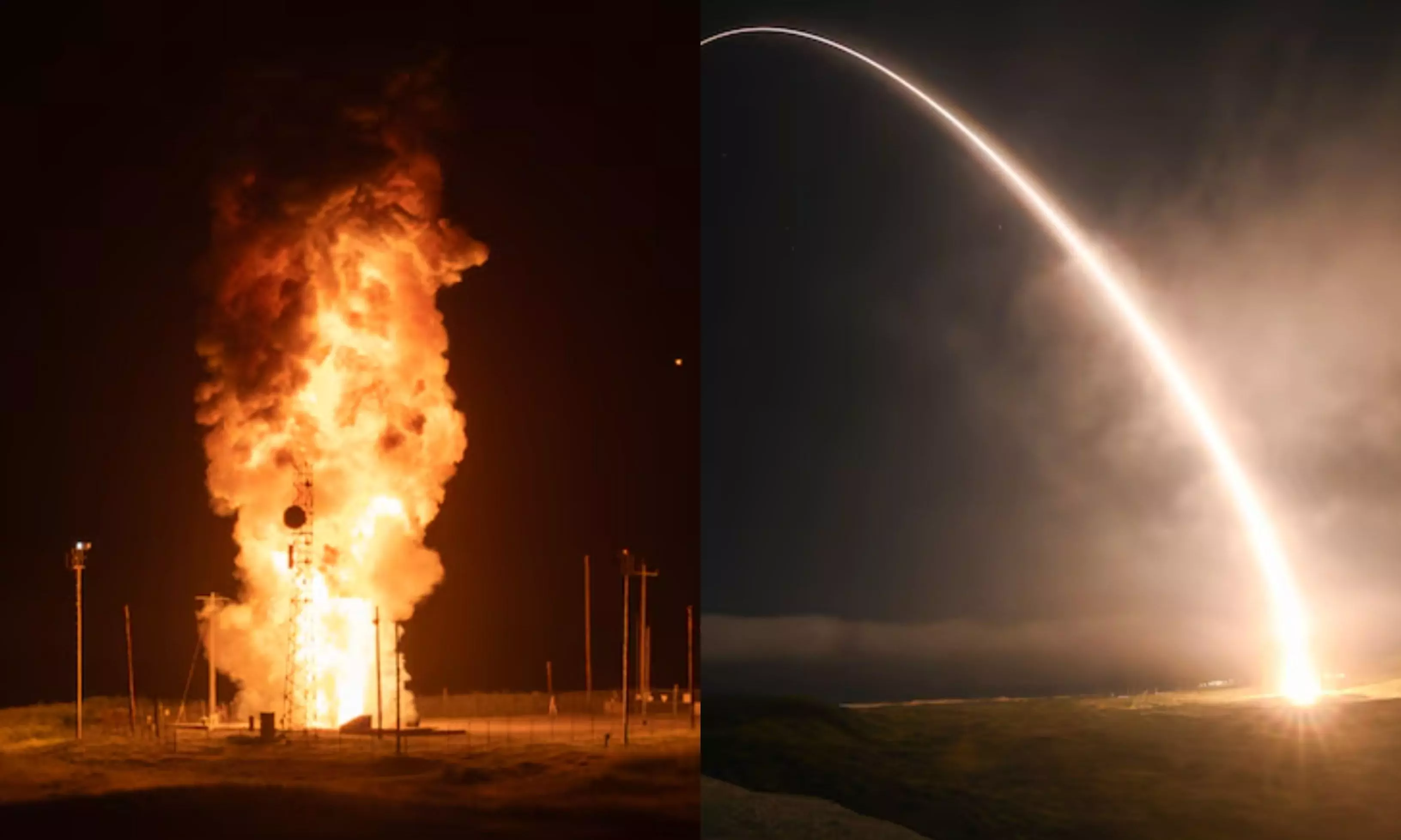
An unarmed Minuteman III intercontinental ballistic missile test on March 3, 2026, at Vandenberg Space Force Base. Photo: United States Space Force
What is the ‘doomsday missile’ that US tested amid Iran war escalation?
While Washington maintains the Minuteman III launch was a routine evaluation scheduled years ago, the timing signals a potent nuclear deterrent to Tehran

In the intervening night of Tuesday (March 3) and Wednesday (March 4), the US launched an unarmed Minuteman III intercontinental ballistic missile from its Vandenberg Space Force Base in California. The test, designated GT 254, carried two re-entry vehicles that travelled thousands of miles before landing at a predetermined target at the Kwajalein Atoll in the Marshall Islands.
Follow Live updates on the Iran war here
According to the Air Force Global Strike Command in an official statement, the launch was "not in response to world events" and is instead "a key component of a data-driven program that has been in place for decades, involving over 300 similar tests designed to validate the performance of the weapon system. The data collected from these routine tests is essential for ongoing and future force development".
"This test is routine & was scheduled years in advance," the command said in a post on X where it confirmed the lethal weapon's test on February 28, the day the US began joint air operations with Israel to obliterate Iran.
Why now? Eyes turn to Iran
The US Space Force said the test formed part of a "long-running, data-driven evaluation programme that has included more than 300 similar launches over several decades to verify the reliability, accuracy and readiness of the land-based nuclear deterrent".
Also Read: Explained | What is IRIS Dena and how the US-Iran conflict reached the Indian Ocean
Despite official assurances, the timing has not gone unnoticed. The test comes as the US finds itself in an active and escalating military conflict with Iran, making the launch difficult to dismiss as purely procedural.
A missile that ends worlds
The Minuteman III earns its grim nickname for good reason. With a range exceeding 13,000 kilometres, it can reach virtually any point on the globe. It is the United States' only non-mobile, silo-based, land-based nuclear-capable ballistic missile and one of the most destructive weapons ever built.
Most strikingly, the missile is capable of carrying nuclear warheads up to 20 times more powerful than the atomic bomb dropped on Hiroshima, Japan, in 1945, a weapon that killed an estimated 1,40,000 people. The scale of destruction the Minuteman III could unleash, by comparison, is almost incomprehensible.
Unlike earlier systems, the missile runs on solid fuel, allowing it to remain on constant high alert and be launched from underground silos within minutes of receiving an order. It can also deploy multiple independently targetable re-entry vehicles, or MIRVs, enabling a single missile to strike several targets simultaneously--though under current nuclear reduction treaties with Russia, each missile carries only one warhead.
Once fired at scale, the resulting radiation fallout could render large parts of the Earth uninhabitable, which is why it carries the "doomsday" label.
What’s special about the 'doomsday' missile?
What makes this particular test notable is its focus on multiple re-entry vehicles, essentially, the ability of a single missile to release several warheads mid-flight, each guided to a different target.
As General S L Davis, commander of the Air Force Global Strike Command, was quoted as saying on the official website of the US Air Force, "It is critical to test all aspects of our ICBM force, including our ability to deliver multiple, independently targeted payloads with absolute precision. This test validates the intricate synchronization of the weapon system, from the initial launch sequence to the flawless deployment of each reentry vehicle."
In simpler terms: one missile, multiple cities.
The Minuteman III’s goal, as Davis put it, is to ensure America's long-range strike capability is "not just a theoretical concept, but a proven, reliable, and lethal force, ready to defend the nation at a moment's notice."
War widens, no sight of end yet
The broader conflict shows little sign of slowing. The war in the Middle East broke out after American and Israeli forces launched strikes on Iranian targets, killing Supreme Leader Ayatollah Ali Khamenei. In retaliation, Tehran fired missiles aiming Israel and American military bases across Gulf nations that harbour them.
Also Read: Stock markets rebound in early trade tracking rally in global peers
The conflict has since spread geographically. An American submarine sank the Iranian warship IRIS Dena near the coast of Sri Lanka, killing at least 80 people. The vessel had been on a friendly port visit to India when it was targeted, marking the first time since the Second World War (1939-45) that a US submarine attacked a surface vessel.
Back in Washington, a Senate resolution seeking to halt the air campaign against Iran and require explicit congressional authorisation for further military action was voted down 53-47, largely along party lines, effectively leaving President Donald Trump's war powers intact as the conflict continues to widen across the Middle East.