Integrated Rocket Force: India’s missing piece in conventional deterrence
As global warfare shifts toward long-range precision strikes, India moves to bridge the gap with a dedicated missile arm distinct from its nuclear command

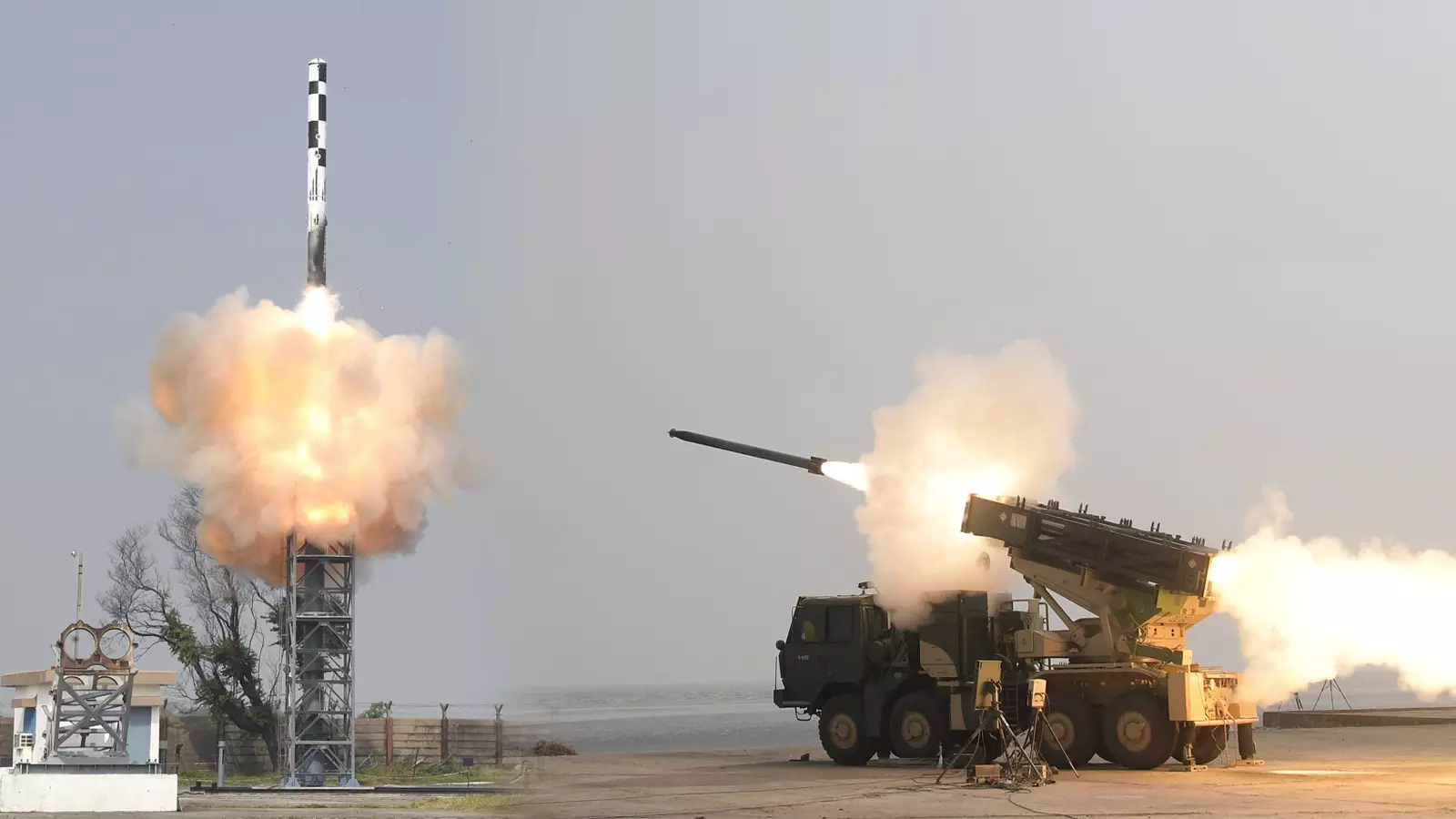
Test-firing of BrahMos missile (left) and the Pinaka multiple launch artillery systems. They give the Indian Army's firepower a much-needed boost.
India needs to get cracking on setting up a dedicated Integrated Rocket Force (IRF) with a mix of advanced conventional (non-nuclear) cruise and ballistic missiles, along with long-range guided rocket systems, for precision strikes deep into enemy territory.
Also read: Iran war tests India’s strategic autonomy as it walks a diplomatic tightrope
The sheer operational necessity for an IRF, with adequate stockpiles for long-drawn conflicts, has repeatedly been driven home by recent conflicts around the globe, including the Russia-Ukraine and US-Israel-versus-Iran wars. In these clashes, adversaries have fired multiple waves of conventional missiles as a primary tool of warfare.
Long-range missiles evolve as a key weapon
Nuclear weapons will, of course, remain the ultimate deterrent. But, with hugely expensive manned fighter jets increasingly becoming vulnerable to advanced air defence systems as well as next-generation air-to-air missiles, long-range missiles have emerged as the most viable instrument for achieving conventional deterrence and waging war below the nuclear threshold.
India needs to boost its rocket power
♦ India must urgently establish a dedicated IRF for conventional (non-nuclear) precision strikes, as modern conflicts show missiles are now primary tools of warfare.
♦ With fighter jets becoming vulnerable to advanced air defence systems, long-range cruise and ballistic missiles have emerged as more effective instruments.
♦ China’s People’s Liberation Army Rocket Force and Pakistan’s new Army Rocket Force Command highlight how adversaries are rapidly expanding missile capabilities.
♦ The IRF should combine systems like BrahMos missile, Pralay missile, indigenous long-range cruise missiles, and upgraded Pinaka rocket system.
♦ India must accelerate hypersonic missile development and mass-produce conventional missiles in large numbers.
China, Pakistan already made moves
China has a huge arsenal of mobile land-based ballistic, cruise and hypersonic missiles, both nuclear and conventional, under its People’s Liberation Army Rocket Force (PLARF), which, with over 40 brigades, is the distinct fourth arm of its military.
Following the four-day cross-border hostilities with India under Operation Sindoor in May last year, Pakistan also announced the formation of a new Army Rocket Force Command (ARFC) that would “have modern technology and capability to strike the enemy from every direction” in conventional warfare.
Also read: A crumbling Iran could turn out more dangerous
In contrast, India's discussions and plans for the IRF remain relatively nascent. Concrete steps are urgently needed both in force restructuring and mass production of conventional missiles, along with a surge capacity to produce such munitions in the thousands.
Structural and technical requirements
The proposed IRF must remain distinct from the unified tri-service Strategic Forces Command (SFC), which was set up to handle the country’s nuclear arsenal in 2003. It includes the Agni and Prithvi series of nuclear-capable ballistic missiles, fighter planes jury-rigged to deliver gravity bombs, and nuclear-powered submarines armed as yet with only short-range nuclear-tipped missiles.
The test-firing of an Indigenous Technology Cruise Missile, which has a subsonic 0.8 Mach speed and a strike range of 1,000 km.
While the SFC focuses on strategic deterrence, the IRF’s thrust should be on high-intensity conventional operations. India must fast-track the development, production and induction of several types of conventional missiles, along with long-range armed drones or loitering munitions, as well as a more robust multi-layered air defence network.
Such a force will require a balance of cheaper "dumb" long-range vectors for saturation attacks as well as the expensive "smart" ones for precision strikes.
The new 800-kilometre (km) range BrahMos supersonic cruise missile, which should be ready in another two to three years with a modified ramjet engine and other upgrades, will of course, be one of the cornerstones of the IRF.
The existing 450-km BrahMos, whose range has been enhanced from the original 290 km, is already the prime conventional precision-strike weapon for the Indian armed forces, with the Army, Air Force and Navy inking separate deals collectively worth around Rs 60,000 crore for them over the last two decades.
The air-breathing missile, which flies at almost three times the speed of sound at Mach 2.8 with a propulsion of Russian origin, however, is very expensive.
Also read: Defence ministry inks Rs 5,083 crore deals for 6 ALH helicopters, Shtil missiles
This is where the more affordable alternative in the shape of the Indigenous Technology Cruise Missile (ITCM), with a subsonic 0.8 Mach speed and a strike range of 1,000 km, will fit into the IRF. These Long Range Land Attack Cruise Missiles (LRLACMs), being developed by the Defence Research and Development Organisation (DRDO), which also include a submarine-launched version, must be produced and inducted in significantly higher numbers.
While jet-propelled cruise missiles fly at low altitudes within the earth’s atmosphere, virtually hugging the terrain to evade enemy radars, the rocket-powered ballistic missiles have a parabolic trajectory, leaving the atmosphere and then descending frequently at hypersonic speeds to hit targets.
The IRF will also need the induction of ballistic missiles in large numbers. The Pralay missile, with a 400 to 500-km strike range, has a quasi-ballistic trajectory with a capability to change its path mid-air to defeat missile defence systems, and is already on its way.
However, the orders for Pralay, which can hit targets with different types of 500 to 1,000-kg high-explosive warheads, number only a few hundred as of now. With time, the range and lethality of Pralay will also need to be greatly enhanced.
Also read: West Asia conflict may have prolonged impact, warns PM Modi, urges preparedness
Its induction also means that India will no longer restrict ballistic missiles to only nuclear-capable ones, as has been the policy till now. Both China and Pakistan, incidentally, have both conventional and nuclear ballistic missiles in their arsenals.
India’s conventional missile arsenal will get a greater punch when the next-generation BM-04 ballistic missile, being developed with a 1,500-km strike range, is ready for induction. This two-stage, solid-fuelled missile, with a 500- kg conventional warhead, is designed for counter-force operations against enemy missile silos, airfields, command and control centres.
The hypersonic frontier
India will also need to step on the gas in the arena of hypersonic weapons, which combine the speed of ballistic missiles in excess of Mach 5 with the manoeuvring capability of cruise missiles to evade enemy missile defence systems. Such weapons have been a major thrust area for countries such as China, the US and Russia.
In November 2024, the DRDO conducted the first test of a hypersonic missile, powered by an air-breathing engine or “scramjet” during its entire flight, with a range of over 1,500 km. But it will require several more tests before it is ready for production and deployment. Towards this end, the so-called Project Vishnu for hypersonic missiles must be accelerated to move from experimental flights to active deployment.
Also read: How Iran has cemented its place in the world of science and technology
If the range of the indigenous Pinaka multiple launch artillery systems, which currently fire multi-calibre rockets with a variety of warheads to distances of 75 to 120 km, is enhanced to over 300-450 km, then they can also be included into the IRF.
Modern warfare is increasingly defined by long-range precision-strike vectors. While the creation of the IRF, with adequate reserves, will require significant capital investments, the strategic calculus is simple: deterrence is always much cheaper than actual war.