CEA, Economic Survey ignore own data to claim states are fiscally irresponsible
Economic Survey 2025-26 demonstrates that states are far more fiscally prudent than the Centre in managing fiscal and revenue deficits and pushing capex

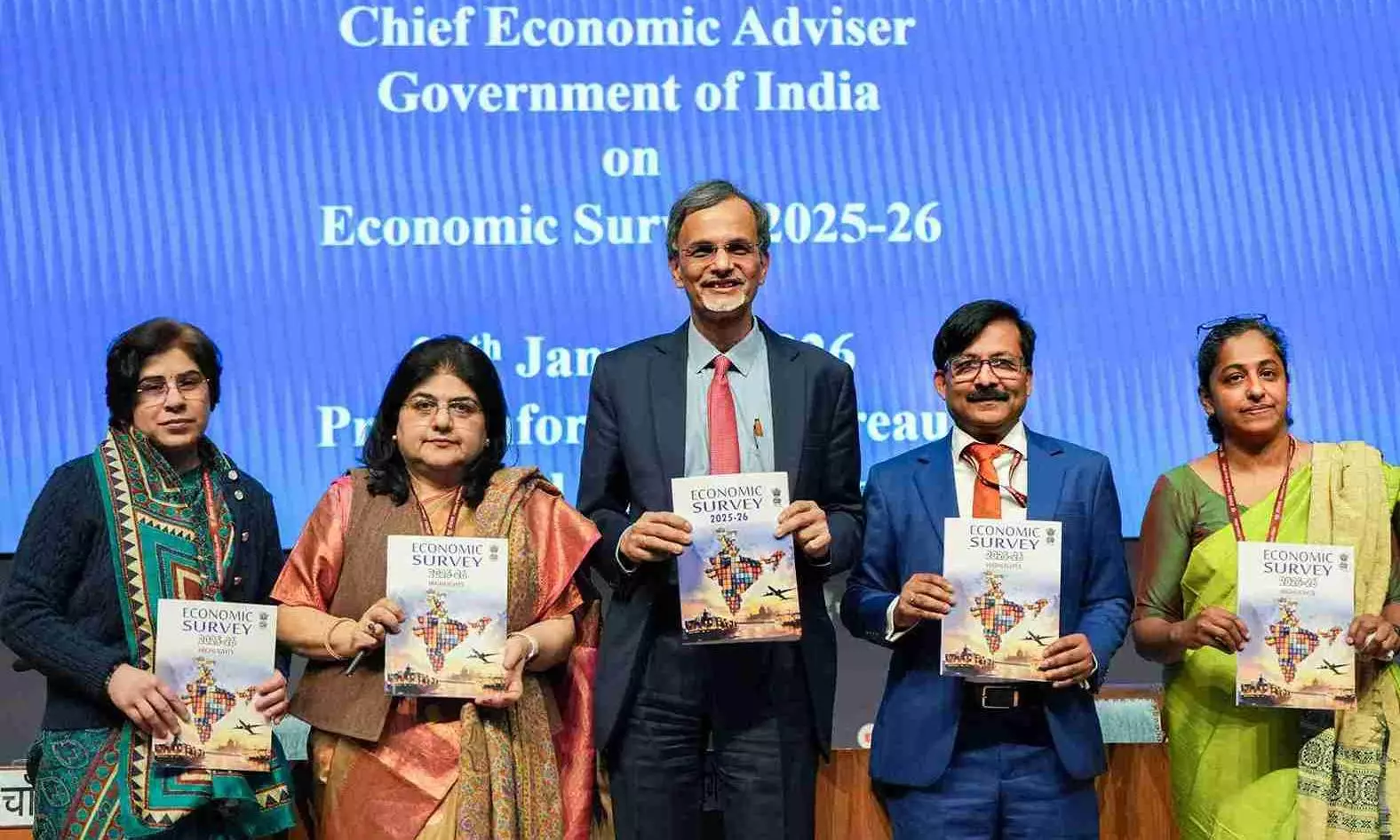
Chief Economic Advisor (CEA) Anantha V Nageswaran on Thursday (January 29) singled out states for their “fiscal indiscipline”, which he said was hurting India’s long-term fiscal sustainability and growth and also “lately casting a shadow” on sovereign borrowings. He particularly flagged states’ unconditional cash transfers in this context.
He further said states’ capex would have been much lower had the Centre not incentivized it. He was briefing the media after his Economic Survey of 2025-26 was tabled in the Parliament.
His Economic Survey of 2025-26 devotes considerable space on the subject, expressing “concerns over fiscal populism, the crowding out of capital expenditure by cash transfers, and the rise of revenue deficits in states”. It made a comparison with the Centre’s fiscal management too, stating: “While the Centre has achieved consolidation alongside record public investment, rising revenue deficits and unconditional cash transfers in several States pose emerging risks by crowding out growth-enhancing spending.”
Also read: Indian economy to grow 7.4 per cent in FY26 as inflation eases, says CEA
It also pointed out that since Indian government bonds were now globally indexed and investors increasingly assessing general-government finances, “States’ fiscal priorities, perhaps, are casting a shadow on the sovereign’s borrowing cost, as investors focus on the fiscal parameters of the general government rather than just those of the Union government. More importantly, the economic costs of the insidious impact that unconditional fiscal transfers have on the incentives.”
These remarks are debatable. The remarks in the chapter “Fiscal Developments” are contrary to the statistical appendix attached to the very Economic Survey of 2025-26. Here is what the statistical appendix says about the relative fiscal performance of Centre and states on all these parameters – capex and fiscal and revenue deficits.
States are fiscally far more responsible than Centre
The following graph maps the capex of Centre and states presented by the Statistical Appendix in percentage of GDP from FY18 to FY25 (P).
As it is obvious, states’ capex has been far higher than the Centre’s. In fact, the ratio is 61:39 in favour of states.
Besides, this is a long-term trend. Economic Surveys have been providing similar data for a few decades.
The CEA asserts that states’ capex would have been lower had it not been for the Centre’s incentives – read “loans” to states for capex and reforms attached to states’ additional borrowing of 0.5 per cent of GSDP, over the 3 per cent of GSDP limit that the FRBM Act of 2003 prescribes. This, again, is debatable.
The Centre started giving states loans under the “Scheme for Special Assistance to States for Capital Investment” was started from FY23 – after the GST Compensation to states ceased.
Reforms-linked borrowing over the FRBM limit of 3 per cent of GSDP was started a year earlier in FY22 in line with the 15th Finance Commission recommendation.
Also read: Economic Survey projects 6.8-7.2 pc growth for India in FY27
But the Economic Survey 2025-26 data shows that even before the Centre made these moves, the capex towered over the Centre’s during FY18-FY21. The ratio was 67:33 in favour of states.
Another metric to measure capex is in percentage of total budget expenditure (totex).
In this case, the Centre scores. The June 2024 report of FinMin think tank National Institute of Public Finance and Policy (NIPFP) showed the Centre’s capex as a percentage of total expenditure averaged 17 per cent during FY20-FY25 (BE) compared to 14 per cent for states.
But here is a catch. The Centre’s expenditure on development activities is very limited compared to states and confined only to central schemes.
States outperform Centre in deficits
Both the CEA and his Economic Survey of 2025-26 appear to be wrong on the fiscal and revenue deficit fronts.
The same Statistical Appendix shows that the Centre’s fiscal deficits average 5.2 per cent of GDP during FY18-FY26 (BE). In comparison, states’ fiscal deficits averages 3 per cent.
The similarity continues in revenue deficits too. The data shows that the Centre’s revenue deficits during FY18-FY26 (BE) averages 3.3 per cent of GDP, while those of states average 0.5 per cent.
So, one wonders how the CEA and his colleagues who wrote the Economic Survey of 2025-26 did not come to the conclusion that states are far more fiscally responsible and disciplined for years than the Centre.
Systemic targeting of states?
It was the Reserve Bank of India (RBI) that broke its tradition and produced an essay on states’ finances in its June 2022 bulletin, warning states of a Sri Lanka-like fiscal crisis. It accused states of indulging in “off-budget” borrowing, “non-merit freebies” leading to “rising subsidy burden” and debt to “4.5% of the GDP” on the basis of a selective reading of states’ budgets.
This RBI bulletin sparked the “revdi” and “revdi culture” campaign, led by the Prime Minister in subsequent months, which was followed by by the Supreme Court.
Also read: Did Budget 2025 keep its promises? Here is a progress report
A couple of months later, in August 2022, the NIPFP exposed the RBI’s misleading study. It studied the budgets of 18 major states and painted a completely contradictory picture – just like the Economic Survey of 2025-26 data do.
This forced the RBI to correct itself with another report on the same subject in January 2023 (State Finance: A Study of Budgets of 2022-23). It lavished praise on states for their fiscal prudence and responsibility, reversing every single charge of fiscal mismanagement – without admitting to the earlier faux pas.
Nonetheless, selective targeting of states’ fiscal management continues.
Shortchanging states in resource devolution
The Centre is accused of shortchanging states in transferring their tax shares as per the 14th and 15th Finance Commission awards (42 and 41 per cent, respectively, of gross tax) and also in the total transfers of the Centre’s gross revenue (tax, non-tax and capital accounts) that is partly guided by the 15th Finance Commission grants and central schemes.
The following graph maps the extent of this shortchange.
Notice, the tax devolution is far below the Finance Commission awards. As for total transfers, it is well below the Finance Commission awards, while the 14th Finance Commission had recorded that it used to be 50 per cent of the Centre’s gross revenue.
Finally, to answer why the “revdi” debate fizzled out.
Also read: How Budget 2026-27 can revive consumption for inclusive growth
It was actually pioneered by the Centre when it announced unconditional cash handouts of Rs 6,000 per annum (in three instalments) to farmers under the PM-KISAN scheme announced in the vote-on-account budget of 2019 – just ahead of the 2019 general elections.
It violated two long-held conventions: One, policy decisions are not made in vote-on-account budgets and two, policy decisions don’t come with retrospective effect, as this one did (from December 2018) to ensure all farmers get the first instalment in their bank accounts just ahead of the announcement of election schedule.