



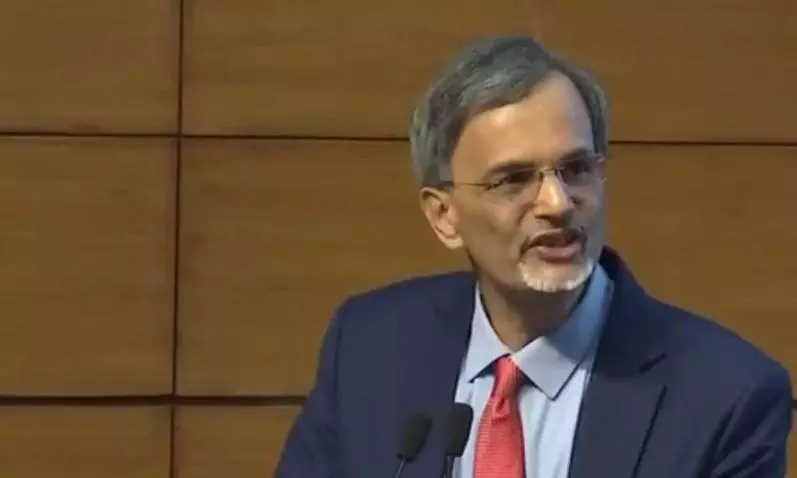
The CEA further stated that the Real GDP Growth has gone up from an average of 6.4 per cent during FY12-FY20 to 6.5 per cent in FY25. Screengrab: ANI
Indian economy to grow 7.4 per cent in FY26 as inflation eases, says CEA
Anantha Nageswaran uses Economic Survey data to say GDP growth is getting a boost from strong domestic fundamentals, including consumption and investment

Chief Economic Advisor(CEA), V Anantha Nageswaran, on Thursday (January 29) said that the growth momentum of the Indian economy has gained strength, adding that there has also been a significant decrease in inflation as data shows strong domestic demand drivers along with a clear easing of price pressures through FY26.
He made the remarks while giving a detailed presentation on the economic survey.
'Real GDP growth increased'
The CEA further stated that the real GDP growth has gone up from an average of 6.4 per cent during FY12-FY20 to 6.5 per cent in FY25, adding that it is projected to increase further to 7.4 per cent in FY26.
"If you look at the last few years in comparison to pre-COVID average, real GDP growth pre-COVID was 6.4% and in FY 25 was 6.5 per cent and this year it is predicted to be 7.4 per cent," he added as quoted by ANI.
Also Read: Economic Survey projects 6.8-7.2 pc growth for India in FY27
The CEA stated that the growth is getting a boost from strong domestic fundamentals, including consumption and investment.
"Private consumption expenditure (PFCE) growth remains resilient, increasing from 6.8 per cent in FY12-FY20 to 7.2 per cent in FY25, before moderating slightly to 7.0 per cent in FY26. Meanwhile, investment activity has picked up sharply, with real Gross Fixed Capital Formation (GFCF) growth rising from 6.3% in FY12-FY20 to 7.1 per cent in FY25, and further to 7.8 per cent in FY26, underscoring sustained capital formation," he added as quoted by ANI.
'CPI inflation gone down'
As for inflation, the CEA pointed out that price pressures have significantly decreased, adding that headline CPI inflation has come down from 6.7 per cent in FY23 to 5.4 per cent in FY24, easing further to 4.7 per cent in FY25, and dropping to 1.7 per cent in FY26 (up to December).
Also Read: Will Modi's electoral juggernaut steer the direction of Budget 2026-27?
He further stated that core inflation (excluding gold and silver) also moderated, coming down from 6.1 per cent in FY23 to 3.0 per cent in FY25, before edging up to 2.9 per cent in FY26 (up to December).
'Steady narrowing of the fiscal deficit'
The CEA also pointed to a steady narrowing of the fiscal deficit as a share of GDP over recent years, indicating a sustained effort at consolidation. He said the deficit, which had touched 9.2 per cent in FY21, eased to 6.7 per cent in FY22, followed by 6.5 per cent in FY23 and 5.5 per cent in FY24.
According to him, the fiscal deficit is estimated at 4.8 per cent in FY25 (RE) and has been budgeted to decline further to 4.4 per cent in FY26 (BE). The primary deficit, he added, has also continued on a downward path, pointing to better fiscal discipline.
Also Read: Budget 2026: Will Sitharaman boost defence post-Operation Sindoor?
“Revenue performance has strengthened, supported by sustained buoyancy and a broadening of the direct tax base. Gross tax revenue increased from an average of 10.8 per cent of GDP during FY16-FY20 to 11.5 per cent in the post-pandemic period (FY22-FY25). Personal income tax collections rose significantly from 2.4 per cent of GDP in the pre-pandemic years to 3.3 per cent of GDP post-pandemic,” the CEA said.
'Tax base expansion evident'
He further noted that the expansion of the tax base has been evident, with the number of income tax payers rising from 6.9 crore in FY22 to 9.2 crore in FY25, reflecting improved compliance and greater formalisation of the economy.
On the spending side, the CEA said the composition of government expenditure has seen a shift, with a sharper emphasis on capital outlay. Effective capital expenditure, he said, increased from 2.7 per cent of GDP in the pre-pandemic period to 3.9 per cent of GDP in the post-pandemic phase, underlining the government’s focus on growth-oriented spending.