



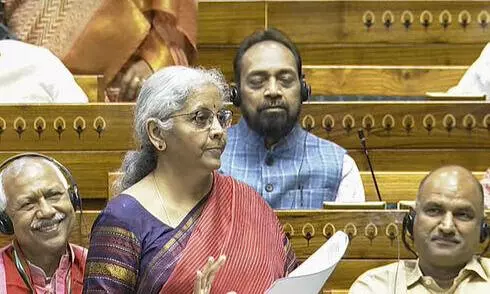
Economic Survey projects 6.8-7.2 pc growth for India in FY27
FM Sithraman tables Economic Survey, which projects strong growth backed by tax relief, manufacturing diversification, even as US tariffs strain global economy

India’s economy is projected to grow between 6.8% and 7.2% in FY27, backed by strong macroeconomic fundamentals and a series of regulatory reforms, according to the Economic Survey 2025-26. The projection reflects expectations of steady domestic demand and macroeconomic stability, even as global economic conditions remain uncertain.
Also Read: Budget 2026: Will Sitharaman boost defence post-Operation Sindoor?
Union Finance Minister Nirmala Sitharaman tabled the Economic Survey 2025-26 in both Houses of Parliament on Thursday (January 29), setting the tone for the Union Budget 2026. The survey outlines a strategic approach to navigating a global economic environment facing strain from a tougher US tariff regime.
Downside risks dominate outlook
The Economic Survey said the outlook for the global economy remains dim over the medium term, with downside risks continuing to dominate. It noted that global growth is likely to stay modest, keeping commodity prices broadly stable. The survey added that inflation has eased across major economies, which could allow monetary policies to turn more accommodative and supportive of growth going ahead.
In comparison, last year’s Economic Survey had projected growth for FY26 in the range of 6.3% to 6.8% and described the outlook as balanced.
Under the pre-Budget document, the govenrment highlighted certain risks to global economic growth. "If the AI boom fails to deliver the anticipated productivity gains, it could trigger a correction in overly optimistic asset valuations, with the potential for broader financial contagion," the govt said.
"Additionally, a protraction of trade conflicts would weigh on investment and further weaken the global growth outlook. These forces collectively suggest that downside risks to global growth remain prominent, although a fragile stability holds for now," it mentioned.
'Weaker rupee aids trade'
"A weaker exchange rate is beneficial for India's trade balance," the Economic Survey said.
"A one per cent appreciation of the Rupee results in net total trade declining by 1.26 per cent. If the rupee strengthens, the merchandise trade balance becomes more negative, with an elasticity of -1.45, indicating that merchandise trade is highly responsive to exchange rate movements. Conversely, if the Rupee weakens, the trade balance improves substantially," it said.
Also Read: Will Budget 2026-27 give new and old tax regimes a makeover?
"On a net basis, therefore, a weaker currency is good for India's merchandise trade balance," it said.
The rupee underperformed even as economic fundamentals remained strong. India’s goods trade deficit and reliance on foreign capital flows increased vulnerability.
Services exports and remittances provided support but were insufficient to fully offset pressures. Currency valuation failed to reflect macroeconomic strength. This disconnect caused investor hesitation despite favourable domestic conditions.
“The rupee’s valuation does not accurately reflect India’s stellar economic fundamentals…India depends on foreign capital flows to maintain a healthy balance of payments,” stated the survey.
Macroeconomic performance and growth outlook
The survey report stated that India maintained strong macroeconomic performance through 2025 despite global uncertainty. Economic growth strengthened quarter after quarter, supported by accommodative monetary policy and fiscal discipline.
Elaborating further, the surveystated that inflation remained under control, banks stayed healthy, and corporate balance sheets improved. Public investment and structural reforms reinforced momentum.
Growth expectations were revised upward, with the economy projected to sustain near-7 per cent expansion. This continuity marked one of India’s most resilient post-pandemic phases, stated the report.
“India’s strong macroeconomic performance, evident in the post-Covid period…Fast forward five months, and India is now anticipating a full-year real growth rate of over 7%,” it added.
Fiscal consolidation and reform measures
As per the report, the Centre exceeded its fiscal consolidation targets in FY25. The fiscal deficit was reduced below budgeted levels, reinforcing credibility. Major reforms were implemented across GST, labour laws, and key sectors such as insurance and nuclear power.
Also Read: Will Modi's electoral juggernaut steer the direction of Budget 2026-27?
It further stated that tax relief for households supported consumption without derailing consolidation. Credit rating upgrades reflected improved confidence in India’s fiscal trajectory.
“It achieved a fiscal deficit of 4.8 per cent of GDP, against the budgeted 4.9 per cent... S&P's upgrade of India from BBB- to BBB was India’s first credit rating upgrade from a major agency in nearly two decades,” it added.
Global uncertainty and risk scenarios
The survey outlines a fragile global environment marked by geopolitical rivalry and financial stress. Trade policy is increasingly shaped by security concerns rather than efficiency.
Three possible global scenarios are presented, ranging from managed fragility to systemic crisis. Financial markets are already pricing elevated risk. Even lower-probability shocks could have disproportionate consequences.