


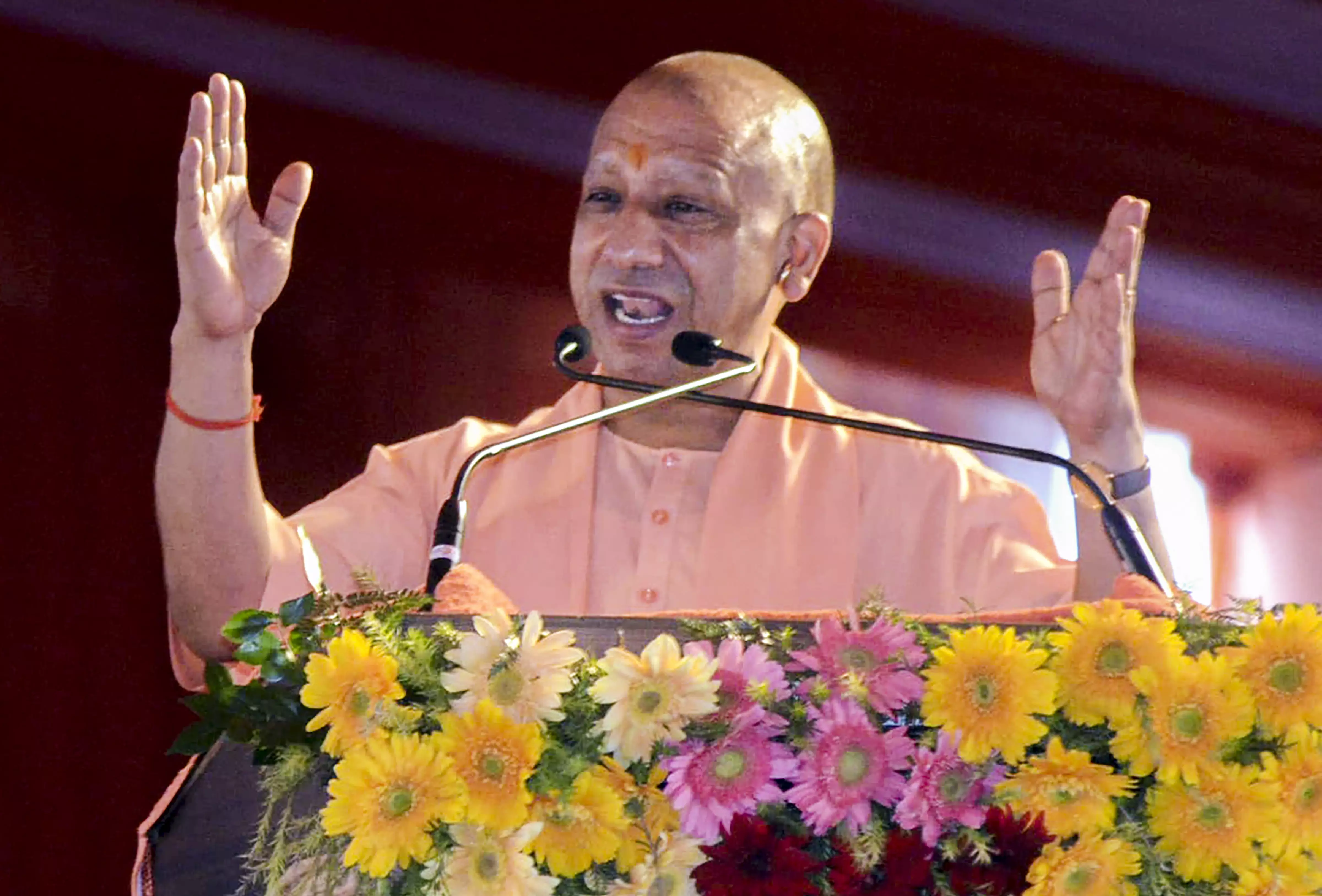
Why Yogi Adityanath is falling back on Hindutva and the 80-20 formula in UP
With development claims facing scrutiny, investment promises falling short and law-and-order concerns mounting, the BJP is returning to polarisation ahead of the 2027 polls

The reality on the ground appears to be catching up with the Yogi government's grand claims of development, economic growth and improved law and order in Uttar Pradesh. Perhaps that explains why Chief Minister Yogi Adityanath is increasingly falling back on his familiar playbook of identity politics, centred on the 80-20 divide between Hindu and Muslim voters in the state.
After months of chest-thumping claims of monumental development, historic investment deals and supposedly unparalleled security, CM Yogi appears to be retreating to the political terrain he knows best: electoral polarisation. That is how political observers interpret his latest political pitches.
Polarisation over performance
The shift is unmistakable in his recent speeches, in which CM Yogi has declared that the battle for power in Uttar Pradesh has once again boiled down to a direct contest along the 80-20 divide, an obvious reference to the Hindu-Muslim population ratio in the state. It is a familiar political refrain that CM Yogi has weaponised to accuse the Samajwadi Party (SP) of Muslim appeasement while positioning the BJP as the custodian of Hindu political and cultural interests.
Also read | 2027 UP polls: Who’ll call the shots in BJP? 209-name list row exposes Yogi-Shah friction
The formula helped the BJP wrest power from the Samajwadi Party in 2017 and secure a second consecutive term in 2022. But after nearly a decade in office, during which the BJP’s tenure has been punctuated by extravagant claims of unprecedented development, multi-million-dollar investment commitments, a transformed state economy and an iron-fisted crackdown on the mafia, its return to polarising rhetoric presents a curious dichotomy.
Speaking to The Federal, political analysts and senior journalists offered several explanations for the compulsions driving the Bharatiya Janata Party (BJP) to fall back on Hindutva polarisation.
They argue that the party may have drawn a lesson from the 2004 India Shining debacle, when the development plank alone proved woefully inadequate for the Atal Bihari Vajpayee-led BJP government to retain power. There is also an apparent recognition within the party of the limitations, contradictions and fault lines in its much-touted development and law-and-order model.
“If Vajpayee’s development model could collapse, then they (the Yogi government) do not have a development record credible enough to win them the next election. This time, they are facing intense pushback from voters, including their core supporters. So, they know that to win, they have to pull out their time-tested electoral weapon: polarisation,” veteran political analyst Sharat Pradhan told The Federal.
Cracks in the growth story
The growing anxieties of the CM Yogi-led BJP government over its touted development boom stem from the wide chasm between the advertised grandeur of its projects and their actual delivery on the ground. This gap has become increasingly evident, with several projects marred by uneven execution, questionable construction quality and the social costs of an often hurried urban makeover.
The temple town of Ayodhya, which lies at the heart of the BJP's UP model, offers a classic example. In June 2024, barely months after its makeover, parts of the 13-km Ram Path caved in following pre-monsoon showers. The Public Works Department (PWD) blamed the hurried construction. Similarly, the Ganga Expressway, hailed by Prime Minister Narendra Modi as a testament to UP's growth story, developed a 10-metre-deep crater barely four months after its inauguration.
“These recurring failures have raised questions about the development model that the government claims to have delivered. People have been releasing videos online to flag concerns over poor construction quality, road safety hazards, structural issues and other problems that have come to define these mega infrastructure projects,” pointed out veteran journalist Pramod Goswami.
The sweeping infrastructure overhaul has also come at a human cost. In Ayodhya, the widening of the Ram Path, Bhakti Path and Ram Janmabhoomi Path reportedly affected 4,000-4,500 shops and residential establishments, according to the city’s traders’ association. The Kashi Vishwanath Corridor, too, led to the loss of hundreds of homes and commercial properties.
The costs of corporatisation
Another aspect of this churn is the growing resentment over what experts describe as the corporatisation of spirituality.
“The sweeping infrastructure overhaul opened the floodgates for big companies to build lavish farmhouses and resorts. The real estate frenzy that followed has driven up property circle rates and made buying a home a distant dream for ordinary people. That’s why people have been protesting in Gorakhpur, Varanasi and other places,” pointed out political analyst Shashikant Pandey.
Also read | SP-Congress seat talks: Akhilesh’s 'add 1 to 180' quip is the start of a negotiation, not a rupture
The government has also faced questions over the choice of companies awarded these projects.
“Many companies did not have the capacity to execute big-ticket projects. Also, a large chunk of these projects were awarded to the Gujarat lobby, which has led to resentment among developers and business houses in the state,” pointed out another veteran political analyst, Anand Vardhan.
Investment claims meet reality
CM Yogi has repeatedly cited figures running into millions of dollars to assert his government’s success in attracting big-ticket investments to the state and transforming it into the country's ‘growth engine’. But the widening gap between announced commitments and operational projects tells a different story.
The government has claimed that over the past 10 years, it has attracted investments worth more than Rs 38 lakh crore across sectors. Fresh commitments have also continued to pour in, including nearly Rs 3 lakh crore in proposals through 31 MoUs signed at the World Economic Forum in Davos in January 2026.
The state government’s own Nivesh Sarathi portal, however, tells a different story. Against MoUs worth nearly Rs 38.7 lakh crore, projects involving investments of about Rs 3.75 lakh crore have commenced commercial operations. That is less than 10% of the claimed investments. Moreover, only a third of the committed investments have reached the ground-breaking stage.
“Much of these promises exist only on paper and, as such, are not legally binding. The government has used these figures to shore up public support. But after a decade of such paper promises, people are seeing through the façade created around UP's growing economy under the BJP government,” Pradhan added.
Muscular policing, uneasy realities
Yogi Adityanath’s claim that Uttar Pradesh has become a model of law and order rests heavily on projecting a tough-on-crime image through police encounters, bulldozer action and high-profile enforcement drives. But the records suggest otherwise.
The NCRB's 2024 data show that UP recorded the highest number of crimes against women in the country, at 66,396, and also reported 14,642 cases of atrocities against Scheduled Castes, the highest among states. More tellingly, its dowry death rate stood at 1.8, more than twice the national average of 0.8.
More recently, the Allahabad High Court flagged concerns over prolonged delays in completing investigations. It also accused the state police of “total lethargy and inaction”.
“In another order on November 3, the court termed the state of civil liberties in UP ‘shameful’, saying that violations of citizens’ fundamental rights appeared to have become routine for the police,” Pandey said.
Experts point out that between the much-touted muscular policing and the established rule of law lies an uncomfortable picture of the state’s law-and-order situation, which is perhaps making the government jittery about its electoral prospects in the upcoming elections.
“After 10 years, you have nobody left to pin the blame on. Perception management works, but only up to a point. The rising number of cases of atrocities against Dalits and women has become amply evident. That’s why the government seems uneasy about whether its law-and-order rhetoric will convince people to give it another term,” argued Goswami.
Polarisation as the last resort
The return to the 80-20 narrative, therefore, is not without reason. Nearly a decade in power has left the Yogi Adityanath government with a development story increasingly at odds with realities on the ground.
Investment figures look impressive on paper but have not translated into functioning factories. Besides, the state's law-and-order record sits uneasily with the claims of muscular governance.
“The discontent over infrastructure failures, displacement, unfulfilled investment promises and persistent crimes against women and Dalits has also made it harder for the BJP to rely on its governance pitch alone,” Pandey added.
Also read | Owaisi-Azad alliance puts Akhilesh Yadav in a tight spot ahead of 2027 UP polls
The party’s internal surveys and feedback from the RSS have also reportedly painted a rather gloomy picture of its electoral prospects in the upcoming elections.
The Samajwadi Party and Akhilesh Yadav, meanwhile, have been steadily expanding their PDA (Pichhda, Dalit, Alpsankhyak) coalition and making inroads into sections of the BJP’s traditional support base. The SP has also launched an offensive to tap into resentment over issues such as the UGC equity guidelines and the alleged theft of donations at the Ram Mandir in Ayodhya.
“The revival of the 80-20 formula, in this context, appears to be an attempt to move the electoral discourse away from questions of delivery and accountability and towards the familiar terrain of religious polarisation. The party hopes to consolidate its Hindu support base and counter the SP’s expanding social coalition,” Vardhan added.