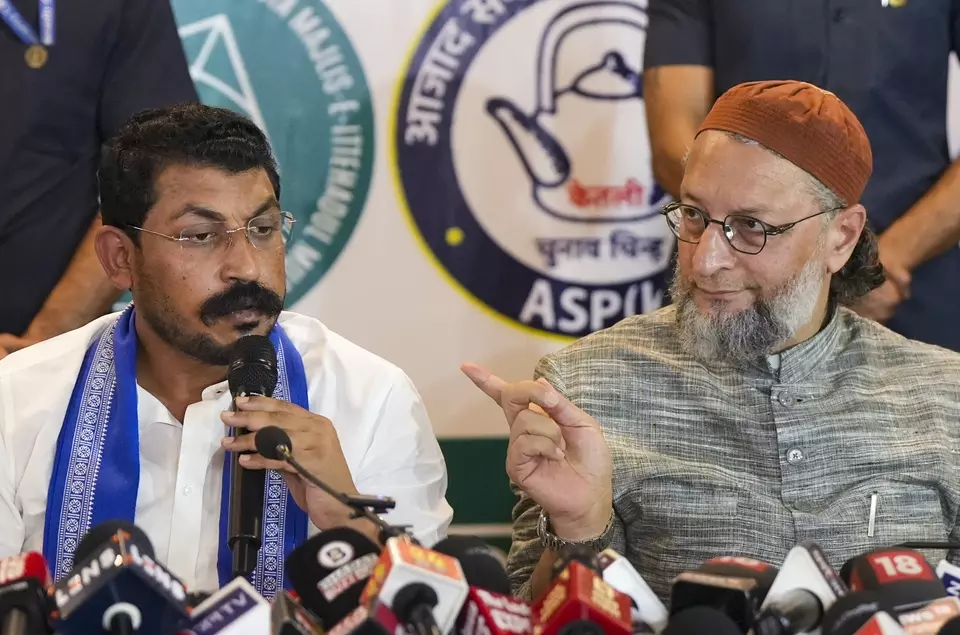
Bhim Army chief Chandrashekhar Azad and AIMIM chief Asaduddin Owaisi. Photo: PTI
Owaisi-Azad alliance puts Akhilesh Yadav in a tight spot ahead of 2027 UP polls
The new Samajik Parivartan Morcha threatens to splinter Dalit and Muslim votes, complicating the Samajwadi Party's balancing act against the BJP

The emerging Bheem-Meem axis of Bhim Army chief Chandrashekhar Azad and AIMIM chief Asaduddin Owaisi has placed the Samajwadi Party (SP) on the horns of a political dilemma. Ahead of the 2027 Uttar Pradesh Assembly elections, the party must not only stitch together an expansive coalition of Hindu votes to challenge the ruling Bharatiya Janata Party (BJP) but also fend off a direct challenge to its traditional Muslim constituency.
For SP chief Akhilesh Yadav, the fight is now on two fronts.
On the one hand, the BJP’s renewed bid to polarise the electorate along its familiar 80-20 Hindu-Muslim divide has complicated Yadav’s efforts to forge a broader Hindu coalition while shedding repeated charges of minority appeasement levelled by the saffron party. Equally pressing is the imperative to keep the SP’s traditional Muslim support base convinced that the party remains its most viable political representative in the state.
Tight space for Akhilesh
The November 12 announcement of the Owaisi-Azad-led Samajik Parivartan Morcha has made this tightrope walk considerably more precarious.
Speaking to The Federal, political analysts argued that regardless of the limited electoral reach of the Bheem-Meem axis, Yadav must now pursue his Hindu outreach without alienating Muslim voters, while simultaneously defending his flanks against a new contender for Dalit support.
“This experiment of courting Hindu votes without alienating its minority vote bank was always fraught with risks. And the Bheem-Meem axis has only made the fight tougher from hereon, especially with BJP’s resurgent Hindutva pitch,” said veteran political analyst Sharat Pradhan.
Also read: UP Assembly polls: SIR, SSR take centre stage as parties switch to election mode
Competing identity politics
At a joint press conference in Lucknow on November 12, Owaisi and Azad unveiled the Samajik Parivartan Morcha, ostensibly to prevent the ruling BJP from forming the government for a third consecutive term. The new front named Azad as its chief ministerial face and declared plans to contest all 403 Assembly seats.
The move followed months of efforts by Owaisi to convince Yadav and the Congress to induct the All India Majlis-e-Ittehadul Muslimeen (AIMIM) into their INDIA bloc alliance for the Assembly polls — overtures both parties snubbed.
Despite the front's stated aim of denting the BJP’s electoral calculations, political insiders say the alliance is far more likely to complicate Yadav’s efforts to expand his Pichhda, Dalit, and Alpsankhyak (PDA) social coalition.
“Owaisi is contesting the SP’s claim to be the default political representative of Muslim voters. In speeches, he has repeatedly launched a scathing attack on Akhilesh Yadav’s pro-Sanatan political posturing and accused the party of treating minorities only as voting blocs without offering increased representation,” pointed out veteran journalist Pramod Goswami.
SP's falling Muslim representation
Electoral data lends some weight to that argument. The SP’s share of Muslim candidates has steadily declined over the past decade. In Lok Sabha elections, the proportion dropped from 16 per cent in 2014 to 10 per cent in 2019; in 2024, only four of its 62 candidates were Muslim. Similarly, in Assembly polls, the share fell from roughly 20 per cent in 2012 to about 18 per cent in 2022.
Owaisi has sharpened his attack on Muslim representation by raising uncomfortable questions over Yadav’s muted response to the prolonged incarceration of senior SP leader and founding member Azam Khan.
Also read: How Azam Khan became the ultimate symbol of UP’s political realignment
Meanwhile, the BJP has fallen back on its established Hindutva playbook, with Chief Minister Yogi Adityanath reviving the 80-20 narrative to further complicate Yadav's task of balancing competing political aspirations among Hindu voters with the party’s traditional Muslim support base.
“The predicament arises from the challenge of navigating competing identity-based political pulls as Samajwadi Party chief Akhilesh Yadav seeks to reshape the SP's social coalition ahead of the 2027 Assembly elections,” argued senior political analyst Shashikant Pandey.
The Dalit factor
Allying with Azad gives Owaisi a Dalit partner and a potential organisational bridge beyond Muslim-concentrated constituencies.
While Azad’s broader political relevance remains debated, his appeal draws on Ambedkarite mobilisation and efforts to position himself as a Dalit voice among the youth, particularly in western Uttar Pradesh. His 2024 Lok Sabha victory from Nagina, where he secured 51.19 per cent of the vote, gave that politics an electoral foothold.
Nagina, however, cannot be treated as a template for the rest of the state. Experts point out that Azad has yet to achieve a breakthrough across Uttar Pradesh’s crowded Dalit political landscape.
“After the decline of Mayawati’s Bahujan Samaj Party (BSP), Dalit voters, mostly the non-Jatavs, have increasingly become a floating voting bloc being courted by different parties. Azad has not been able to make the most of that decline beyond Western UP. Much of this electorate has gravitated towards the BJP and the Samajwadi Party,” noted senior journalist Piyush Rai.
In the 2024 general elections, the SP’s alliance with the Congress helped Yadav expand his party's footprint among Dalit voters — gains the SP hopes to consolidate in 2027. Analysts suggest that while Azad may not pose a major threat outside western Uttar Pradesh, he retains the capacity to make contests significantly tighter.
Watch: Owaisi, Azad in alliance; will 'third front' take on Akhilesh and Yogi?
Swaying the outcome
The new front carries political weight less for its ability to win seats outright than for its potential to sway outcomes in closely contested constituencies. In the past two Assembly elections, Owaisi’s AIMIM contested 38 seats in 2017 and 95 in 2022, failing to win a single seat and polling less than 0.5 per cent of the total vote.
Likewise, the Azad Samaj Party (Kanshi Ram) contested 111 seats on its Assembly debut in 2022 but drew a blank, securing just 0.13 per cent of the vote. Azad himself contested against Adityanath in Gorakhpur Urban, polling 7,640 votes.
Yet, candidates from both outfits polled more votes than the eventual victory margins in several tightly fought seats, including Moradabad Nagar, Nakur, Sultanpur, and Ramnagar. Their relevance in 2027, therefore, lies in turning bipolar battles into triangular contests in pockets with wafer-thin margins.
“They (Azad and Owaisi) can, at best, make the fight a nail-biting cliffhanger in constituencies where the victory margin is smaller than the votes they poll. Such fragmentation could weaken the SP in at least 30 to 40 seats, potentially hurting the Opposition, as Assembly elections are tightly fought battles even when the contest is bipolar,” Goswami argued.
Also read: Akhilesh on alliance talk with Owaisi-Azad front: 'Will go ahead with existing partners'
Testing the PDA formula
The challenge for Yadav is not merely containing the electoral impact of the Bheem-Meem axis, but preserving the political coherence of his PDA formulation.
Observers believe Yadav cannot afford to tilt too far toward either side of his balancing act. An overt Hindu outreach aimed at widening the PDA base risks alienating sections of the Muslim electorate. Conversely, granting greater ticket representation to minorities risks handing the BJP fresh ammunition to revive its minority appeasement charges.
“The SP has to accommodate both the Yadavs and Muslims for its PDA to work where he wants to give more representation to non-Yadav OBCs and MBCs. He has been doing so by offering them some district level positions and other overtures,” Rai said.
Pandey believes the entry of the new front will force the SP to rethink Muslim representation to prevent triangular contests from undercutting its prospects.
“They are only spoilers who will try to complicate things for the SP. Akhilesh Yadav has to be more cautious in managing the disquiet within his party through more representation,” he argued.
PDA should be more than a slogan
Ultimately, the challenge for Akhilesh is to ensure that the PDA remains more than an electoral slogan and translates into a credible political alternative offering representation and a sense of political ownership to its constituent communities. The emergence of the Bheem-Meem axis has made that task considerably precarious.
Yadav must ensure that the PDA remains more than an electoral slogan, translating it into a credible political platform that offers genuine representation and ownership to its constituent communities — a task the Bheem-Meem axis has made significantly harder.
For Pradhan, the emergence of the front serves as a timely reality check for the SP leadership.
“He’s been too confident about Muslim votes and even Dalit votes which the party got because of Congress in the alliance. So, let this be a reminder for him to keep his ears to the ground before it shifts underneath his party’s feet,” Pradhan concluded.