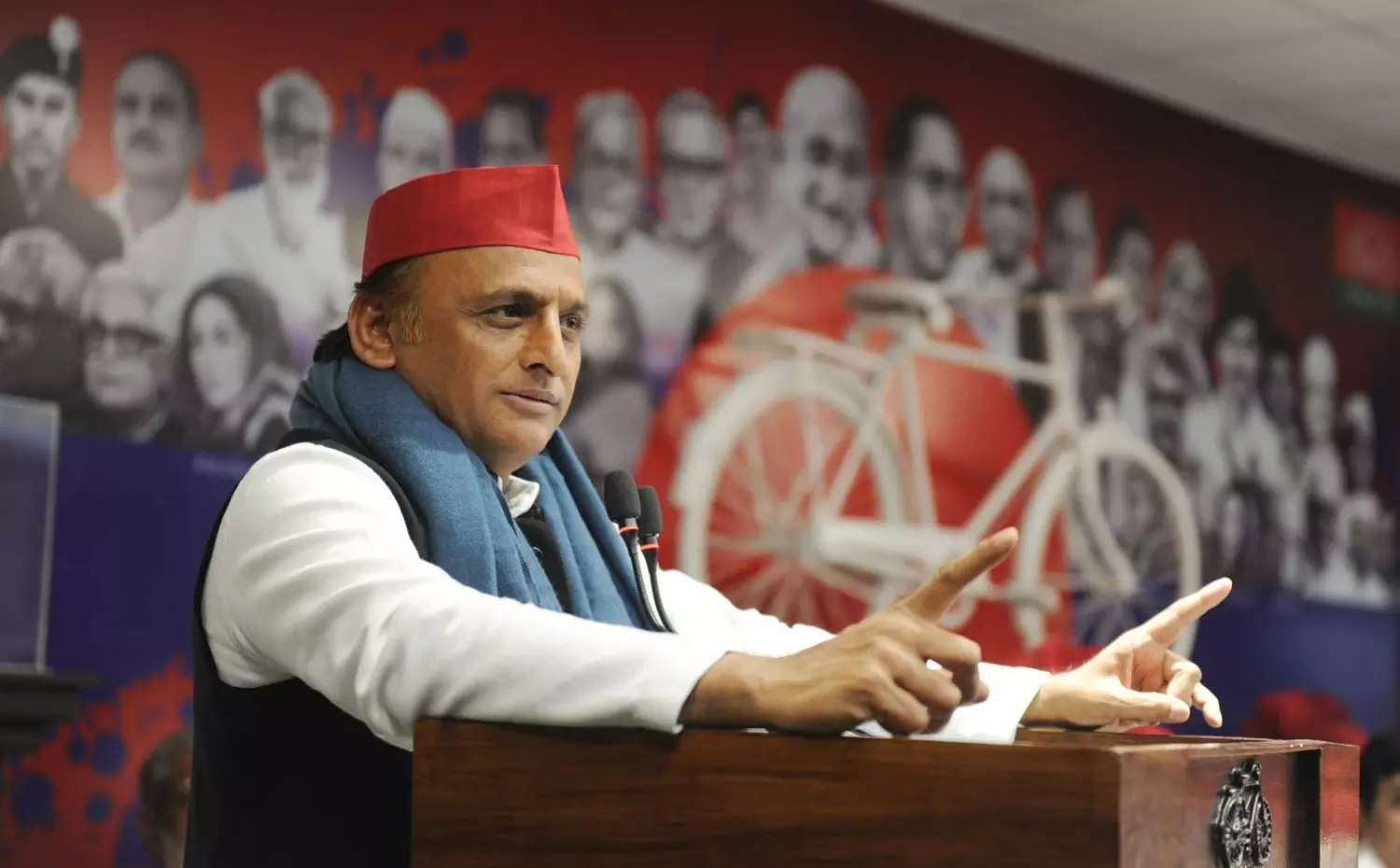
Will Nishads steer Akhilesh Yadav’s PDA boat to power in 2027 UP elections?
Akhilesh Yadav is courting Nishad voters to strengthen the SP’s PDA coalition and tap discontent over the BJP’s unfulfilled reservation promises ahead of the 2027 UP polls

Brahmins will show the way and the Kevats (a riverine community) will steer the Picchda, Dalit, Alpsankhayak (PDA) boat towards the shore where Uttar Pradesh’s Vidhan Sabha stands. This is the new political pitch the Samajwadi Party is making as the state inches closer to a high-stakes Assembly election next year.
The imagery is striking, drawing on episodes from the Ramayana in which a Kewat (boatman) helps Lord Rama cross the River Ganga. Beyond its apparent outreach to Brahmins, the poster carries a clear political message: Akhilesh Yadav is seeking to bring the Nishad community into the party’s PDA social coalition.
The poster is part of the Samajwadi Party’s concerted efforts to woo this electorally consequential community, from invoking its mythological roots to appointing Phoolan Devi’s sister, Rukmani Devi Nishad, as the chief of the party’s women’s wing.
Also read | In Akhilesh starting PDA yatra from Rahul’s Raebareli, a message to Congress?
For Akhilesh Yadav, this electoral arithmetic is perhaps more than an exercise in political expediency. It is a strategic imperative for a party seeking to wrest power from the ruling BJP, after nearly a decade out of office.
“The P in our PDA can be used interchangeably for both Picchda (backward classes) and Peedit (aggrieved) voters. Brahmins are pained by what we call chanda chori (theft of donations). Kevats are resentful because the BJP has failed to fulfil the promises it made to woo the community. This is why our PDA boat is gathering momentum, drawing more communities and people into its fold,” Samajwadi Party spokesperson Abbas Haider told The Federal.
Why Nishads matter in PDA
Nishads are a politically fragmented but electorally consequential social bloc comprising several riverine sub-castes, including Mallahs, Binds, Kewats, Kashyaps, Manjhis, Turhas and Bathams.
Social scientists and political observers say the community’s social and cultural history lends weight to its political standing, despite its modest share of the state’s electorate.
“From their mythological roots in the Ramayana, where Nishadraj Guha ferried Lord Rama across the River Ganga, to bandit-turned-politician Phoolan Devi, their social history spans a complex terrain of cultural pride and social marginalisation. Proponents of subaltern politics have also repeatedly invoked the story of Eklavya, the master archer who sacrificed his thumb to Dronacharya so that he would not outshine Arjuna, to curry favour with the community,” said Rama Shankar Singh, a Kanpur-based historian and author of Nadi Putr: Uttar Bharat mein Nishad aur Nadi.
This layered identity, however, has not translated into ideological allegiance to any one political formation.
Electorally, the community is significant, accounting for nearly a fifth of Uttar Pradesh’s OBC vote, or 5-6% of the state’s electorate.
“Their geographical concentration makes them influential in more than 60 seats, particularly in the Purvanchal belt around Gorakhpur and Varanasi,” said Harsh Sinha, a political commentator and professor at Deen Dayal Upadhyaya Gorakhpur University. “So, they become indispensable for any party trying to negotiate the tricky caste terrain of that belt,” Sinha added.
A floating electorate bloc
Despite their cultural significance and electoral weight, Nishads have not experienced the kind of caste-based political mobilisation seen among Jatavs or Yadavs. As a result, they have remained a floating electoral bloc, repeatedly courted with promises of representation and political concessions.
Since the Mandal-Kamandal churn, their allegiances have shifted between competing political narratives.
“If the BJP managed to swing the community through its Hindutva consolidation around the Ram Janmabhoomi movement by invoking Nishadraj Guha, Mulayam Singh Yadav wrested back that voter base by offering the iconic bandit Phoolan Devi the SP ticket from Mirzapur,” Singh said.
The EBC reservation question
Interestingly, Nishads are among the communities that became part of the electoral formula devised by Karpoori Thakur, Bihar’s first non-Congress socialist chief minister, which created a separate constituency of Extremely Backward Classes (EBCs).
“Nitish Kumar further consolidated that voter base by offering them over 20% reservation, and the community has stuck with him ever since,” Sinha said.
Uttar Pradesh attempted a similar exercise, but without comparable political consolidation.
“In 2001, when the NDA came to power and Rajnath Singh became chief minister, the BJP tried to replicate that formula. The Hukam Singh Committee, which was set up, recommended reservations for EBCs, including Nishads. But the proposal was stalled, leaving the community disenchanted,” Sinha added.
Also read | UP polls: Bargaining chip or overreach? Why Congress is asking for so many seats
The reservation question has since remained a recurring fault line in Nishad politics. Consequently, the community’s political loyalties have remained in flux, shifting from Mulayam Singh Yadav’s governments in 2003 and 2012 to Mayawati’s in 2007 and the BJP’s in 2022.
NISHAD Party's political bargain
After decades of shifting political allegiances, the Nirbal Indian Shoshit Hamara Apna Dal (NISHAD) Party emerged in 2016 as a political pressure group seeking to advance the community’s demands.
Its first major breakthrough came in the 2018 Gorakhpur Lok Sabha by-election, when its candidate, Praveen Nishad, backed by the SP-BSP alliance, defeated the BJP in a constituency long regarded as a saffron stronghold and associated with Chief Minister Yogi Adityanath.
“The victory was widely interpreted as a demonstration of the electoral potential of a consolidated Nishad vote working in conjunction with a broader opposition coalition,” said Lucknow-based political commentator Piyush Rai.
Yet the alliance proved short-lived. Ahead of the 2019 Lok Sabha elections, Sanjay Nishad joined the BJP camp. Praveen Nishad subsequently contested from Sant Kabir Nagar on a BJP ticket and won. The NISHAD Party went on to become a BJP ally in the 2022 Assembly elections, winning six of the 10 seats it contested and securing a cabinet berth for Sanjay Nishad, who was given charge of the fisheries department.
“The bargain was simple. Even though Nishads have had a longer association with the SP, the party wanted to be in power to expand its organisational base. That was the only way for it to fulfil the promises made to its voters,” said SR Dharapuri, a retired IPS officer and national president of the All India People’s Front.
But the bargain has yielded little on the ground. Promised reservations and fishing rights remain elusive, while a sizeable section of Nishad voters backed the SP in 2022 despite the NISHAD Party’s alliance with the BJP. This has raised questions about the party’s political relevance ahead of 2027.
“This is why they are issuing threats to the BJP and reminding it that they must either be given reservation or more seats,” Dharapuri added.
Akhilesh's gamble to win Nishad votes
Buoyed by its gains in the 2022 Assembly elections and encouraged by the community’s history of political non-conformity, the Samajwadi Party believes it has a good chance of winning over Nishad voters.
Political observers say Akhilesh Yadav’s strategy rests on two parallel planks: cultivating alternative leadership within the community and exploiting growing discontent over the BJP’s failure to fulfil its promise of reservation.
In March 2026, Akhilesh appointed Rukmani Devi Nishad, sister of former SP MP Phoolan Devi, as state president of the party’s women’s wing. He also appointed Lautan Ram Nishad, a prominent OBC activist and former head of the party’s backward classes cell, as its in-charge for the Gosainganj Assembly constituency in Ayodhya.
Also read | Ayodhya showdown? Yogi counters Akhilesh’s dare with a face-off challenge
On Thursday, the party inducted former BJP MP Dharmendra Kashyap, a prominent Kashyap leader from Bareilly, along with his daughter Kirti. Kashyap, who represented Aonla in the Lok Sabha in 2014 and 2019, has pledged to mobilise the fishing community behind the SP.
“The message is clear: Akhilesh Yadav is not limiting his outreach to the NISHAD Party. He is signalling that the SP can still swing a sizeable chunk of Nishad votes, with or without Sanjay Nishad and his party. At the same time, he has kept the door open for an alliance,” Singh added.
For Sinha, even without defections from the NISHAD Party, the SP can capitalise on growing discontent with the BJP and build an alternative leadership within the community. “Even if Akhilesh Yadav’s gamble helps him swing 50% of that vote, it would not only damage the BJP’s calculations but also hurt the future of the NISHAD Party,” Sinha said.