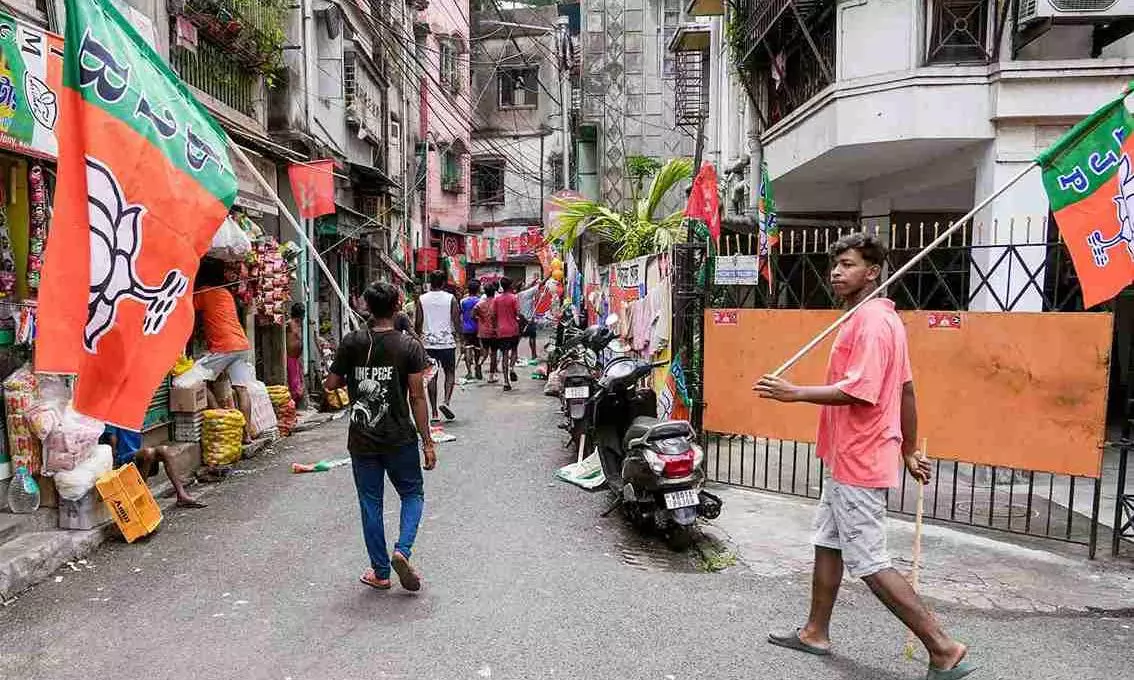
Will a BJP govt deliver what Bengal needs: Industry and employment?
The BJP has its job cut out in Bengal: Improve the state’s employment and migration scenario without depriving the people of their precious land—a mammoth task

The Opposition’s Bengal fortress has fallen. As expected, scattered reports of violence, arson, and vandalism are coming in, coupled with a sense of disquiet even two days after the election results were declared on May 4. As many rejoice over the fall of Mamata Banerjee’s “evil empire”, many others continue to be shocked at the saffron turnaround of a state they always believed to be liberal and secular in spirit.
While the BJP’s communal colour is the starkest, there is another major reason for many in Bengal to have voted for the right-wing party, which is purely economic in nature. For a state ruled by parties in the Opposition for half a century—a state now plagued by unemployment, or a lack of quality employment, and outmigration—the hope for an economic turnaround likely fuelled many a vote for the saffron party.
But how easy will it be for the BJP, or any political party for that matter, to turn things around in Bengal?
Migration and unemployment
According to the 2011 Census, West Bengal ranked fourth in India for employment-related outmigration, with nearly 5.8 lakh people leaving between 2001 and 2011. At the same time, around 2.2 lakh people migrated into Bengal from other states for employment, but the majority were unskilled labourers from Bihar and Jharkhand.
Also read: What explains Bengal’s saffron shift? 6 reasons why Mamata was decimated
Coming to employment figures, interestingly, West Bengal has the fifth lowest unemployment rate in India, trailing only Gujarat, Karnataka, Jharkhand, and Madhya Pradesh. However, youth unemployment (ages 15–29) remains a challenge, though it declined to 9.9 per cent in 2025 from 10.3 per cent the previous year.
Yet, experts note that while official unemployment is low, it often masks underemployment. Many workers are engaged in low-yielding agricultural or service roles with limited upward mobility. About 70 per cent of the workforce is concentrated in services and agriculture, while manufacturing accounts for roughly 18.8 per cent.
History of Bengal’s economic decline
Bengal’s economic decline has a long and complex history that started right after Independence. The Congress, which controlled both the Centre and the state until 1966, pursued policies that effectively downgraded Bengal from an industrial hub to a labour reserve.
As cited in an article in Observer Research Foundation, Bengal’s share of income-tax receipts was cut from 20 per cent to 12 per cent, while what was then Bombay and Madras saw increases. Refugee rehabilitation funds for Bengal were far smaller than those for West Pakistan migrants, despite Bengal’s heavier burden. Even though Bengal had more registered factories than Maharashtra and Gujarat combined, by the mid-1950s, Maharashtra received far more industrial licences than Bengal.
Also read: Bengal polls: Mamata’s refusal to resign sparks a constitutional crisis
As a result, Bengal’s share of India’s industrial output fell from 27 per cent in 1947 to 17 per cent by 1960-61. And now, it is a mere 3-5 per cent. Industrialists like BM Birla once openly blamed the Centre for stifling Bengal’s growth. This economic decline fueled political discontent, with the Left repeatedly accusing the Congress of depriving the state.
Tussle for land
However, Bengal’s troubles did not vanish with the Congress. Ajoy Mukherjee, the first non-Congress chief minister (Bangla Congress), resigned in 1967 citing the Left’s anti-industry stance, which he said had destroyed small and medium enterprises (MSMEs). The Left’s militant trade unionism in the 1960s and ’70s accelerated the flight of capital.
Later, under CPI(M) rule (1977–2011), attempts to attract investment were undermined by land acquisition challenges and entrenched anti-industry politics. Bengal’s high population density (second only to Bihar) makes it impossible to acquire land without resistance. Former Left chief minister Buddhadeb Bhattacharjee’s push for industrialisation, particularly in Singur and Nandigram, collapsed amid fierce resistance.
Mamata Banerjee’s rise was built on these land movements, and once in power, her Trinamool Congress declared it would never acquire land for industry. This cemented Bengal’s shift away from industrial growth. The state’s dense population, fragmented landholdings, and political hostility to big business make large-scale projects nearly impossible.
Also read: Bengal's Didi shield cracks: How Mamata Banerjee lost the state she dominated
The cumulative effect has been a long-term drain of resources and opportunities from Bengal even as the state ranks fifth in terms of central debt of Rs 7.1 lakh crore, thanks to a heavy dose of populist schemes.
BJP’s promises
Question is, can the BJP reverse this record without inviting another Singur- and Nandigram-like movement? And will having a “double-engine government” for the first time in 49 years change the state’s fortunes? Let’s explore what the saffron party promised in its manifesto for West Bengal.
Speaking of Singur, the BJP has promised an industrial park there besides establishing four major industrial zones. Its other promises include transforming Haldia into a leading national port hub, reviving traditional sectors such as jute (modernisation) and tea (rejuvenation) alongside strengthening the Darjeeling tea branding.
The party has also promised to implement a single-window clearance system to improve the “Ease of Doing Business”, and has hinted at changes to the state’s land policy to facilitate easier land procurement for industries. How well that goes down with the people when it actually comes to implementation remains to be seen.
Focus on fisheries
Another promise is to register all fishermen under the PM Matsya Sampada Yojana to develop Bengal as a leading fish-exporting hub. It is pertinent to say that West Bengal currently accounts for roughly 10 per cent of India’s total fish output and is the national leader in fish seed production.
Also read: Yogendra Yadav flags ‘curated’ elections in Bengal verdict | AI With Sanket
It produced about 23.75 lakh metric tonnes of fish in the 2024–25 financial year, making it the second-largest fish-producing state in India, and exported around 1.78 lakh tonnes of fish to other states and international markets. The fisheries sector supports nearly 32 lakh people in the state.
Another promise is a dedicated revival package and modernization plan for MSMEs to boost local entrepreneurship. The BJP has pledged to create 1 crore jobs and self-employment opportunities within five years, and promised a monthly financial assistance of Rs 3,000 for all unemployed youth plus a one-time assistance of Rs 15,000 for youth to prepare for competitive exams.
While the SSC scam became a major cause for anti-incumbency against the Mamata government, the BJP promised to fill all vacant state government posts through a transparent, merit-based drive by December 2026. Targeting women, Mamata’s biggest vote bank, the BJP has promised 33 per cent reservation for women in all state government jobs, including the police force.
Will BJP deliver?
When the people of Bengal voted Mamata to power in 2011, they genuinely hoped for “change” after 34 years of stagnation under Left rule. But over the past 15 years, any tangible change on the ground has eluded the state as Mamata essentially continued exactly where the Marxists left off—including a heavy dose of populist schemes even as brutal cadre-based control of resources continued. The saffron party has promised a crackdown on sand mafia and syndicate raj, two of the biggest evils of the previous governments. But the million-dollar question is whether it will deliver.
Also read: West Bengal election 2026: The many firsts emerging from early trends
The BJP has its job cut out in Bengal: Improve the state’s employment and migration scenario without depriving the people of their precious agricultural land. This will be a mammoth task even with genuine intent. While direct cash-transfer schemes will work for a while, in the long run, people will look for concrete change to reverse at least some of the damage done to the state since 1947.
However, if the focus remains solely on communal polarisation and cadre-based control like the past half a century, it may not be long before the people start looking for yet another change.