



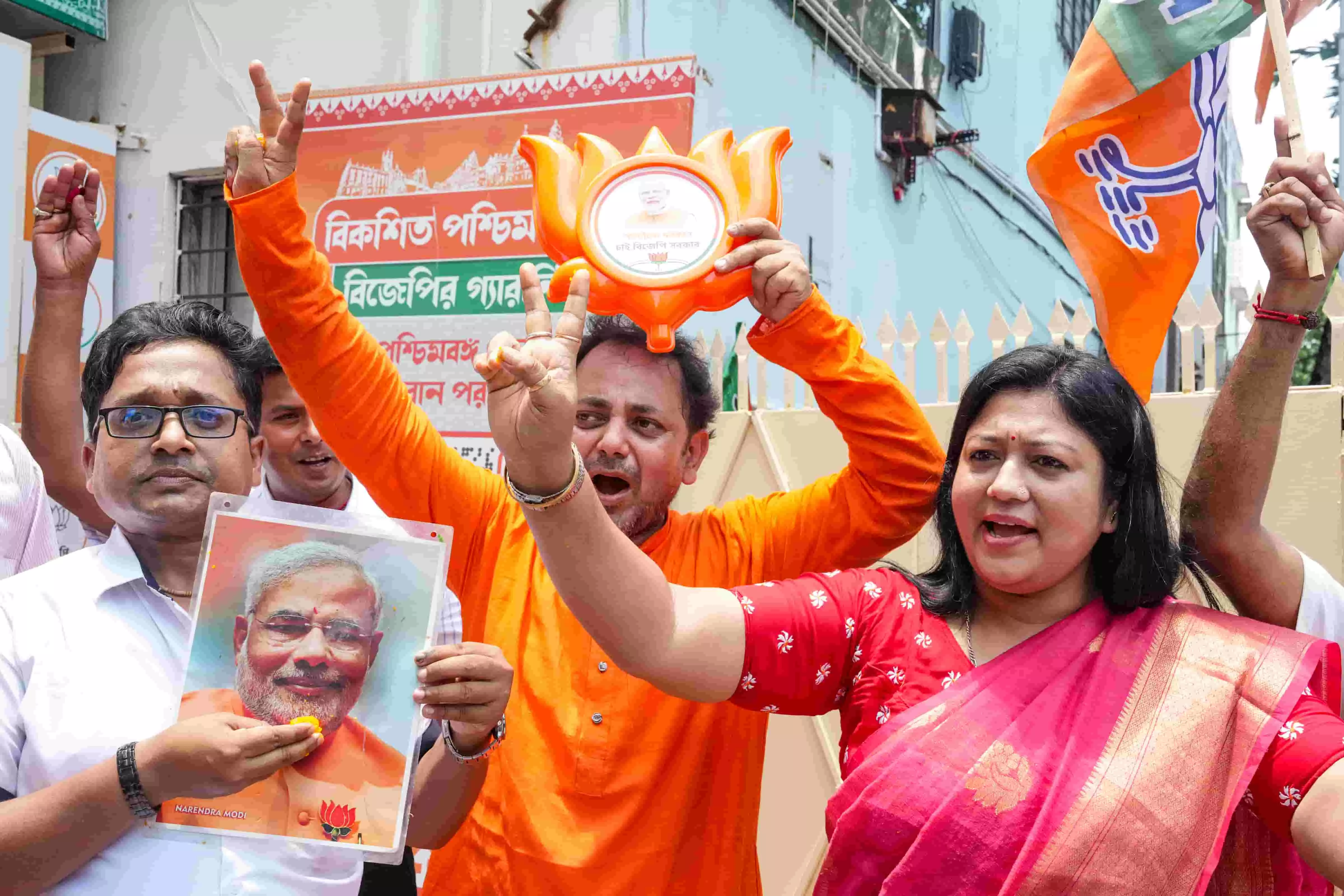
As per early trends, Mamata Banerjee’s party seems to be on a sticky wicket in its longtime bastion in South Bengal, including Kolkata. Photo: PTI
West Bengal election 2026: The many firsts emerging from early trends
Early West Bengal election trends indicate multiple political firsts, from shifting regional vote patterns to the possibility of a split mandate

As counting progresses in West Bengal with the early trends indicating that the Bharatiya Janata Party (BJP) might be able to breach its proverbial “final frontier” in the state which has been under Left rule for 34 years since 1977 and then under the firm grip of Mamata Banerjee led All India Trinamool Congress (TMC) for the last 15 years, the politically volatile state seems all set to witness many firsts in its electoral history.
Early trends, which despite giving a clear upper hand to the BJP, do not indicate a wipeout for the TMC either. It seems that after a long time, West Bengal may not deliver a sweeping mandate to any single party, though the BJP appears to have gained early momentum.
Early seat trends
According to an NDTV report as of 11:52 am, the BJP is leading in 193 seats in Bengal, while TMC is leading in 98 seats. Although it’s far less than TMC’s massive 215-seat tally in the 2021 Assembly elections, the TMC has not yet faced a total wipeout.
Also Read: TMC cries foul as BJP surges in Bengal vote count
However, as per early trends, Mamata Banerjee’s party seems to be on a sticky wicket in its longtime bastion in South Bengal, including Kolkata.
Regional voting shifts
But the BJP is set to retain its stronghold in North Bengal from where it got the bulk of its 18 seats in the 2019 Lok Sabha elections. Added to this, the saffron party also seems to be benefiting from a split in Muslim votes in Malda and Murshidabad.
Moreover, despite SIR-linked deletions, there appears to be a continued tilt towards the BJP’s Hindutva plank among the Matuas.
The Matua factor
The Matuas, one of the most politically influential refugee communities in West Bengal, appear once again to be playing a crucial role as counting trends begin to reveal a sharply shifting electoral landscape in the state.
Also Read: 37 ‘bellwether seats’ may decide Bengal poll outcome: Report
Predominantly belonging to the Namashudra Dalit community, the Matuas trace their origins to migrants who crossed over from erstwhile East Pakistan, now Bangladesh, over several waves of displacement.
But beyond their refugee identity, they remain a deeply rooted socio-religious movement founded in the 19th century by Harichand Thakur, whose legacy still carries enormous political weight across several border districts.
Jangalmahal 'swing'
As early trends unfold, there seems to be a continued inclination among sections of the Matua electorate towards the BJP, particularly on issues of identity, citizenship and cultural assertion.
After making deep electoral inroads during the 2019 Lok Sabha elections, the saffron party now appears to have once again found momentum in the politically sensitive Jangalmahal belt. From Purulia to Jhargram and parts of West Midnapore, regions once marked by political volatility now seem to be gradually titling towards the BJP.