Yogendra Yadav flags ‘curated’ elections in Bengal verdict | AI With Sanket
Psephologist links voter deletions and delimitation fears to results, urges Opposition introspection, and warns of a possible national template

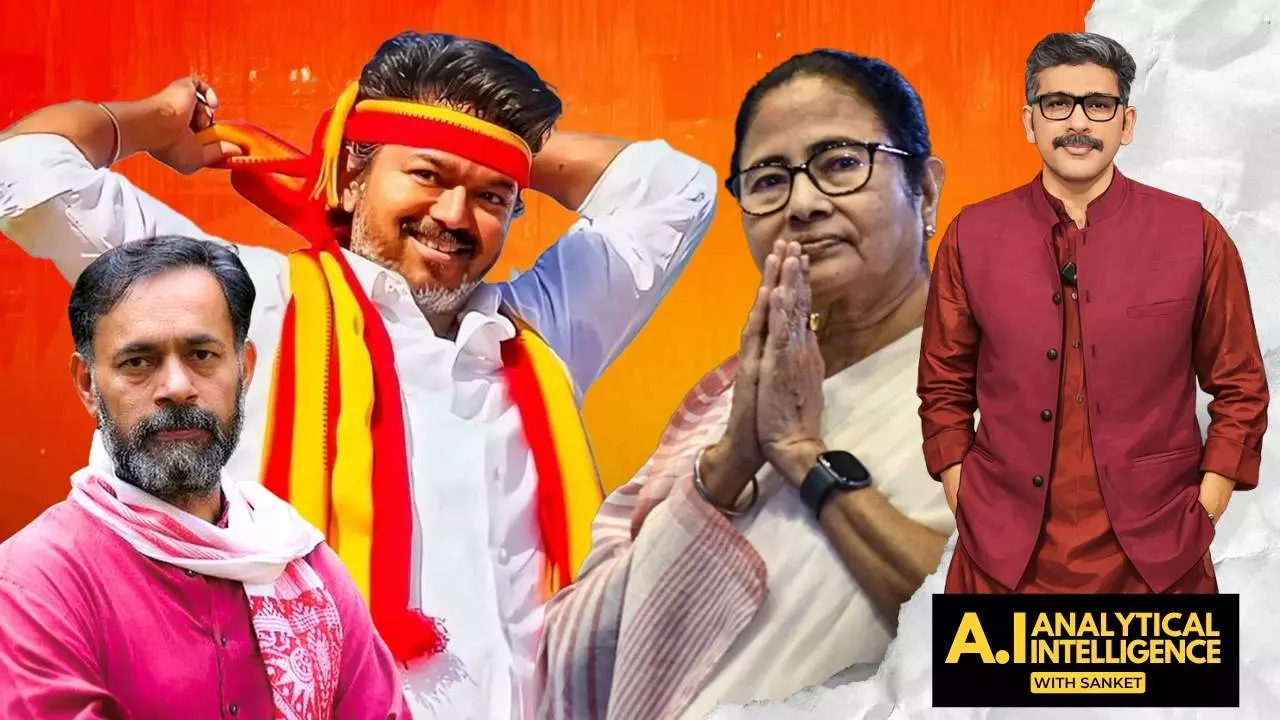
“The elections appear to be curated in a way that makes outcomes easier for one party,” was the sharpest charge made by psephologist and politician Yogendra Yadav on AI With Sanket, as concerns over voter deletions and electoral integrity took centre stage a day after Assembly election results in four states and one Union territory were declared on May 4.
The broader verdict, he argued, carries a dual message — one for the Opposition to introspect, and another for the system to answer difficult questions. The Federal spoke to Yadav about the election results, the role of institutions, and what lies ahead for Indian democracy. Excerpts:
What are your initial thoughts on the election results, especially West Bengal?
It’s a moment of reckoning for the democratic Opposition in this country — a moment to reflect and ask hard questions, both to themselves and to the system we have.
What happened in West Bengal is undoubtedly the most important development. These results cannot be explained only by voter list revisions. Such a large shift happens only when there is popular unease, disappointment, or even anger. There was anti-incumbency against the Mamata Banerjee government — that is undeniable.
But the question I have been asking, even before the election and now more sharply, is whether this was only a reflection of popular sentiment. In Tamil Nadu, for example, the result can be entirely explained by the public mood. People were unhappy, they wanted an alternative, and they found one. You don’t need to refer to the Election Commission there.
Also Read: What explains Bengal’s saffron shift? 6 reasons why Mamata was decimated
Similarly, in Kerala, you don’t need to talk much about the Election Commission. It’s a routine political transition. The Congress won, and it’s not a dramatic shift — it’s a deferred transition.
In Assam, the Election Commission did matter. Its conduct allowed a certain kind of campaign, and delimitation clearly favoured one party. But even then, I would say the BJP would have won Assam anyway. The Commission’s role was not decisive.
Bengal is different. Here, the question is: how did a party ahead by 10 percentage points fall behind by 4? That needs explanation beyond just public sentiment.
Do you believe voter list deletions played a decisive role in Bengal?
I would not say it is the only factor. But we must ask: if the Special Intensive Revision (SIR) had not taken place, would the result have been different?
Around 90 lakh names were deleted. We cannot say all were targeted. The first 58 lakh deletions were somewhat arbitrary and typical of such exercises — erratic and often against the poor, but not clearly targeted.
However, the last phase — 27 lakh deletions — is critical. These were people who had applied, appeared for hearings, and submitted documents like birth certificates, PAN cards, even passports. Yet, their names were removed.
Also Read: Bengal's Didi shield cracks: How Mamata Banerjee lost the state she dominated
These 27 lakh people are prima facie eligible voters. In most cases where appeals were heard, tribunals said they should have been included. It is also clear there was targeting — of Muslims and certain political supporters.
Now consider this: 27 lakh voters amount to about 4.3 per cent of the electorate. The margin between the two main parties is around 4.4 per cent or 4.5 per cent. So what if these 4.3 per cent had voted? That is a valid question.
This is not just my question — it was raised by Justice Bhagwati in the Supreme Court. He had observed: what if the number of deleted voters exceeds the margin of victory? That concern now applies to the entire state.
Would the Supreme Court step in now? That is something we must watch.
What can the Opposition do if they believe elections are ‘curated’?
This is a very difficult situation with no simple answers. If the Opposition boycotts elections, they will be accused of running away. If they participate, they are told they cannot complain later. It’s a double bind.
But the word ‘curation’ is justified. If you look at the entire SIR process in Bengal, there is a consistent pattern — as if someone instructed the Election Commission to delete at least 5 per cent of voters. Every step makes sense if you assume that objective.
Also Read: Polarisation to anti-incumbency — what helped BJP change the political narrative in West Bengal
Of course, this alone does not explain the result. There was genuine public dissatisfaction. But when analysing elections, you look at the turning point — the factor that converts victory into defeat.
In Bengal, that decisive factor could be the Election Commission’s intervention. That is not the case in Assam, Kerala, or Tamil Nadu.
Could such ‘curation’ become a template for future elections?
That is precisely the fear. What happened in Assam through delimitation and in Bengal through SIR could become national templates.
In Assam, constituency boundaries were drawn in a way that appears highly strategic — even splitting panchayats across multiple constituencies. This is textbook gerrymandering.
Also Read: What is gerrymandering, and why is everyone suddenly talking about it?
The Opposition fears this could be replicated across the country. Similarly, SIR could be used elsewhere — Punjab, Tamil Nadu, or any region where one party struggles electorally.
This is not just an Opposition concern. Every Indian should worry about this. Democracy is about voters choosing governments — not the other way around.”
Can you explain gerrymandering for viewers unfamiliar with the term?
Gerrymandering refers to manipulating constituency boundaries to favour a particular party. In India, boundaries were traditionally drawn by neutral authorities, so we didn’t see much of this.
But in places like the US, politicians themselves draw boundaries. So they shape constituencies to include favourable voters and exclude unfavourable ones.
For example, if a party loses in two constituencies — one with 60 per cent minority voters and another with 40 per cent — it may combine them in a way that creates one overwhelmingly minority seat and one where minorities are reduced. This helps them win at least one seat.
This kind of manipulation appears to have happened in Assam. And that’s why it raises serious concerns.
You mentioned a ‘triple curation’. What does that mean?
I describe it as ‘Desh, Kal, Patra’.
‘Desh’ refers to geography — handled through delimitation and gerrymandering.
‘Patra’ refers to voters — handled through SIR.
‘Kal’ refers to timing — handled through proposals like One Nation, One Election.
Together, these reshape the entire architecture of electoral democracy. The concern is that this could create a permanent majority for one party. That is something every democrat should worry about.
How do you explain Vijay’s rise in Tamil Nadu?
Something dramatic has happened, and it actually underlines the strength of democracy. An establishment can be challenged by a complete outsider — that is the beauty of democracy.
Tamil Nadu has a strong Dravidian political culture. The DMK represents that today. But people were unhappy, and ruling parties tend to become complacent.
There is also a pattern — Tamil Nadu rarely gives consecutive mandates. The opposition space existed, but AIADMK could not fill it. It is seen as fragmented and as a proxy for the BJP, which many voters in Tamil Nadu do not favour.
This created a vacuum. Vijay stepped into that space.
Also Read: How Assam CM Himanta Biswa Sarma became the strategist who rewired the state’s politics
He follows the tradition of film personalities entering politics — like MGR, Karunanidhi, and others. But importantly, he operates within the Dravidian ideological framework. He speaks of Periyar, Ambedkar, Kamaraj, social justice, federalism, and secularism.
He positions DMK as his political opponent and BJP as his ideological opponent. That is a very strategic positioning.
His appeal is strongest among youth, urban voters, and women. This has led to a major shift.
In the long run, I think AIADMK will suffer the most. DMK has resilience and tends to return to power. AIADMK may face an existential crisis.
(The content above has been transcribed from video using a fine-tuned AI model. To ensure accuracy, quality, and editorial integrity, we employ a Human-In-The-Loop (HITL) process. While AI assists in creating the initial draft, our experienced editorial team carefully reviews, edits, and refines the content before publication. At The Federal, we combine the efficiency of AI with the expertise of human editors to deliver reliable and insightful journalism.)