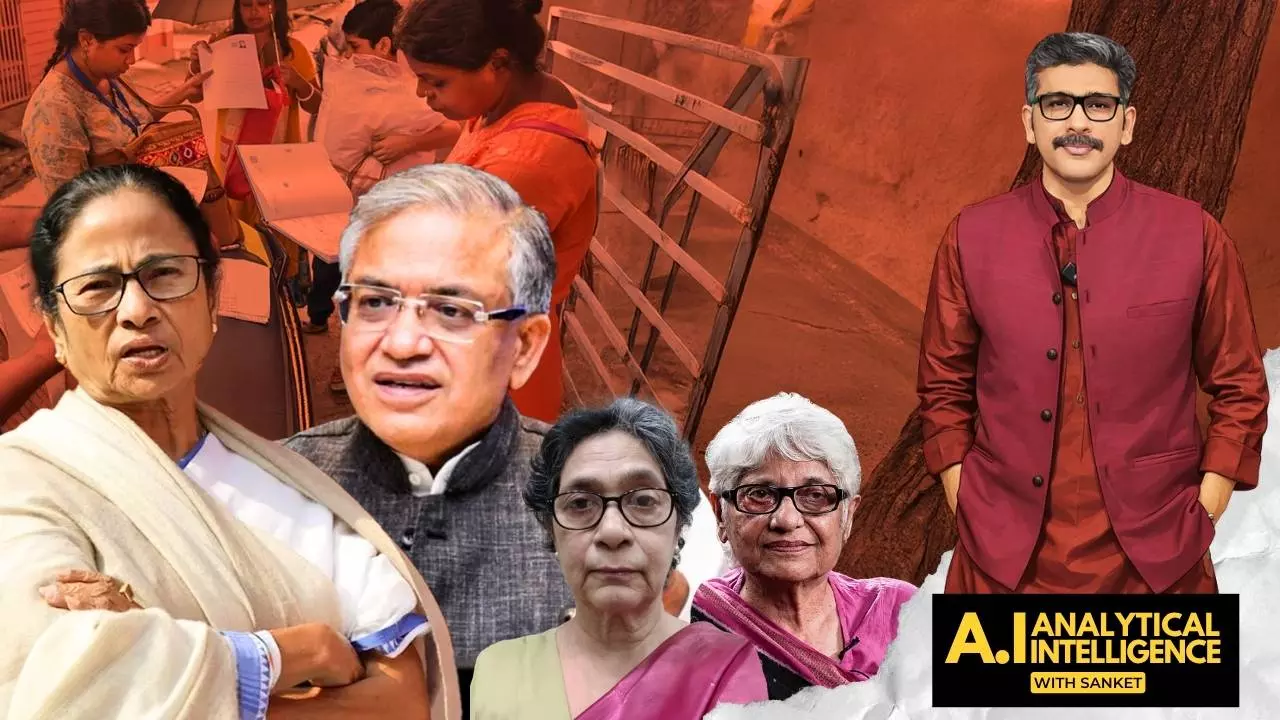
91 lakh voter deletions in Bengal: 'EC needs to get its act together' | AI With Sanket
Senior journalists flag credibility crisis as massive voter deletions in West Bengal raise concerns over fairness, timing, and impact on upcoming elections

A staggering 91 lakh voter deletions in West Bengal have triggered what senior journalists describe as a “credibility crisis” for the Election Commission (EC), with concerns mounting over whether the exercise could influence the outcome of the upcoming polls. The scale and timing of the deletions have raised serious questions about fairness, transparency, and democratic rights.
On the latest episode of AI With Sanket, The Federal spoke to senior journalists Neerja Chowdhary and Shikha Mukherjee on the implications of the Special Intensive Revision (SIR) exercise, the political narratives surrounding it, and whether the process undermines trust in electoral institutions.
Credibility concerns
The sheer scale of deletions—91 lakh names—has become the central point of concern. Mukherjee said the number “hits you in between the eyes”, especially after earlier figures of 58 lakh deletions were already being debated.
Also read: Bengal SIR’s 91 lakh voter deletions shrink TMC cushions, unsettle BJP’s Matua base
She pointed out that the perception on the ground is rapidly shifting, with people across social and economic groups beginning to “club the Election Commission and the BJP together”. According to her, this merging of identities reflects a deeper erosion of trust.
Mukherjee added that in a politically aware state like West Bengal, such perceptions are significant. “The Election Commission has lost credibility,” she said, noting that many now see the exercise as a “central imposition of a blueprint on Bengal.”
Perception matters
Chowdhary stressed that in a democracy, perception is as important as procedure. “If a large party going to the polls feels justice is not being done, the Election Commission has to respond,” she said.
She noted that the Commission, as the “umpire”, must remain above suspicion. The current situation, however, has led to widespread unease, particularly given the timing of the exercise so close to elections.
Also read: Poll-bound Bengal rocked as Humayun Kabir's anti-Mamata 'plot' video surfaces
Chowdhary also questioned the haste. “Why do it now?” she asked, suggesting the process could have been conducted earlier or elections postponed until completion.
Timing debate
The timing of the SIR exercise emerged as a major issue. Mukherjee argued that “there is nothing routine about this SIR”, calling it “extraordinary” in both scale and execution.
She described it as resembling a “punishment on the people of West Bengal”, citing narratives around “detect, delete, deport” that have shaped public perception even before the exercise began.
According to her, the process created an atmosphere of fear, with reports circulating about consequences like frozen bank accounts or travel restrictions for those removed from electoral rolls.
Implementation flaws
Mukherjee highlighted what she described as glaring inconsistencies in implementation. She cited cases where “a mother is on the electoral roll and the son and granddaughter have been deleted”, calling such instances inexplicable.
Also read: Despite deletion of over 90 lakh voters in Bengal SIR, TMC will win: Mamata
She argued that if the process had been routine, such discrepancies would not occur. “If EROs and BLOs had been allowed to do their work, there would have been none of this nonsense,” she said.
She also pointed to cases where individuals with passports and international travel history were removed, raising further doubts about the accuracy of the exercise.
'No small number'
Both panellists agreed that the magnitude of deletions demands scrutiny. Chowdhary noted that while some deletions may be justified—due to death or migration—“91 lakhs is no small number”.
She added that the figure itself reflects a failure to maintain updated electoral rolls over time. “It shows the Election Commission has not done what it should have done over the years,” she said.
Mukherjee also referenced figures suggesting shifts in deletion patterns across communities, though she clarified these were indicative and not verified facts.
Adjudication gaps
A major concern raised was the lack of clarity in the adjudication process. Mukherjee emphasised that individuals placed under review must be given clear reasons.
“You can’t just say it was a technical error,” she said, adding that in several cases, no explanation was provided.
She also flagged delays in setting up tribunals. Despite announcements, “over two weeks” had passed without operational tribunals, leaving affected individuals with little recourse.
Legal recourse
Chowdhary said judicial intervention may be inevitable. “Where else do you go?” she asked, pointing out that if doubts arise about the Election Commission itself, courts become the only option.
She recalled that West Bengal Chief Minister Mamata Banerjee had previously approached the Supreme Court, calling it both a legal and political move.
However, she warned that legal processes may further complicate matters given the proximity to election dates.
Voter hardship
The discussion also highlighted the burden on ordinary voters. Chowdhary described scenes of people “lining up in queues, desperate to get documentation in order.”
She argued that the process is not “user-friendly,” especially for marginalised communities. “You can’t subject your citizens to this kind of harassment,” she said.
She stressed that the right to vote includes the right to be heard if removed from rolls—a principle she believes is currently undermined.
Missing additions
Another key issue raised was the lack of focus on adding new voters. Chowdhary pointed out that in a growing population, electoral rolls should see both deletions and additions.
“How is it that we are only hearing of deletions?” she asked, sharing her own experience of struggling to update her voter registration despite repeated efforts.
Mukherjee echoed this concern, saying the focus appeared disproportionately on removing names rather than expanding voter inclusion.
Political impact
The political implications remain uncertain but significant. Mukherjee argued that the narrative around the exercise could shape voter sentiment more than the actual numbers.
She maintained that the emphasis on “detect, delete, deport” reflects a broader ideological approach influencing the process.
Chowdhary added that the lack of clarity and transparency raises suspicions of “mili bhagat” between institutions and the ruling establishment, even among those not inclined to believe in large-scale manipulation.
Final take
Both panellists agreed that while electoral roll cleansing is necessary, the current exercise raises more questions than answers.
Mukherjee summed it up bluntly: “The Election Commission needs to get its act together.”
Chowdhary concluded that the process must inspire confidence. “It doesn’t leave you with the reassurance that things are fine,” she said.
(The content above has been transcribed from video using a fine-tuned AI model. To ensure accuracy, quality, and editorial integrity, we employ a Human-In-The-Loop (HITL) process. While AI assists in creating the initial draft, our experienced editorial team carefully reviews, edits, and refines the content before publication. At The Federal, we combine the efficiency of AI with the expertise of human editors to deliver reliable and insightful journalism.)