



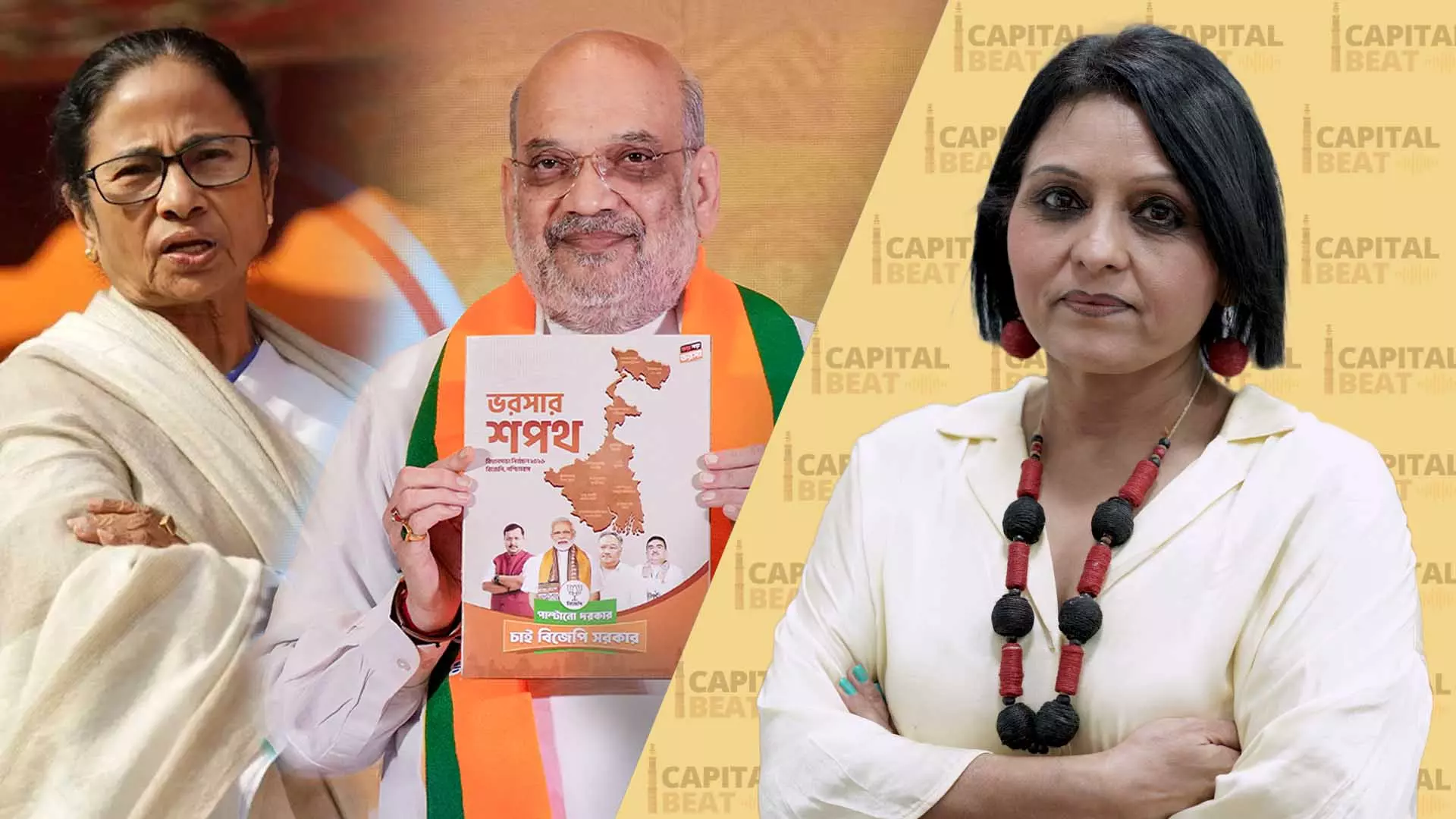
Mamata attacks BJP with 'snake' jibe as Bengal poll battle hots up | Capital Beat
With the BJP’s manifesto out and voter deletions debated, TMC, Congress and analysts clash over campaign momentum, fairness and narrative ahead of Bengal polls

A heated political debate marked Friday's (April 10) episode of Capital Beat, featuring Shubhankar Bhattacharya of the Trinamool Congress (TMC), Chandan Ghosh of the Congress, and senior journalist Shikha Mukherjee, as parties clashed over manifesto promises, voter list revisions, and campaign momentum ahead of the West Bengal Assembly elections.
With 12 days to go for polling, the BJP’s manifesto, released by Union Home Minister Amit Shah, promises Rs 3,000 monthly assistance for women and a Uniform Civil Code (UCC) within six months. At the same time, Bengal Chief Minister Mamata Banerjee has intensified her attacks, alleging misuse of agencies and external interference in elections.
Also read: BJP promises UCC in 6 months, Rs 3,000 aid for women in West Bengal manifesto
The discussion focused on whether BJP’s campaign narrative is gaining traction, the impact of voter list deletions, and the positioning of Congress in a largely bipolar contest.
Debate over BJP manifesto and voter deletions
Mukherjee pointed to contradictions in the BJP’s messaging, particularly around the issue of “infiltrators” and electoral roll revisions.
“There is a slight contradiction in what the BJP is saying,” she noted, referring to claims that millions of ineligible voters had already been removed.
She highlighted that “91 lakh people had been deleted from the electoral roll”, calling it a development that “hit everybody between the eyes like a bullet.”
Also read: 91 lakh voter deletions in Bengal: 'EC needs to get its act together' | AI With Sanket
Mukherjee added that many individuals across political affiliations had reported wrongful deletions, stating, “We all know people who have been wrongfully deleted from the voters' list.”
She described the overlap between the BJP’s campaign focus and the electoral revision exercise, noting that “the Guspetia as a priority and the cleaning of the election roll has become a coordinated exercise.”
TMC response to BJP’s campaign narrative
Bhattacharya rejected the BJP’s narrative, focusing on the fairness of the electoral process.
“A voter is a voter first. To make it a free and fair election, you have to ensure that every legitimate voter gets to vote,” he stated.
He questioned the BJP’s emphasis on “detect, delete, deport”, saying, “I am actually confused—are they talking about cattle or people?”
Also read: AIMIM exits alliance with Humayun Kabir ahead of Bengal elections amid video row
Bhattacharya also raised concerns about the scale of voter deletions, citing specific areas. “You targeted areas like Nandigram where 98 per cent of Muslims’ names were deleted,” he claimed.
On allegations of corruption raised by the BJP, he responded, “If the BJP is so confident about the cut money narrative, then why do you need agencies to support you in the election?”
He added that the ruling party was “fighting against all odds”, including institutions and administrative systems.
Congress position and role in election
Ghosh outlined the Congress party’s approach, emphasising its decision to contest across all constituencies.
“We have filed nominations in all 294 constituencies to penetrate every inch of the state,” he said.
He stated that the Congress aimed to present an alternative to both BJP and TMC, highlighting governance issues. “There is no specific vision of education or health system in Bengal,” he said about the BJP’s manifesto.
On the issue of electoral roll revisions, Ghosh said the party had been actively raising concerns. “We have been 17 times at the Election Commission,” he stated, adding that protests and demands had been made at multiple levels.
He stressed that “one single valid voter should not be excluded from the electoral roll”, calling it central to democratic functioning.
Campaign momentum and ground reality
Mukherjee assessed the campaign dynamics, noting a shift from anti-incumbency to manifesto-driven narratives.
“The campaign up to about a week ago was about anti-incumbency. Today all that is over,” she said.
She observed that the BJP’s campaign appeared less intense compared to previous elections. “In 2021, the BJP was buzzing… this time it seems to be a little subdued,” she noted.
Mukherjee added that this has allowed Mamata to campaign more effectively. “She is not up against the kind of array of BJP leaders that she was up against earlier,” she said.
She described the contest as largely bipolar, stating, “It’s a fight between Mamata and the BJP… Mamata and Modi.”
Modi factor and manifesto strategy
On Prime Minister Narendra Modi’s influence, Mukherjee said his appeal has become more familiar to voters.
“Modi is no longer a new element in Indian politics… what he says is familiar,” she observed.
She described the BJP’s manifesto as an extension of its broader governance model. “It is a perfect example of a double engine Sarkar manifesto,” she said, citing infrastructure, welfare, and economic promises.
Mukherjee added that while earlier campaigns relied heavily on charisma, the current approach appears more structured and less aggressive.
“They are being very correct… they are not attacking Mamata personally,” she said.
Political contest and electoral concerns
Bhattacharya reiterated concerns about the fairness of the electoral process.
“Are you going to have a free and fair election, which is completely impartial? It is not possible,” he stated.
He also questioned the need for extensive campaign resources. “If BJP is so confident, why do they need all these conspiracies?” he asked.
Ghosh maintained that Congress aimed to re-establish its presence. “We can expect a good number of seats, which can be a factor inside the Assembly,” he said, without giving specific projections.
He emphasised the party’s focus on constitutional values and governance issues.
Rising tensions and narrative battle
The discussion highlighted growing tensions between parties, with sharp exchanges over allegations of external influence, institutional bias, and campaign strategies.
Mukherjee pointed out that the energy of the campaign differs from previous elections. “West Bengal has been in election mode for several months,” she said, but added that the current momentum appears more subdued.
She noted that the absence of heavy campaigning by Congress and Left leaders has reinforced the perception of a direct contest between BJP and TMC.
Bhattacharya concluded by stressing voter rights, stating, “If I have a voting right, don’t take it away from me.”
(The content above has been transcribed from video using a fine-tuned AI model. To ensure accuracy, quality, and editorial integrity, we employ a Human-In-The-Loop (HITL) process. While AI assists in creating the initial draft, our experienced editorial team carefully reviews, edits, and refines the content before publication. At The Federal, we combine the efficiency of AI with the expertise of human editors to deliver reliable and insightful journalism.)
