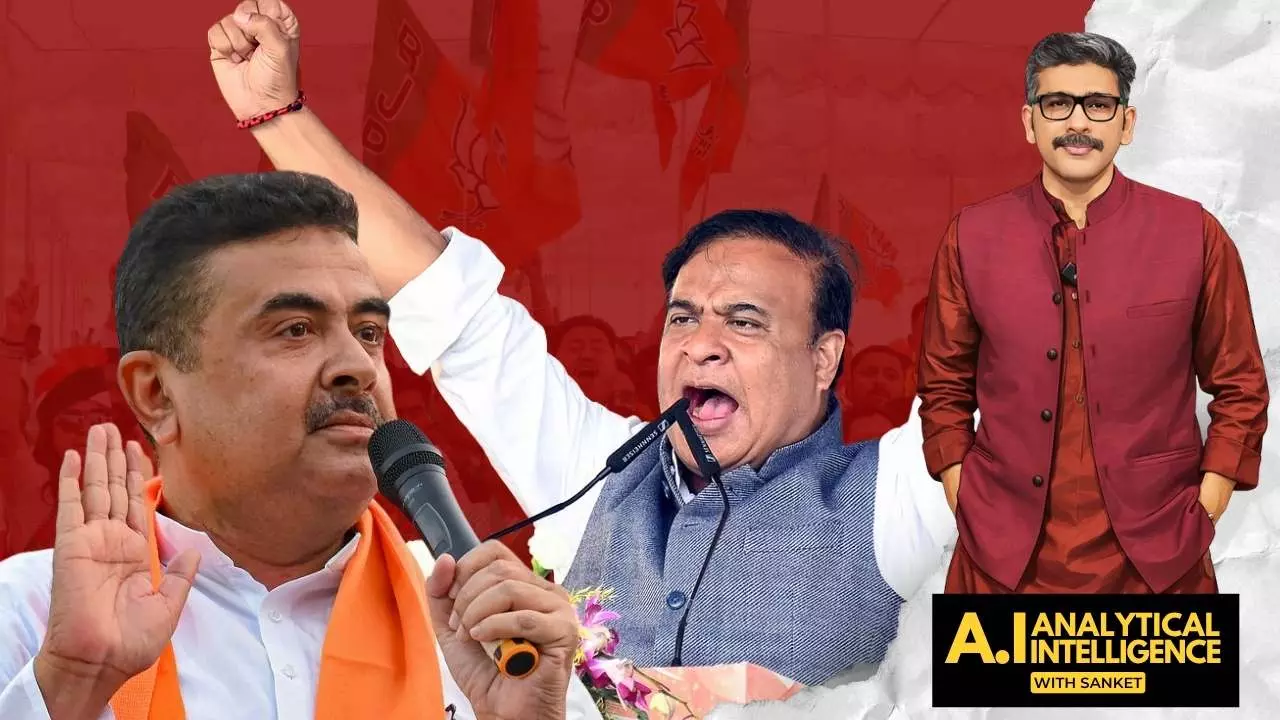
Deciphering BJP’s landmark victories in Bengal, Assam | AI With Sanket
Panellists debate BJP’s surge in the two eastern states, the TMC’s failure in Bengal, and the impact of SIR, leadership, and opposition weaknesses

As West Bengal witnessed a change of guard after a gap of 15 years, thanks to the Bharatiya Janata Party's (BJP) sweeping victory in the 2026 Assembly elections, several factors came up for analysis as experts tried to understand what caused this result.
Follow 2026 Assembly election results here
Dramatic reversals were witnessed in many key constituencies, and pointing to them, senior journalist Samir K Purkayastha said multiple factors indeed shaped the final outcome, including the voter list revision and strong anti-incumbency against the outgoing Trinamool Congress (TMC) of Mamata Banerjee.
Besides him, The Federal also spoke with other experts and party representatives in this episode of AI With Sanket, such as Bengal BJP leader Charles Nandi, Prof Saminur Rahaman of the TMC, and Asom Gana Parishad (AGP) leader Apurba Kumar Bhattacharjee, to understand what enabled a saffron wave in Bengal and also Assam, where the BJP formed its third successive government this time.
Bengal verdict
The BJP is poised for a sweeping victory in Bengal, crossing the 190-seat mark, marking a major political shift in the state. According to Purkayastha, several factors contributed to this outcome, including the controversial Special Intensive Revision (SIR) of the voter lists.
Also read: Polarisation to anti-incumbency — what helped BJP change the political narrative in Bengal
He highlighted that in nearly 177 seats, the number of deleted voters exceeded the victory margins from the 2021 elections. Of these, the TMC had previously won 120 seats, while the BJP had secured 57. This time, the trend reversed significantly in favour of the saffron party.
Anti-incumbency factor
Beyond SIR, strong anti-incumbency also played a crucial role in the TMC’s setback. Purkayastha pointed to corruption allegations, including job-for-cash cases, and incidents such as the RG Kar rape and murder case, which triggered public outrage.
He observed that while official data may suggest Bengal remains relatively safe, such incidents had a deep psychological impact, especially among urban voters. Protests in cities reflected this anger, which ultimately translated into votes.
The anti-incumbency wave was so strong that even traditional TMC strongholds, including minority-dominated regions, saw an erosion in support for Mamata's outfit. A split in minority votes in districts such as Malda and Murshidabad further aided the BJP.
Victory to 'save India'
Nandi framed the verdict as a rejection of the Mamata government, calling it a vote against corruption, lawlessness, and “appeasement politics”.
He argued that the election was not merely political but a “battle for civilisation” and claimed that the BJP’s victory was necessary to “save India.” Nandi linked the result to concerns over infiltration from Bangladesh, alleging that undocumented migrants had been given identity documents with political backing.
Also read: Why BJP is set for a stronger return in Assam
However, questions were raised about the role of central agencies, given that issues such as border security and the issuing of the Aadhaar fall under the Union government, complicating the narrative.
TMC cites 27L voters
Acknowledging that anti-incumbency was at play in this election, Professor Rahaman insisted that SIR had a significant impact on the results. He pointed out that around 27 lakh voters were still under legal scrutiny, with their cases pending before tribunals.
According to him, such a large number of excluded voters could not be ignored and reiterated the party’s allegation that the Election Commission was not functioning impartially.
What happened in Assam
In Assam, the BJP’s sweeping victory was attributed to a combination of leadership, development, and opposition weakness. Bhattacharjee credited Chief Minister Himanta Biswa Sarma for leading from the front and delivering governance.
Bhattacharjee emphasised that development initiatives and welfare outreach, particularly among women voters, played a decisive role in consolidating support for the National Democratic Alliance (NDA), of which his AGP is also a part.
He highlighted Sarma’s leadership as dynamic and effective, suggesting that his governance model resonated strongly with the electorate.
Opposition gaps
Purkayastha, however, pointed to significant weaknesses within the opposition in Assam. He noted that the Congress failed to present a united front, with leaders quitting even after the election schedule was announced.
Alliance negotiations were marked by delays, disagreements, and public spats, undermining the opposition’s credibility as a challenger. This lack of cohesion, he argued, sent a negative signal to voters.
Also read: Opposition deficit, rather than BJP triumph, is the message
He flagged the role of polarisation and governance narratives, suggesting that multiple factors—including leadership, strategy, and perception—worked together to shape the outcome in Assam.
Polarisation debate
The discussion also touched on allegations of polarisation in Assam politics. While critics argued that divisive strategies played a role, Bhattacharjee maintained that development remained the central plank of the BJP’s campaign.
He stressed that the aspirations of younger voters and the delivery of welfare schemes were key drivers behind the NDA’s success.
At the same time, Purkayastha said that both governance and political strategy, including polarisation, must be considered to fully understand the verdict.
Political implications
The panel concluded that the results in both Bengal and Assam reflect a complex interplay of factors—voter list revisions, anti-incumbency, leadership, and opposition dynamics.
While the BJP views the verdict in Bengal as a decisive mandate against the TMC and a validation of its governance model in Assam, the opposition continues to raise concerns about electoral processes and institutional fairness.
The debate underscores deeper questions about the future of electoral politics in India, particularly the balance between governance performance and the integrity of democratic processes.
The content above has been transcribed from video using a fine-tuned AI model. To ensure accuracy, quality, and editorial integrity, we employ a Human-In-The-Loop (HITL) process. While AI assists in creating the initial draft, our experienced editorial team carefully reviews, edits, and refines the content before publication. At The Federal, we combine the efficiency of AI with the expertise of human editors to deliver reliable and insightful journalism.