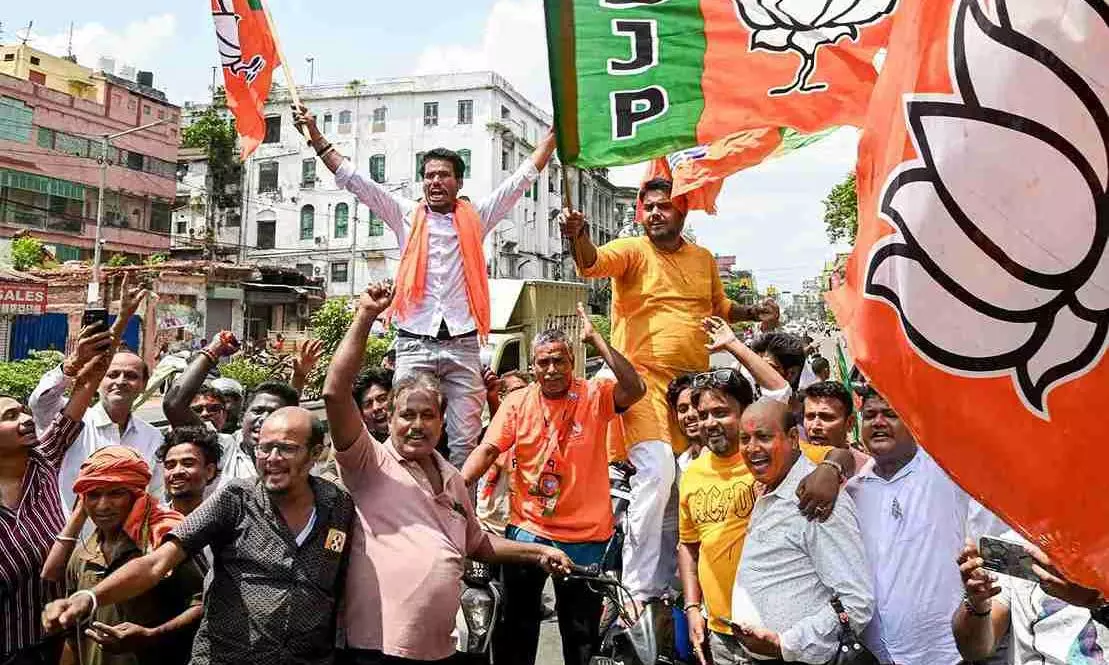
BJP workers celebrate at the state party headquarters as trends show the party leading in the West Bengal Assembly elections, in Kolkata, on Monday, May 4. PTI Photo
Polarisation to anti-incumbency — what helped BJP change the political narrative in West Bengal
All set to script a historic victory and form its first government in the state, the scale of the BJP’s lead signals a structural shift in Bengal politics, long dominated by parties occupying the centre-Left space; from the Congress to the Left Front and, more recently, the TMC.

The Bharatiya Janata Party (BJP) was all set to script a historic victory in West Bengal on Monday (April 4). The party’s defeat of the incumbent Trinamool Congress (TMC) points to a shift in the state’s political landscape driven by polarisation, anti-incumbency and the possible fallout of the special intensive revision of electoral rolls (SIR), say experts.
At around 7pm, the BJP had won 80 seats and was leading in another 124 — a total 204 of the 293 assembly constituencies where votes were being counted. This put it well past the majority mark of 148 seats, while the Mamata Banerjee-led TMC was left trailing far behind. Having won (or leading in) only 83 seats at 7 pm, this was the TMC’s first setback since coming to power in West Bengal in 2011.
Also read: Bengal's Didi shield cracks: How Mamata Banerjee lost the state she dominated
The scale of the BJP’s lead signals not just a victory but a structural shift in Bengal politics, long dominated by parties occupying the centre-Left space, from the Congress to the Left Front and, more recently, the TMC.
“This is a historic day for Bengal. For us, it is a civilisational victory,” BJP spokesperson Charles Nandi told The Federal, summing up the party’s ideological assessment of the mass mandate.
According to political commentator and author Amal Sarkar, multiple factors played a role in Monday’s outcome — religious consolidation by the BJP, identity politics, competition over welfare schemes by the two rivals and growing concerns over the state of governance in West Bengal.
Consolidating Hindu votes
At the heart of the BJP’s success is its ability to consolidate Hindu voters across caste and regional lines, turning the 2026 assembly elections into a sharply polarised contest.
This consolidation was evident in the belt dominated by the Matua population (a Scheduled Caste group in West Bengal), where, despite SIR-linked deletions that reportedly struck off lakhs of names, the Namasudra caste group (identified as Matuas) largely continued to support the BJP. In Matua-dominated constituencies such as Bongaon Uttar, Gaighata, Bagdah, Ranaghat Dakshin, the party retained or strengthened its position.
For West Bengal Chief Minister Mamata Banerjee, the defeat marks her most serious political setback in over a decade. Photo: @MamataOfficial
Campaign messaging centred on issues such as alleged illegal immigration, border security and demographic change, particularly in districts with mixed populations, played a major role in the BJP’s vote sweep. This narrative, analysts say, resonated beyond the BJP’s traditional base and helped it expand into constituencies where it had previously enjoyed marginal presence.
The controversy surrounding the SIR also became a defining feature of the election. While the TMC and other opposition parties alleged that the exercise disproportionately affected Muslim voters, the BJP framed it as a necessary clean-up of voter lists.
The pattern of voting, however, suggests that the issue may have indirectly worked in the BJP’s favour. In constituencies with significant voter deletions, the party improved its strike rate, reinforcing its narrative around “correcting” electoral rolls.
Also read: No victory rallies today after poll results are declared: Bengal CEO
The SIR exercise also appears to have rewritten electoral arithmetic in several minority-dominated constituencies, where deletions are seen to have diluted the relative influence of Muslim voters. As a result, even a marginal shift in Muslim votes away from the TMC, combined with a consolidation of Hindu votes behind the BJP, proved consequential in closely contested seats.
This was evident in Muslim-majority districts such as Malda, where the BJP was leading in six of 12 seats and the TMC in six, and Murshidabad, where the BJP was ahead in eight and the TMC in nine of the 22 seats, a sharp departure from 2021 when the TMC had swept the districts.
Trends till the evening also indicated divisions in Muslim voting between the TMC, the Left-Congress alliance and smaller parties, which allowed the BJP to gain ground.
Women voters and governance issues
Equally crucial was the shift among women voters, a demographic that had long formed the backbone of the TMC’s electoral success.
Both parties aggressively targeted women through welfare promises, but the BJP paired its financial pledges with a sustained campaign on safety and law and order. In recent months and years, incidents such as the RG Kar Medical College rape and murder case and Sandeshkhali controversy — where local TMC leader Shahjahan Sheikh stands accused of corruption and sexual assault — became recurring political references, reinforcing a broader narrative questioning governance under the TMC.
BJP supporters celebrate. Photo: PTI
Incidentally, the RG Kar victim’s mother, Ratna Debnath, who contested the elections as a BJP candidate from Panihati, was leading by 20,799 votes around 7pm, over her closest rival, the TMC’s Tirthankar Ghosh.
While the TMC’s flagship welfare schemes retained visibility, they were no longer sufficient to fully offset these concerns, particularly in urban and semi-urban constituencies.
The BJP, meanwhile, promised to replace the state’s existing Lakshmir Bhandar scheme for women with its own Annapurna scheme, offering Rs 3,000 per month to women beneficiaries compared to the presently-offered Rs 1,500. It also pledged Rs 3,000 per month for unemployed youth, doubling the Rs 1,500 provided under the Yuva Sathi scheme.
Also read: What explains Bengal’s saffron shift? 6 reasons why Mamata was decimated
Economic distress further amplified anti-incumbency.
Issues such as unemployment, stalled recruitment processes and migration pressures, especially among the youth, appear to have influenced voters’ choices, say experts. Allegations of recruitment scams and corruption in public distribution systems added to the perceptions of governance fatigue.
The BJP also benefited from its narrative of “aspirational Bengal”, positioning itself as an agent of economic change and investment. That message appears to have found traction among sections of the middle class and business community, particularly in urban areas.
The BJP’s gains in this year’s assembly elections were especially pronounced in regions that had previously resisted it.
In the politically crucial zones, including Kolkata and surrounding districts, the party made deep inroads into what had been a TMC stronghold. It also retained its dominance in North Bengal and staged a comeback in Jangalmahal (spanning Purulia, Jhargram, Bankura and parts of West Midnapore), where it regained Adivasi (tribal) support after setbacks in previous elections.
Of the 40 Jangalmahal seats, the BJP took the lead in 38, while the TMC trailed in all seats in the Jhargram, Purulia and Bankura districts of the region. The outcome is largely attributed to local grievances against the TMC over lack of development and employment opportunities, as well as an Adivasi–Kurmi backlash. The Kurmis have been pushing for inclusion in Scheduled Tribes. An apex body of the community, the Kurmi Samaj, had called for the community members to not to vote for the TMC. Kurmis constitute over 30 per cent of voters in the region, which was once affected by Maoist insurgency.
Failure of 'Bengali asmita' plank
The TMC had hoped, as in the past, to blunt the BJP’s Hindutva appeal through its push for Bengali sub-nationalism, and that this identity battle would help negate the impact of its governance shortcomings. But the scale of anti-incumbency ultimately proved so strong that the strategy failed to deliver.
At the same time, the BJP worked to counter the TMC’s ‘Bengali asmita’ (Bengali pride) plank by adopting visible cultural markers. Campaign optics included leaders indulging in local cuisine and traditions, part of an effort to shed the perception of being an “outsider” party. Prime Minister Narendra’s unscheduled stop during campaigning last month to enjoy the Bengali snack of jhalmuri (spicy puffed rice) is being seen as a part of this larger strategy to assimilate with locals.
Monday’s outcome also reflected the continuing decline of the Left Front and the Congress, as the battle largely remained bi-polar, though both parties appeared poised to improve their respective tally of last time’s zero votes. While the Congress had won two seats till 7pm, the CPI(M) had bagged one.
For the BJP, the outcome highlights the party’s ability to adapt its national messaging to regional contexts. For West Bengal Chief Minister Mamata Banerjee, the defeat marks her most serious political setback in over a decade. After three consecutive terms in power, the limits of a model centred on welfare delivery and strong personal leadership appear to have been exposed by cumulative anti-incumbency and shifting voter expectations.
The verdict signals not just a change in government but a transformation in Bengal’s political contour, where identity, governance and voter aspirations have come together in new ways. As the BJP prepares to form the government, attention will now shift from campaign promises to actual governance. Whether it can turn its electoral success into lasting support will depend on how well it addresses key issues such as unemployment and lack of industrialisation and is able to meet the high expectations that it has set among the public.