



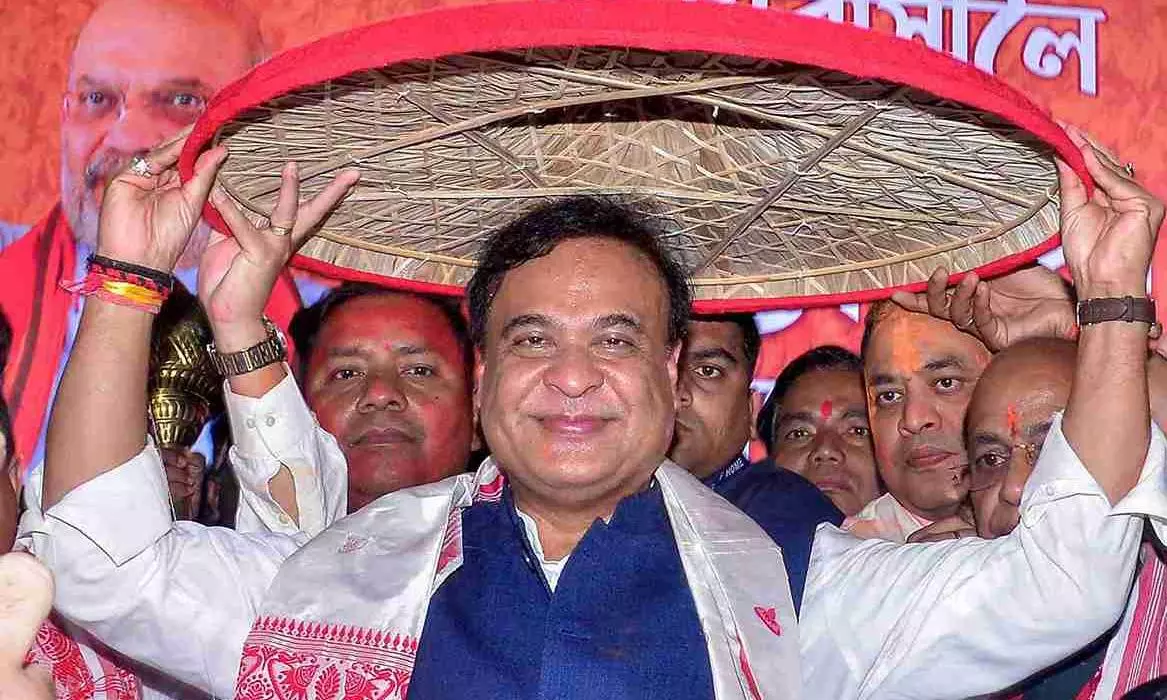
Why BJP is set for a stronger return in Assam
Delimitation, fractured Opposition, and selective welfarism help BJP expand its base in Assam, turning identity politics into a bigger mandate

What makes the BJP tick? Ask Assam, where the saffron party is set to make a return after two successful runs in the government, with a bigger mandate than 2021.
While last time, the BJP had 60 seats with a 33 per cent vote share, its lead in the current election is more than 80 at the time of this article being written, with a 38 per cent vote share. The overall NDA tally was 75 seats in 2021, with a 44.8 per cent vote share, which is 85–95 seats, according to trends.
Interestingly, just like in West Bengal, the BJP was a marginal player in the state’s politics until a decade ago. Assam’s politics was traditionally dominated by the Congress and regional outfits like the Asom Gana Parishad (AGP). In the 1990s, the BJP’s influence was largely confined to urban pockets and Bengali Hindu communities, particularly in Barak Valley.
Also read: How Assam CM Himanta Biswa Sarma became the strategist who rewired the state’s politics
The rise of Hindutva politics nationally provided the BJP with ideological momentum, but Assam’s ethnic complexities initially limited its appeal. Yet, the BJP finally cracked the code and consolidated the votes in 2016. Its meteoric rise in Assam is a product of strategic alliances, organizational discipline, strong grassroots welfarism, and the politicization of identity and migration issues.
How BJP decoded Assam
Assam’s politics has long revolved around issues of ethnicity, language, and migration. The BJP capitalized on Assam’s anxieties over alleged illegal immigration from Bangladesh, framing itself as the defender of Assamese identity and Hindu interests.
Strategic alliances with regional parties like the AGP and Bodoland People’s Front (BPF) expanded its reach. These coalitions allowed the BJP to penetrate constituencies where it previously had little influence.
The party invested heavily in grassroots mobilization, building a cadre-based structure that could rival the Congress. Its parent, the RSS, played a crucial role in ideological and organizational groundwork.
The BJP leveraged Hindu-Muslim divides, particularly around the issue of Bengali Muslim migrants. Campaigns emphasized cultural preservation and security, resonating with Assamese Hindus and tribal groups.
The 2016 win
When the BJP won 60 out of 126 Assembly seats in 2016, forming the government for the first time in Assam, anti-incumbency against the Congress played a major role.
Strong leadership under Sarbananda Sonowal and Himanta Biswa Sarma, a former Congress leader who defected to the BJP, helped consolidate the party’s position in the state.
Also read: What explains Bengal’s saffron shift? 6 reasons why Mamata was decimated
As the BJP emphasized development, infrastructure, and welfare schemes, it continued to foreground identity issues, reinforcing narratives of protecting Assamese culture and Hindu identity.
Eventually, Assam became a showcase of the BJP’s ability to expand beyond its traditional Hindi-belt strongholds.
2023 delimitation
Another big factor was the 2023 delimitation exercise that structurally disadvantaged Muslim voters ahead of the 2026 Assembly elections. Along with the BJP’s polarisation strategy, delimitation helped consolidate Hindu votes.
The 2023 delimitation reduced Muslim-majority constituencies from about 29-30 to 22-23, and Muslim-influenced seats from 41 to 26. This concentrated Muslim votes in fewer constituencies, limiting their leverage in marginal contests.
The BJP benefited from a more favourable distribution in Hindu-majority areas, making its path to victory structurally easier.
Opposition split
Historically, Muslims (34 per cent of Assam’s population) supported the Congress, but votes often split with the AIUDF.
In 2016, the Congress contested alone, resulting in fragmented Muslim votes. In 2021, the Congress-AIUDF alliance consolidated minority votes, but the BJP still retained power with 75 seats due to Hindu vote consolidation.
Also read: Bengal's Didi shield cracks: How Mamata Banerjee lost the state she dominated
In the 2024 Lok Sabha elections, Congress’s Rakibul Hussain defeated AIUDF’s Badruddin Ajmal in Dhubri by over 1 million votes, showing that Muslim voters rejected identity-based politics.
But the big surprise came in the 2025 panchayat elections, when the BJP made gains even in Muslim-dominated areas, highlighting its welfare outreach at the grassroots.
BJP’s smart tactic
The Congress ended its alliance with the AIUDF in 2021, fearing the BJP’s branding of it as a “Muslim party”. This decision always risked splitting minority votes in competitive constituencies, potentially handing seats to the BJP.
The AIUDF, though weakened, retains cadre strength in Lower Assam and Barak Valley, enough to influence outcomes.
The BJP, on the other hand, does not try to woo Muslim votes; instead, it ensures that the Muslim identity remains central to elections, keeping Hindu voters consolidated.
Sarma’s rhetoric has repeatedly framed Bengali-speaking “Miya” Muslims as outsiders and threats. Terms like “love jihad”, “land jihad”, and “vote jihad” are deployed in abundance to portray Muslims as a demographic and cultural danger.
By fragmenting Muslim votes between the Congress and the AIUDF, the BJP secures victories even in constituencies with anti-BJP majorities.
Selective welfarism
The BJP’s approach also combines the exclusion of Miya Muslims with selective welfarism for indigenous Assamese Muslims, splitting the community internally.
Targeted social welfare, such as the Orunodoi cash transfer scheme, has helped build a loyal beneficiary base.
Also read: Bengal giant killer’s gambit: Suvendu Adhikari and the BJP’s breakthrough
Also, under Sarma, the party has established a robust grassroots network, making inroads into areas previously dominated by the Congress.
Coupled with that, visible improvements in roads, bridges, and digital connectivity, and a focus on peace and anti-corruption measures, have enhanced the party’s image.
But bigger environmental and governance issues, such as floods and unemployment, keep getting sidelined as identity politics dominates the discourse.