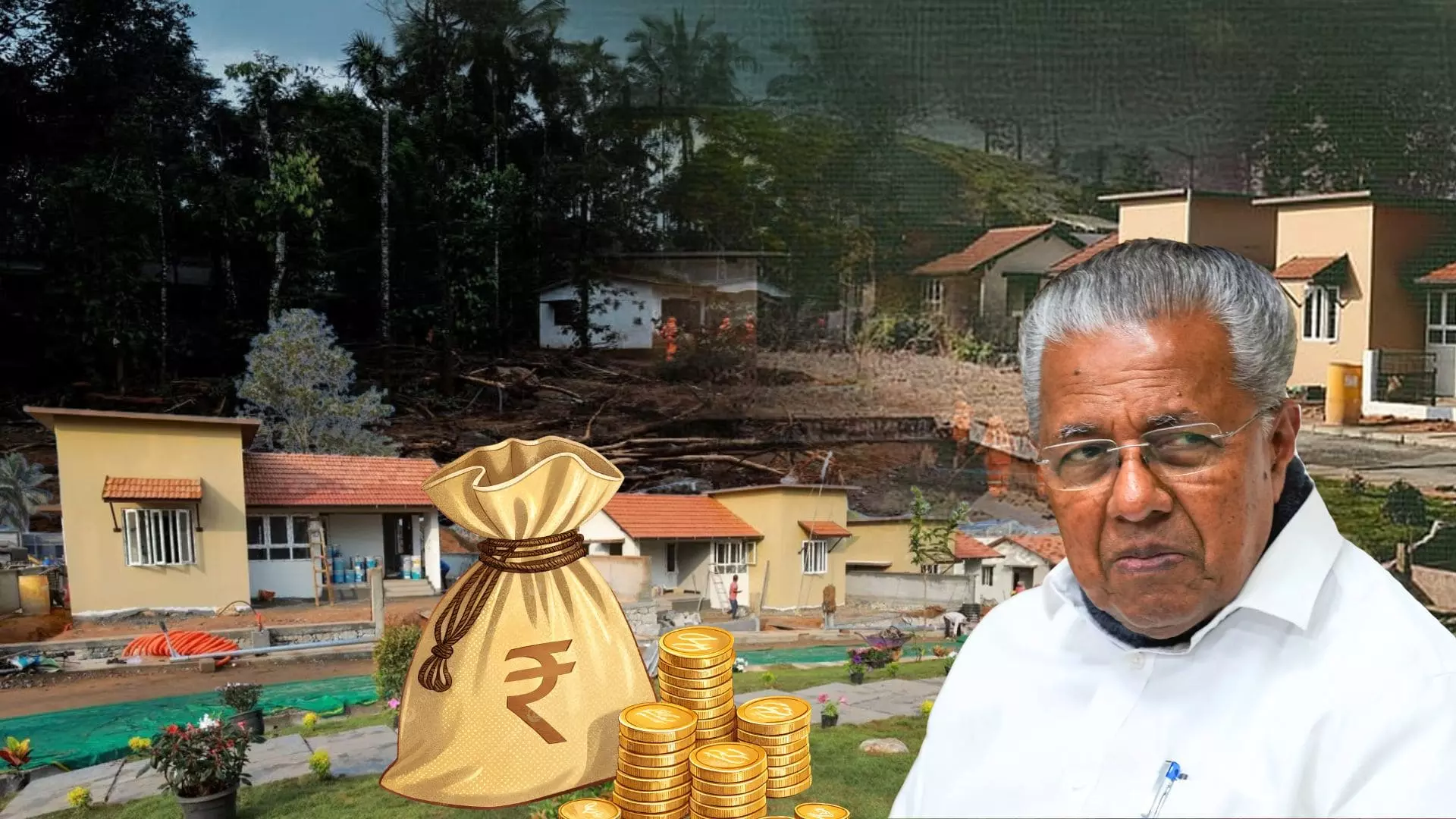
The issue centres on the fund collection drive initiated by the Congress for victims in Wayanad. Instead of gaining a political advantage, the campaign is now under scrutiny for delays and discrepancies.
Why the 2024 Wayanad relief fund is back in focus now
Delays, fund scrutiny and competing models of rehabilitation push Wayanad relief efforts to centre of Kerala’s election narrative

A relief campaign launched after the 2024 Wayanad landslides has turned into a political flashpoint in Kerala’s election narrative. What began as promises of rehabilitation has now raised questions over funds, land, and delivery, putting the Congress on the defensive in the final hours of campaigning.
“At one level, this is about relief and rehabilitation after a disaster. But at another level, it has clearly become a political issue,” the explainer notes, capturing the shift from humanitarian response to electoral controversy.
The issue centres on the fund collection drive initiated by the Congress for victims of Mundakkai and Chooralmala in Wayanad. Instead of gaining a political advantage, the campaign is now under scrutiny for delays and discrepancies.
Relief race
The story began soon after the disaster struck Wayanad. As rescue operations were underway, multiple political players stepped in with relief promises.
The Congress announced it would build 100 houses. This was followed by Rahul Gandhi pledging another 100, and the Congress government in Karnataka promising an additional 100 houses. Together, this brought the broader Congress ecosystem’s commitment to 300 houses.
Also read: Wayanad landslides not a 'national disaster': Centre faces flak for 'double standards'
Soon after the Democratic Youth Federation of India (DYFI) declared it would construct 25 houses, the Youth Congress announced its plan to build 30 houses. Early on, there was visible competition among political groups over relief efforts.
Govt model
The Kerala government, however, set clear guidelines. It stated that no private organisation or political party would be allowed to build houses independently on designated rehabilitation land.
Instead, contributors were asked to sponsor houses within the government’s rehabilitation project, with a fixed cost of Rs 20 lakh per unit.
Also read: Wayanad relief: Why India needs climate-sensitive banking now more than ever
The DYFI followed this model, raising Rs 20.49 crore through campaigns, including scrap collection drives, and handed over the funds to the Chief Minister’s Distress Relief Fund (CMDRF).
Parallel efforts
Meanwhile, the Indian Union Muslim League (IUML), part of the UDF, took a different route by launching its own housing project.
So far, the IUML has completed 51 houses, about half of its original promise, and handed over keys even before the government did, three days ahead of schedule.
At the same time, the state government’s project is larger in scale, aiming to build 410 houses in a planned township near Kalpetta. The focus is not just on housing, but on creating a complete living environment for displaced families.
Congress lag
In contrast, the Congress initiative, despite strong visibility and a digital fundraising campaign, slowed down significantly on the ground.
The main hurdle cited was land. Congress leaders claimed they expected the government to provide land, but the revenue department denied receiving any formal request during the all-party meeting on rehabilitation.
Also read: Congress' Wayanad landslides rehabilitation fund disclosure fails to silence critics
As a result, while other stakeholders progressed, the Congress project remained stuck at the foundation stage, even months after initial announcements.
Money questions
The controversy intensified when questions arose about the funds collected.
Senior Congress leaders, including K C Venugopal and Kerala Pradesh Congress Committee (KPCC) president Sunny Joseph, stated that the party had collected Rs 5.38 crore. “To be precise, Rs 5,38,21,632,” they said, adding that the funds were maintained in a Dhanalakshmi Bank account for transparency.
They provided a breakdown: Rs 3.68 crore was spent to purchase 3.25 acres of land, with Rs 1.05 crore contributed by the Youth Congress. Another 2.18 acres was bought for Rs 2.5 crore, along with Rs 97 lakh from KPCC funds.
Also read: When hills gave way, hope did not: Wayanad township for victims opens doors
However, critics argued that these figures did not match the scale of the fundraising campaign.
Political heat
The CPI(M) has questioned the Congress’s claims, citing earlier statements and social media posts suggesting a larger collection.
“The numbers don’t seem to match the scale of the campaign,” opponents argue, turning the issue into a major political talking point.
Adding another layer to the controversy, some victims who had accepted Rs 15 lakh government aid and opted out of the official rehabilitation project are now reportedly willing to return the money and rejoin the government scheme.
Perception gap
The government’s township project near Kalpetta has received positive feedback, particularly for its design and facilities.
This has further highlighted the gap between promises and delivery, especially for Congress.
Also read: Centre’s refusal of funds for Wayanad is helping LDF kill two birds with a stone
“There is a growing sense that this could have been handled better,” as the narration puts it, pointing to internal concerns within the party.
Final stretch
The timing of the controversy has amplified its political impact, emerging just as election campaigning reaches its final phase.
Despite having strong leadership figures like Rahul Gandhi and Priyanka Gandhi, and support from a neighbouring Congress government in Karnataka, the party’s delivery record is now under scrutiny.
What was intended as a show of solidarity has turned into an election-time embarrassment, with opponents using it as a key campaign issue.
In the end, the debate returns to a simple question: beyond promises and politics, how many houses will actually be built, and how soon can Wayanad rebuild its future?
The content above has been transcribed from video using a fine-tuned AI model. To ensure accuracy, quality, and editorial integrity, we employ a Human-In-The-Loop (HITL) process. While AI assists in creating the initial draft, our experienced editorial team carefully reviews, edits, and refines the content before publication. At The Federal, we combine the efficiency of AI with the expertise of human editors to deliver reliable and insightful journalism.