When hills gave way, hope did not: Wayanad township for victims opens doors
First phase of 178 houses ready in government-led rehabilitation project; political sparring continues over funding and parallel housing initiatives

PV Ashraf still remembers the sound of the hill giving way.
A shopkeeper from Chooralmala, he lost not only his two-storied house but also the small shop that sustained his family when the landslide struck in July 2024. In a matter of minutes, years of work were buried under mud and debris. For months afterwards, he moved between relief camps and rented accommodation, uncertain about what lay ahead.
On the day of the draw of lots at the Kalpetta rehabilitation township, there was a hush in the hall as officials began calling out names. Ashraf’s was the first to be announced. House number 104 in Cluster J.
Valsala from Chooralmala followed, allotted house number 76 in Cluster G. Veerankutty of Vellarimala was next. One by one, names that had once appeared on missing persons’ lists and relief registers were now being linked to permanent homes in a planned township.
‘I am more than happy’
“We are people who lost everything. But we never imagined something of this scale would happen for us,” Ashraf said, standing amid rows of newly built homes. “I am very happy. Now we have also come to know that the government has announced a package for shopkeepers who lost their shops. That is a very welcome move. My earlier house was two-storied. This one is smaller in area compared to that. But it is so good, and I am more than happy.”
Also Read: Wayanad landslide rehab: 178 houses to be handed over on February 25
Nearby, Valliyamma, another beneficiary who lost her home in the landslide, clutched her allotment papers tightly.
“I am so happy. I was very tense because of the uncertainty for the last one-and-a-half years. We are so grateful that the government took care of us,” she said.
Vilasini with her allotted house number in the township
Blueprint to reality in 11 months
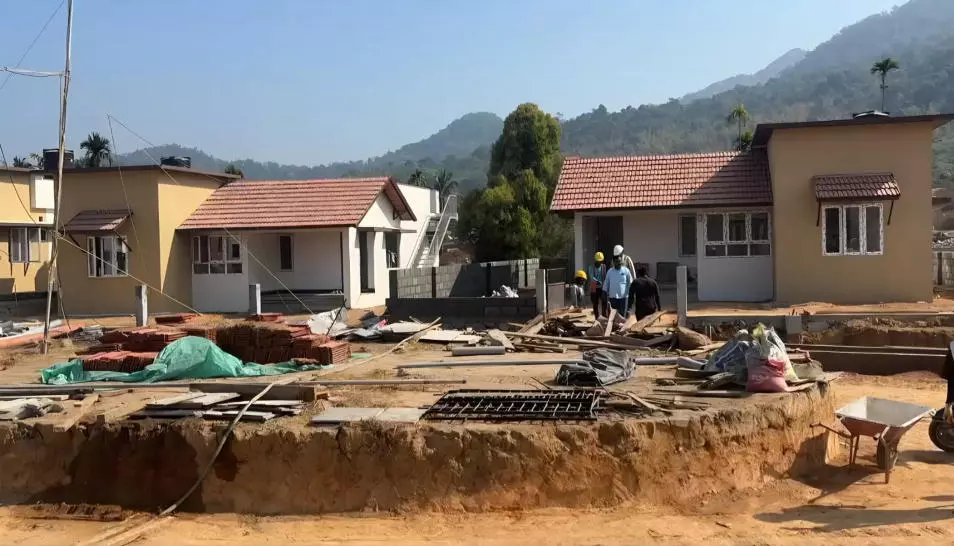
Their stories are now part of a larger narrative unfolding in Wayanad. The Kalpetta rehabilitation township, conceived after the devastating Mundakkai and Chooralmala landslides, has moved from blueprint to reality within 11 months of the foundation stone being laid. In the first phase, 178 houses are ready for handover, part of a total of 410 planned in the township.
Built as a planned settlement within the Kalpetta municipal area, the township is more than a cluster of houses. Internal roads connect housing clusters. Water supply systems and storage tanks have been installed. Drainage, electricity connections, and community facilities have been integrated into the layout. The design allows for structural stability and future expansion, officials say.
In the first phase, 178 houses are ready for handover, part of a total of 410 planned in the township.
The speed of construction has become central to the political conversation in Kerala. The Left Democratic Front government has projected the township as a model of coordinated disaster rehabilitation, pointing to legal hurdles in land acquisition and court cases linked to the Elston Estate that had to be resolved before work could begin in earnest. The administration also decided against allowing sponsors to build houses independently, citing lessons from earlier rehabilitation efforts where variations in quality were reported.
Also Read: Wayanad relief: Why India needs climate-sensitive banking now more than ever
However, this very approach has also fuelled political controversy. The United Democratic Front chose not to formally associate with the government-led township project and instead decided to pursue its own rehabilitation initiatives. Opposition leaders maintained that they would directly support survivors through separate housing efforts rather than contribute to a centrally-executed scheme.
DYFI mobilised Rs 20.45 crore
On the other hand, the ruling party, especially through their youth wing, Democratic Youth Federation of India (DYFI), chose to channel its efforts into the government’s rehabilitation mission. The organisation contributed around Rs 20.45 crore to the Chief Minister’s Distress Relief Fund, mobilised through a series of fundraising campaigns including scrap collection drives towards the construction cost of 100 houses, thereby becoming part of the project.
Several charitable organisations and state governments, including Karnataka, also extended financial support to the rehabilitation initiative.
Alternative scheme
The State had offered an alternative Rs 15 lakh in financial assistance package for families that preferred to rebuild independently or secure housing on their own. A section of beneficiaries chose this option, and were subsequently covered under housing projects supported by the UDF and its constituent parties.
Also Read: Kerala HC slams Centre over loan waiver for Wayanad landslide survivors
The Indian Union Muslim League, a key UDF ally, has so far completed 52 houses out of the 105 it announced, with work on the remaining units progressing. The Congress, which had declared that it would construct 100 houses for survivors, has encountered delays in initiating construction and is now scheduled to lay the foundation stone for its project on February 26.
Congress’s housing project to begin on Feb 26
Later, the UDF, particularly the Congress, accused the government of not making land available for its proposed housing project. The ruling front rejected the charge, maintaining that rehabilitation was being carried out in a coordinated manner and that political differences should not obstruct the larger objective of resettling survivors.
“The government’s rehabilitation project itself was delayed. It received Rs 1,200 crore in the Chief Minister’s Distress Relief Fund and sat on it without doing anything substantial for the affected families. Even hospital expenses were not fully met. It has taken nearly a year to complete this project. In fact, the government did not provide us land in the initial phase, and that is why our rehabilitation plan got delayed. We will begin our housing project on February 26,” Leader of the Opposition VD Satheesan said.
“There are discussions and even complaints about the funds collected by the Congress as donations. Even their own workers have raised questions about that. But we are not making that an issue here,” said K Rajan, the state revenue minister.
Also Read: Wayanad landslide, one year on: Scars remain, but hope endures
“During the rehabilitation mission, we convened all-party meetings and leaders of the UDF were present. At no point did they raise any demand for land, either in writing or even informally. It is only now that they are making these accusations.”
Rajan maintained that the government’s priority remained the welfare of the affected families.
“What we want is better lives for the affected people. If the Congress is building houses, that is welcome. Let them do it. It is better late than never,” he added.
Revenue officials in Kalpetta admit that some of the families that initially opted for the cash assistance instead of houses in the government township are now returning and requesting to be included in the housing project. They have conveyed their willingness to refund the amount they received under the rehabilitation package.
However, officials say many others are in a difficult position, having already spent the Rs 15 lakh assistance, and are now expressing disappointment that they cannot easily reverse their decision.
Comparisons with other rehabilitation programmes
As the first set of families prepare to move in, the project has triggered comparisons with past rehabilitation programmes. In particular, tsunami housing projects built after the 2004 disaster have re-entered public discussion.
At Anchuthengu in Thiruvananthapuram district, 98 houses built in 2011 for tsunami-affected families are now often cited in political debates. Residents there have raised concerns over deterioration and are demanding reconstruction. Similar issues have been flagged in Ponnani in Malappuram district, where compact one-bedroom tsunami houses have drawn criticism over space and quality.
Residents of houses built for tsunami-affected families in Anchuthengu, Thiruvananthapuram district, have raised concerns over deterioration and are demanding reconstruction. Photo: The Federal
“We were given single-room houses with a small kitchen. They were poorly built and began deteriorating in the very next year itself. Now they are leaking, and in many houses even the concrete on the roofs has come off. Officials say they are helpless,” said Silvester, a tsunami survivor from Thiruvananthapuram district. “Now the Wayanad victims are getting high-quality houses. We urge the government to consider us too,” he added.
Also Read: Wayanad landslides: Centre's loan conditions face flak; Kerala govt seeks flexibility
These comparisons have sharpened the political divide. The ruling front argues that the Wayanad township represents an improvement in planning, scale, and construction standards. The opposition counters that tsunami rehabilitation was undertaken on a massive scale and that isolated shortcomings should not overshadow the broader effort.
A chance to begin again
For the likes of Ashraf, Valsala, Veerankutty, and Valliyamma of Wayanad, however, the political crossfire feels distant. What matters is the solidity of the walls around them and the assurance of ownership after months of displacement. For families who had watched their world collapse in mud and rain, the township represents something simple yet profound: a chance to begin again.