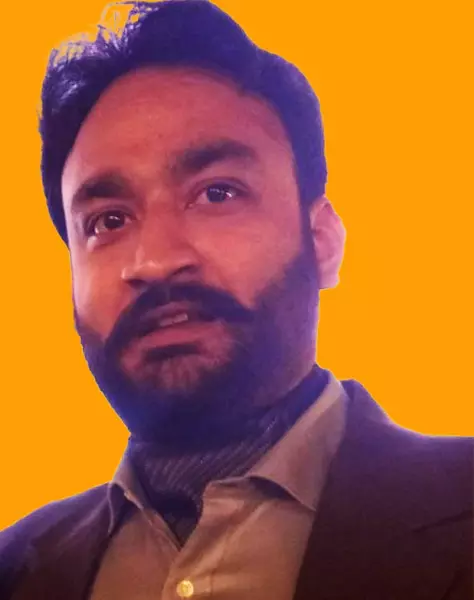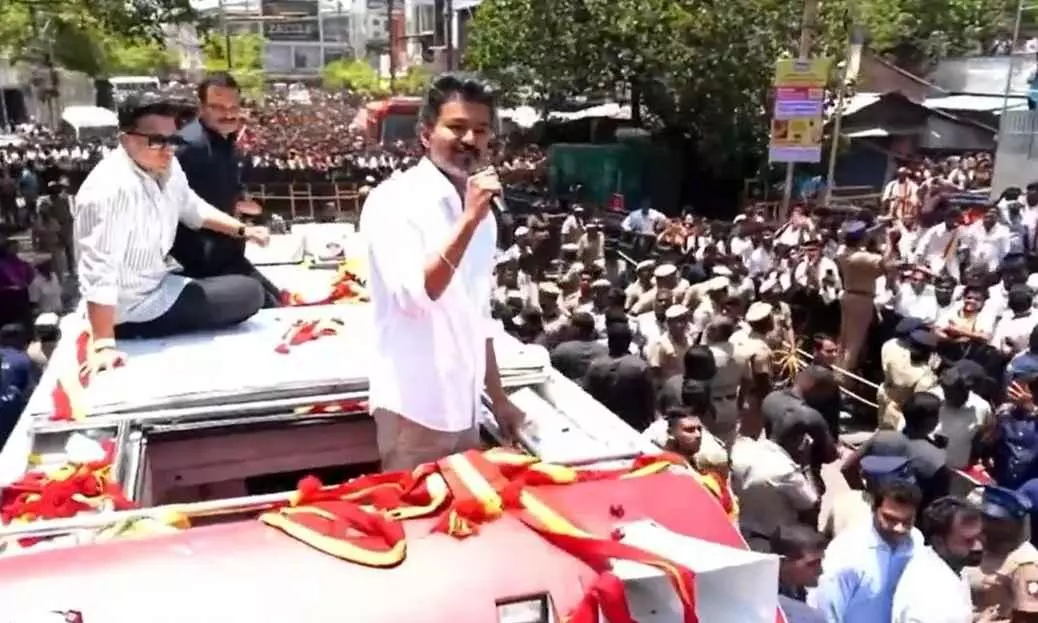
Actor Vijay's emergence has stirred Tamil Nadu's political pot
From TVK surge to SIR row: Key forces shaping Tamil Nadu and West Bengal elections
TVK’s emergence adds unpredictability in Tamil Nadu, while Bengal’s SIR exercise and identity politics deepen electoral polarisation ahead of polling

“Vijay may generate hype, but without a strong organisational base, he is unlikely to replicate an MGR-like impact in this election,” said Mahalingam Ponnusamy, setting the tone for a high-stakes discussion on Tamil Nadu’s evolving political landscape. As Tamil Nadu and West Bengal head into crucial polling on April 23, questions around leadership, voter sentiment and shifting narratives dominate the political discourse. The Federal spoke to its Editor – Special Projects Ponnusamy in Chennai, and Associate Editor Samir Purkayastha in Kolkata, to break down what is at stake in both states.
Vijay factor
Tamil Nadu’s electoral battle is no longer a straightforward contest between the DMK-led alliance and the AIADMK-BJP combine. The entry of actor Vijay’s Tamilaga Vettri Kazhagam (TVK) has added a new dimension.
Also read | Annamalai says Vijay’s TVK will get votes but won’t play spoilsport for NDA
Ponnusamy pointed out that Vijay has managed to draw massive crowds, particularly among youth and urban voters, projecting himself as a clean alternative with a strong anti-corruption pitch. “People want to see him, take selfies with him — his personal appeal is undeniable,” he said.
However, he cautioned against overestimating this popularity. Drawing comparisons with past actor-politicians, he noted that only MGR succeeded due to strong organisational groundwork and a pro-poor image. “Vijay lacks a deep cadre network and second-rung leadership. The party relies heavily on fans, which is not enough in Tamil Nadu politics,” he explained.
Pre-poll projections suggest TVK could secure 10–25% vote share, but seat conversion remains uncertain, with estimates ranging from zero to five seats.
DMK challenges
Despite its strong organisational base, the DMK is not without challenges. Ponnusamy said the party continues to rely on its core narrative of social justice, welfare schemes, and Tamil identity.
“The DMK is positioning itself as a protector against the BJP, especially on issues like delimitation and federal rights,” he said, referring to Chief Minister MK Stalin’s visible protests against central policies.
However, issues such as law and order, women’s safety, drug-related concerns, and corruption allegations have emerged as key talking points for the Opposition. “Even some DMK leaders acknowledge that law and order needs attention if they return to power,” he added.
Yet, a fragmented Opposition — with AIADMK, BJP, TVK, and NTK all competing — could work in DMK’s favour. “Vote splitting among opposition parties is likely to benefit the DMK,” Ponnusamy noted.
Minority dynamics
The minority vote remains a critical factor in Tamil Nadu, traditionally favouring the DMK. Ponnusamy emphasised that the party has strategically framed the election as a contest against the BJP to consolidate this base. “The DMK has built a strong shield around its minority vote bank,” he said.
Also read | Are DMK’s poll promises and Vijay’s charm shaking AIADMK’s hold over Kongu belt?
While Vijay’s TVK may attract a fraction of minority votes, he believes it is unlikely to significantly dent the DMK’s dominance. “At best, TVK may take a fraction of these votes, but breaking DMK’s hold is difficult,” he added.
Alliances under strain
The Congress, though part of the DMK alliance, appears to be playing a limited role. Seat-sharing tensions and speculation about alternative alliances briefly surfaced but were eventually resolved.
“The alliance remains intact, though there are minor ground-level frictions,” Ponnusamy said, describing Congress as “loyal but assertive.”
On the other hand, the BJP’s alliance with AIADMK presents its own challenges. The DMK has successfully framed the BJP as an external force attempting to impose Hindi and Hindutva narratives.
“This anti-BJP positioning suits Tamil Nadu’s political culture and helps the DMK,” he said, adding that the BJP’s presence could be a liability for its allies in certain regions.
Bengal stakes
In West Bengal, the stakes are equally high, with the Trinamool Congress (TMC) seeks to defend its long rule against an aggressive BJP challenge.
Also read | Bengal polls: Farmers’ distress in Malda turns into political ‘hot potato’ for TMC
Purkayastha highlighted that Phase 1 polling covers 152 constituencies, including politically sensitive regions like Nandigram, Malda, Murshidabad, and North Bengal.
“The TMC has a cushion from its past performance, but the BJP has entrenched itself in several areas, especially in North Bengal and Jangalmahal,” he said.
He noted that many seats were decided by narrow margins in previous elections, making even small vote swings crucial.
SIR controversy
A major factor shaping the Bengal election is the voter list revision known as the SIR exercise.
Purkayastha pointed out that large-scale deletions — particularly affecting minorities and women — have introduced uncertainty into the electoral landscape. “In several constituencies, deletions exceed previous victory margins,” he said.
This has raised concerns for the TMC, whose support base relies heavily on these demographics. “This phase will show the most visible impact of the SIR exercise,” he added.
Identity politics
The campaign in Bengal has increasingly turned into a battle of identity narratives.
While the BJP continues to push its Hindutva agenda, it has attempted to blend it with Bengali cultural identity. The TMC, meanwhile, has countered this by highlighting issues like food habits and cultural imposition.
“Fish has become a political issue,” Purkayastha said, referring to debates over dietary practices and cultural identity.
He noted that incidents targeting Bengali-speaking migrants and restrictions on food practices in BJP-ruled states have been used by the TMC to strengthen its narrative.
Nandigram focus
Nandigram remains one of the most closely watched constituencies. Purkayastha described it as “a laboratory of polarisation,” with strong Hindu-Muslim divisions shaping voter sentiment. BJP leader Suvendu Adhikari’s campaign has focused heavily on religious consolidation.
However, the TMC has countered this by fielding a candidate with local roots and insider knowledge. “This creates a direct challenge for Adhikari,” he said.
Mamata's strategy
Mamata Banerjee’s aggressive campaign style has also drawn attention. Purkayastha argued that her confrontational approach is less about nervousness and more a calculated strategy. “She is framing the election as unfair and positioning herself as a victim,” he said.
By shifting the focus to issues like SIR, central interference, and financial constraints, the TMC aims to move the narrative away from governance concerns.
Also read | In Bengal's Muslim heartland, quiet discontent tests TMC's grip
At the same time, he acknowledged an undercurrent of anti-incumbency. “There is some unease, particularly among youth over unemployment and corruption issues,” he noted.
As Tamil Nadu and West Bengal head into crucial polling, both states present complex political landscapes shaped by new entrants, shifting narratives, and strategic battles.
In Tamil Nadu, the rise of TVK adds unpredictability, while in Bengal, the SIR controversy and identity politics could prove decisive.
With fragmented Opposition in Tamil Nadu and polarised contests in Bengal, the results will hinge on how effectively parties convert their narratives into votes.
The content above has been transcribed from video using a fine-tuned AI model. To ensure accuracy, quality, and editorial integrity, we employ a Human-In-The-Loop (HITL) process. While AI assists in creating the initial draft, our experienced editorial team carefully reviews, edits, and refines the content before publication. At The Federal, we combine the efficiency of AI with the expertise of human editors to deliver reliable and insightful journalism.