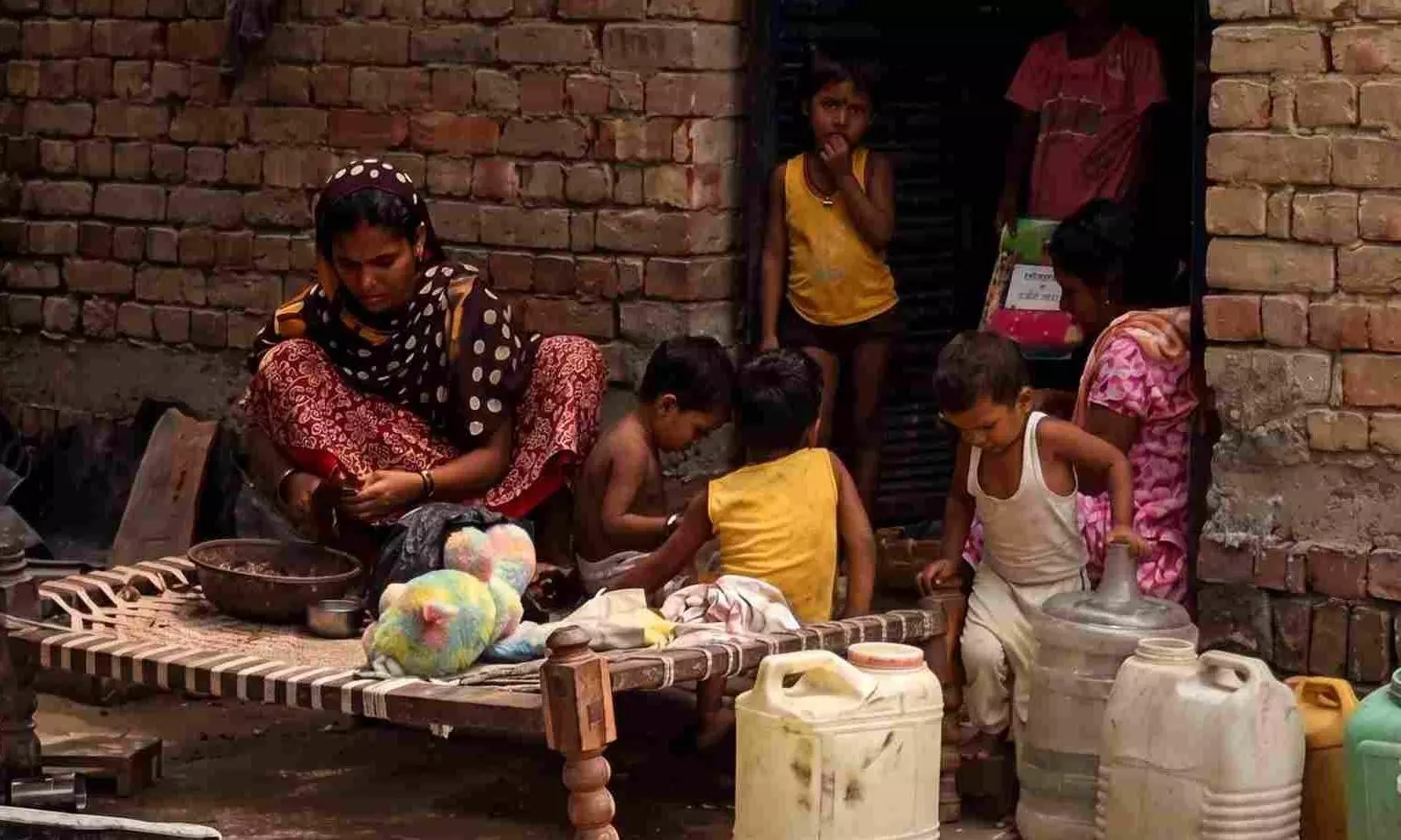
In the bidi-making lanes of Malda and Murshidabad’s rural heartland in West Bengal, politics rarely enters formal conversation, as livelihood concerns dominate daily life.
It surfaces occasionally among women rolling leaf-wrapped bidis in courtyards, or in pauses between talk on wages, household expenses and voter lists. In one such courtyard in the bidi belt, women working in small groups say their household economies have long depended on state welfare support along with informal labour.
Quiet shift
Yet, ahead of the election, a quieter shift is emerging beneath the routine, a gradual rethinking of long-held political loyalties.
“We have voted the same way for years,” said middle-aged bidi worker Matwora Bibi from Malda’s erosion-affected Panchanandapur village, under the Mothabari assembly constituency, without naming any party. “But this time people are thinking differently. Income is stagnant, work is uncertain, and promises feel the same.”
Malda and Murshidabad, with a significant Muslim-majority electorate, have been regarded as important support bases of Chief Minister Mamata Banerjee’s Trinamool Congress (TMC).
But, conversations across villages, migrant homes, and small towns suggest that the political ground is becoming less settled.
Precarious life of migrant labourers
What is most visible in this shift is a growing unease among younger Muslim voters, particularly men in working age groups, in districts that are also among Bengal’s largest exporters of migrant labour.
Murshidabad and Malda send thousands of workers every year to states such as Kerala, Tamil Nadu, Karnataka, Delhi and Maharashtra, for construction and informal sector jobs. To find work within the state, they often migrate to Kolkata and adjoining industrial belts such as North 24 Parganas, Burdwan and Hooghly, as employment opportunities within their home districts remain limited.
Bangi Tola, Mothabari: Ahead of the election, a quieter shift is emerging beneath the routine, a gradual rethinking of long-held political loyalties
While official district-wise census data on migrant labour is not available, estimates based on labour department records and field surveys suggest that around seven to eight lakh workers from Murshidabad and about five lakh from Malda migrate for work outside the state, taking the combined figure to roughly 12-13 lakh migrant workers.
The precarious nature of migrant work of late has also fed into a sense of vulnerability among workers from the region, shaping political perceptions back home.
Frustrated youth
The ordeal of Mehboob Sheikh, a migrant worker from Bhagwangola in Murshidabad district, has underscored these anxieties.
He was picked up along with other Bengali-speaking workers from the Mira Road area in Mumbai last year, and had their belongings, including identity documents and phones, allegedly seized. They were later transported to Bagdogra in West Bengal before being pushed across the border into Bangladesh.
Sheikh and others were repatriated only after intervention by the West Bengal government.
“If there were enough job opportunities in our own state, we would not have to face harassment, insult and humiliation in other states,” Sheikh said.
Among sections of educated Muslim youth, frustration is more visible, and is increasingly directed not only at the lack of jobs but also at what they describe as the absence of a clear road map to better jobs and income in their home districts.
Many say welfare schemes ensure subsistence but not stability.
Muslim youth are frustrated since there is no clear road map for jobs in the region: Morsalim Sheikh (left), Sofullah Ansari (centre) and Samim Akhtar
“Those of us who are educated but unemployed do not want allowances. We want our degrees to be valued and a transparent recruitment process in place. But neither the state government nor political parties seem to care. They are busy with allowances, fairs, festivals, and temples or mosques. We want both the state and the country to move forward on the path of development,” said Samim Akhtar, a part-time teacher from Basudebnagar in Murshidabad’s Samserganj assembly constituency.
“Both the current state government and the BJP-led central government are playing with the lives of the unemployed. No one is clearly talking about jobs in their manifestos. As many as 26,000 jobs were cancelled in the state due to corruption. Everyone talks about allowances, but there is no assurance of permanent jobs,” said Morsalim Sheikh, another unemployed youth from the area.
Minorities anxious
Alongside economic concerns, a set of policy-related anxieties has begun to creep in among minority communities in the region.
One concern raised in conversations relates to the implementation of waqf property registration under the amended law, which many residents describe as poorly handled in the state. West Bengal saw extremely low registration of Waqf properties in West Bengal on the central UMEED portal.
Many say the low registration is largely because the state government had initially delayed implementation saying it would not allow roll out of the amended Waqf Act in the state.
“The state government misled minorities on the waqf issue and did not allow space for protest,” said Md Saduddin, a political commentator and author. “When people raised concerns, the chief minister asked them to go to Delhi. That has clearly caused resentment within the community.”
Another issue repeatedly mentioned is the restructuring of the state’s OBC classification list. The revised OBC list reclassified several Muslim sub-communities from the “OBC-A” (more backward) to the “OBC-B” (less backward) category, while removing some from the list altogether.
“The revised list has undermined the minority interest,” said Samiul Alim, a private tutor at Samserganj, whose Pailan sub-caste has been “downgraded” from A category to B category.
Above all controversy over voter list revisions further contributed to an atmosphere of uncertainty.
For many voters, these issues are not viewed in isolation but as part of a broader perception that governance systems are becoming less predictable.
“We are not saying rights are taken away,” said Sayed Reza Ali Mirza, a descendant of erstwhile nawab of Bengal. “But there is confusion everywhere over documents, categories, lists. People do not understand what will change next.”
In recent months, sporadic tensions in parts of Malda district, including areas such as Mothabari, have also reflected underlying social frustration.
Political fallout
The political fallout, however, has extended beyond the immediate incidents. Smaller political formations such as the Indian Secular Front (ISF), along with outfits linked to Humayun Kabir and other local leaders, have attempted to position themselves as voices articulating minority grievances.
The All India Majlis-e-Ittehadul Muslimeen (AIMIM) has also tried to expand its presence, though with limited organisational reach in the region.
Amid this shifting environment, the Congress is attempting to rebuild its presence in Malda and Murshidabad, districts where it once held strong organisational control before its decline over the past decade.
Senior leader Adhir Ranjan Chowdhury has been projecting optimism about the party’s prospects. “The Congress has been striving hard to secure its own political existence as well as to restore its lost ground, and common people are responding,” he told The Federal. “We are optimistic that Congress will emerge as a force to be reckoned with.”
Minorities will vote for the TMC despite some minor discontent here and there, which is natural for any incumbent government in a democracy, says TMC's Mothabari candidate Md Nazrul Islam
Party leaders acknowledge privately that while there is receptiveness among sections of voters, breaking the TMC’s hold remains difficult due to fear of vote division benefiting the BJP. "Minorities will vote for the TMC despite some minor discontent here and there, which is natural for any incumbent government in a democracy,” said TMC's Mothabari candidate Md Nazrul Islam.
Fear factor
The BJP, meanwhile, continues to focus its messaging largely on issues of border security and demographic change. In districts like Malda and Murshidabad, which share porous borders with Bangladesh, the party hopes to make incremental gains by consolidating Hindu votes and capitalising on any split in minority votes. However, political arithmetic in the region remains complex.
Even where dissatisfaction exists with the TMC, many minority voters express hesitation about shifting allegiance in a fragmented opposition scenario.
“There is anger, yes,” said Mosarekul Anwar, a Malda-based social worker. “But there is also fear. People ask, if not the TMC, then who? And what if a drift in votes from the TMC ultimately helps the BJP?”
This “fear factor” often leads to last-minute consolidation behind the TMC, even among voters who are critical of its governance.
To counter this, the Congress has begun signalling that in a hung assembly scenario it could support a non-BJP government, including the TMC if required, a message aimed at assuring voters that a Congress vote would not be “wasted”.