



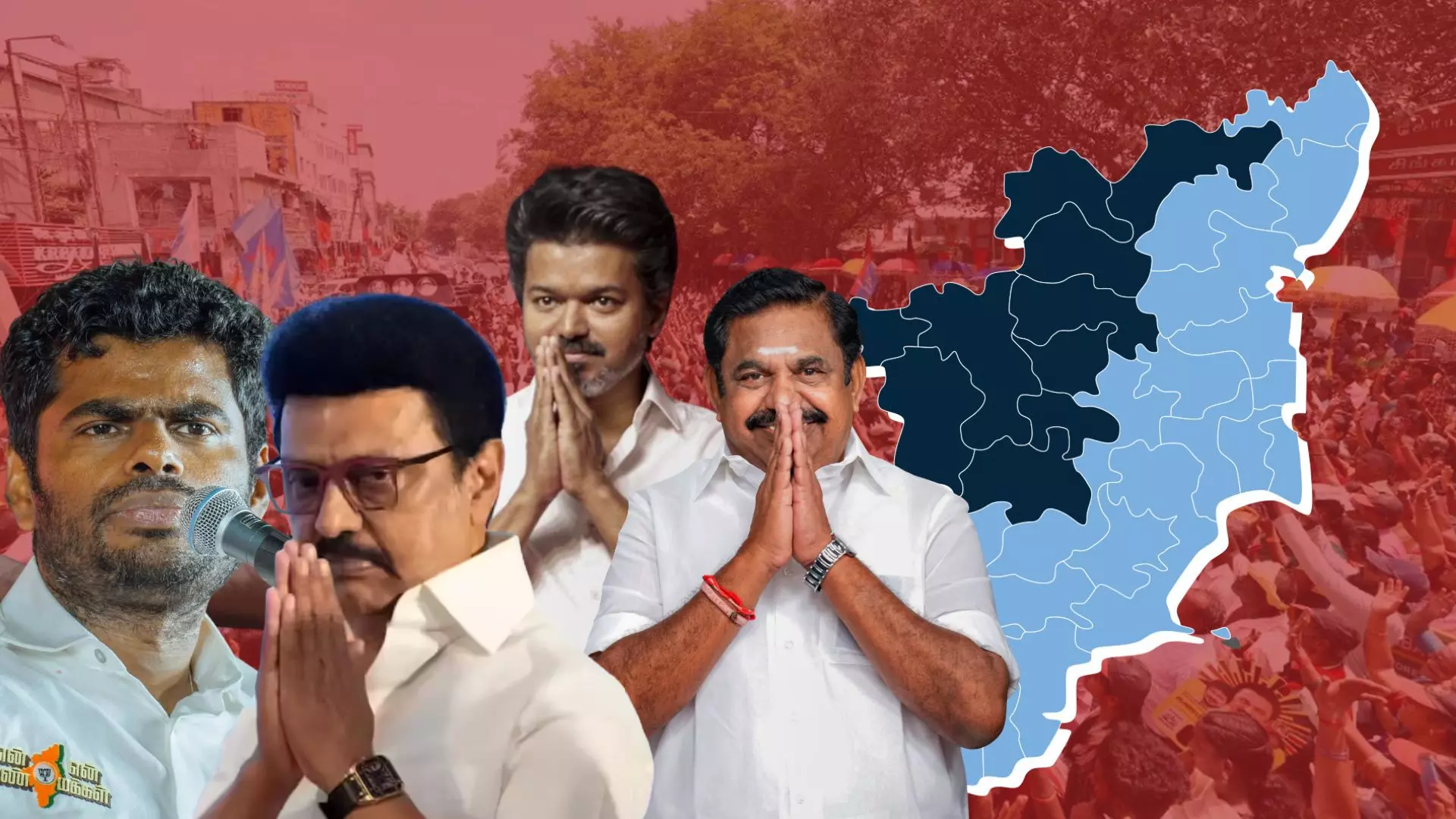
Are DMK’s poll promises and Vijay’s charm shaking AIADMK’s hold over Kongu belt?
As DMK floods Kongu with cash politics and actor Vijay’s wave sweeps the region, is the once unbreakable AIADMK fortress on the verge of collapse in 2026?

The Kongu region, traditionally the industrial heartland of Tamil Nadu, is witnessing a significant shift in political dynamics as the 2026 Tamil Nadu Assembly elections draw near.
Known for its economic prosperity and strong AIADMK influence, the Kongu belt is now experiencing the rise of new players like the DMK, driven by aggressive cash-and-gift politics, and the growing star power of actor Vijay. As AIADMK grapples with internal challenges, particularly with the rise of BJP in the region, the landscape is more fluid than ever.
Will DMK’s strategy and Vijay’s charisma be enough to break AIADMK’s hold on Kongu? Here’s an in-depth look at the forces shaping the Kongu region’s future.
What is the Kongu belt?
The Kongu belt, also known as Kongu Nadu, is made up of the western districts of Tamil Nadu, including Coimbatore, Tiruppur, Erode, Namakkal, and Salem. The region has long been an industrial powerhouse, especially in textiles, engineering, and small-scale industries. It is home to the dominant Kongu Vellalar Gounder community, which makes up about 30-40 per cent of the population, and has historically leaned towards the AIADMK. This region has also seen significant caste-based political alignments, which AIADMK has skilfully navigated to maintain its stronghold.
The rise of DMK’s influence
For decades, the Kongu region was a fortress for AIADMK. However, recent shifts indicate that this stronghold could be at risk. The DMK has aggressively targeted Kongu with promises of cash and gift politics, including distributing anklets to women voters and gaining traction in local body elections. According to Senthil Rajagopal, a political observer, “Caste is not important anymore. Money and contractors decide the election.”
Also Read: DMK’s Chennai manifesto | Ezhilan Naganathan explains party’s final-phase pitch
This strategy has already shown results, with DMK gaining significant ground in recent years. The party’s attempts to appeal beyond traditional caste-based politics have gained traction, particularly as AIADMK struggles with internal issues and BJP’s growing influence.
BJP’s rise and its impact on AIADMK
The rise of BJP in Kongu has been another factor that is weakening AIADMK’s traditional base. BJP leader K Annamalai’s popularity, particularly among the youth, has drawn votes away from AIADMK. In fact, many observers believe that 10-15 per cent of AIADMK’s traditional vote share has shifted towards the BJP in recent years.
According to Ka. Su. Velayutham, a senior journalist, "After the Coimbatore bomb blasts, women voted heavily for the lotus symbol. The blasts completely changed the politics here. Annamalai brought youth into politics, and the BJP's total vote share came 50% from AIADMK and 50% from Kongu Nadu Gounder Associations."
With AIADMK now heavily reliant on BJP support, its grip on Kongu is weakening, making room for new political forces like DMK.
Vijay’s growing influence
Actor Vijay, often called the “Thalapathy” of Tamil cinema, is fast becoming a political figure of significant importance in Kongu. His massive fan base, which spans across caste and religious lines, is expected to have a profound impact on the upcoming elections. Many analysts predict that Vijay could win as much as 25% of the votes in Kongu, pulling support away from both AIADMK and DMK.
Also Read: Annamalai says Vijay’s TVK will get votes but won’t play spoilsport for NDA
Ka. Su. Velayutham adds, "Vijay’s wave is going to be extremely strong in the Kongu region. He will get votes cutting across caste and religion. The same Kongu region that helped MGR and Jayalalithaa win big will now favour Vijay."
With Vijay appealing to the region’s youth and bypassing traditional caste politics, his popularity could be a game-changer in the 2026 elections.
DMK’s cash-and-gift strategy
The DMK’s aggressive use of cash and gift politics has become a key element in the party’s strategy for winning the Kongu region. The party is leveraging its strong welfare schemes and promises to the electorate, such as free bus rides, subsidized breakfast schemes, and financial assistance to women. While these moves have sparked criticism from political rivals, they have proven effective in garnering support, especially in areas where caste-based politics no longer hold the same sway.
As Murugavel, a writer, points out, “Jayalalithaa cleverly prevented any strong Kongu caste organisations from growing, making the Kongu Vellalar Gounders the face of the AIADMK.” With DMK’s growing focus on welfare and promises of financial support, AIADMK’s long-standing dominance in the region may no longer be enough.
What’s next for Kongu?
The Kongu region is no longer the bastion of AIADMK that it once was. With DMK’s cash politics, the rise of BJP’s Hindutva appeal, and the increasing star power of Vijay, AIADMK is facing its biggest challenge in years. As political dynamics evolve, it remains to be seen whether the region will shift fully in favour of DMK or if AIADMK, with the support of BJP, can reclaim its lost ground.
As we approach the 2026 elections, Kongu voters will be more crucial than ever, and the political parties are leaving no stone unturned to win their favour. The future of Kongu politics is uncertain, but one thing is clear: change is on the horizon.
(The content above has been transcribed from video using a fine-tuned AI model. To ensure accuracy, quality, and editorial integrity, we employ a Human-In-The-Loop (HITL) process. While AI assists in creating the initial draft, our experienced editorial team carefully reviews, edits, and refines the content before publication. At The Federal, we combine the efficiency of AI with the expertise of human editors to deliver reliable and insightful journalism.)
