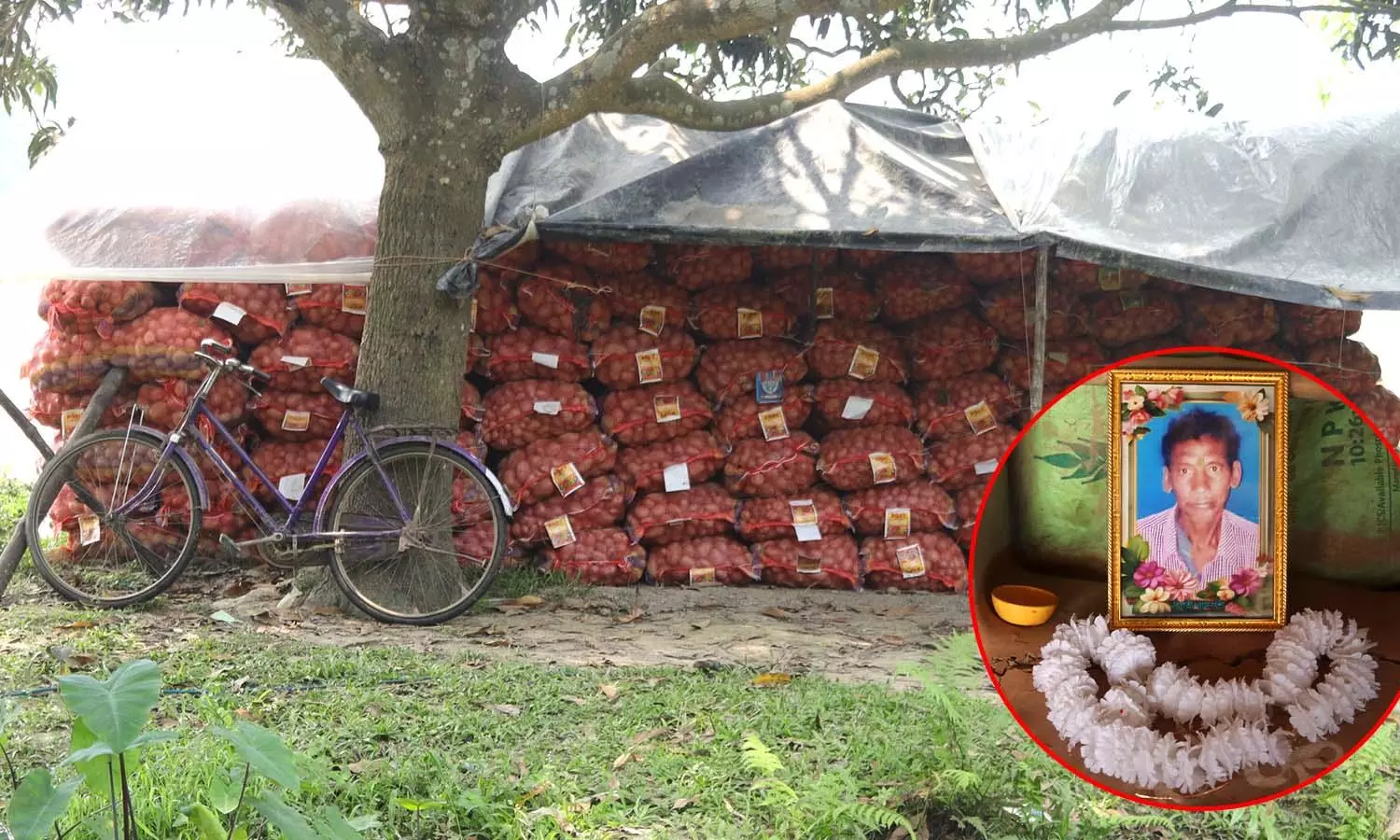
A 63-year-old farmer's tragic suicide last month has become a political flashpoint in Malda district in poll-bound West Bengal.
Rajbanshi had borrowed around Rs 50,000 to cultivate nearly five bighas of land in Telipukur village in Old Malda. When heavy rainwater accumulated in his fields, the standing potato crop began to rot, he was crushed and was worried sick about paying his accumulating debts. His nephew Bipati Rajbanshi shared his story with The Federal.
“He had planted potatoes hoping to repay loans he had taken from moneylenders, but unseasonal rain submerged the fields and destroyed the crop. He already had some financial pressure, and when the potatoes were ruined, he could not recover his costs. He didn’t tell anyone anything… and then he took this step," said Rajbanshi.
Across the state’s potato belt, spanning districts like Malda, Hooghly, Paschim Medinipur and Purba Bardhaman, farmers are grappling with a combination of factors like a bumper output, weather shocks and a sharp fall in prices.
West Bengal accounts for roughly a quarter of India’s potato production, making it the country’s second-largest producer. The crop supports lakhs of small and marginal farmers, many depend on informal credit and seasonal price cycles. This year, however, prices have collapsed.
“There is no price for potatoes here right now,” Rajbanshi’s nephew pointed out. “After harvesting, traders are offering Rs 130-Rs 150 per packet, which comes to around Rs 2.50 to Rs 3 per kilo. One packet contains 50kg of potatoes. But cultivating one bigha costs Rs 35,000 to Rs 40,000, including seeds, fertiliser and irrigation," he added.
The mismatch between input costs and market prices has triggered widespread distress, with the Opposition citing the crisis as evidence of broader governance failures. The issue has quickly acquired political overtones.
Policy shift
Chief Minister Mamata Banerjee, addressing a recent rally in Malda district, in the run up to the two-phase state assembly elections on April 23 and April 29, acknowledged the problem and said her government would step in to support farmers. She announced compensation measures and eased earlier restrictions on inter-state potato sales, signalling a policy shift after protests from farmers and traders.
In 2024, her government imposed restrictions on the movement of potatoes outside the state to stabilise retail prices in the domestic market, following a crop shortage that year. The curbs forced neighbouring states such as Odisha, one of the major importers of Bengal’s potatoes, to source the crop from elsewhere. “Since then, potato exports from Bengal have declined, creating a dip in demand,” said Lalu Mukherjee, secretary of the Progressive Potato Traders Association (PPTA).
Amid low demand and a bumper harvest this year, despite some initial crop damage due to unseasonal rains, has further worsened the situation.
Prime Minister Narendra Modi has used the crisis to target the ruling Trinamool Congress, telling a rally in North Bengal that “farmers are suffering because of wrong policies” and accusing the state government of failing to provide adequate market support.
High risks
On the ground, farmers say the crisis reflects a far more deep-rooted problem than just the over-production and demand equation. A bumper harvest, without sufficient processing capacity or export linkages, has led to oversupply. At the same time, rising input costs, from seeds and fertilisers to labour and packaging, have increased financial risk for cultivators.
Binoy Mandal, a potato farmer from Balarampur in Malda, said he had cultivated around two acres but was now facing severe distress due to crashing prices and lack of buyers. “I haven’t been able to sell a single potato. They are rotting here,” he said, adding that rising input costs and dependence on loans had deepened his financial crisis. “I’ve taken loans from seed shops and fertiliser dealers. Now I cannot repay them. My children are studying elsewhere and I cannot even send them money,” he said.
Explaining the scale of losses, Mandal pointed to the sharp gap between production costs and market prices. “We are spending around Rs 150 to Rs 200 per bag, but in the market it is selling for Rs 100 to Rs 120. That means a loss of about Rs 20,000 per bigha,” he said. He added that limited cold storage access provides no relief. “Storage costs about Rs 90 per packet, plus transport. We cannot store everything. So, we are forced to sell immediately after harvest, when prices are the lowest,” he said.
Fearing further losses from storing unsold produce in cold storage, farmers are forced to abandon their crops in the field or stack them under temporary tree sheds. For many, the risks are becoming untenable.
“We take loans every season, hoping for a good return,” said Prafulla Sarkar, a farmer from Malda’s Bhabuk village. “But if prices fall like this, we are left with nothing.” “Those who farmed their own land are somewhat okay; they got some capital back. But those who cultivated on leased land have nothing left. They are in complete despair,” said another farmer Bitesh Rajbangshi, describing the extent of the losses.
No government support
Criticising the government’s role in the crisis, he added, “The government does not look at any of this. They are not protecting the farmers (interest) at all. Whenever we sell potatoes at a better price, the government steps in and restrictions are imposed to controls the market. But when prices fall and we suffer, the government does not intervene at all.”
Asu Rajbangshi, another farmer, suggested that like paddy, the government should also procure potatoes at a minimum support price. Mukherjee of the PPTA endorsed the suggestion, saying it would help farmers to a large extent. In the absence of any such mechanism, farmers are left in complete despair. They allege that even crop insurance offers no help.