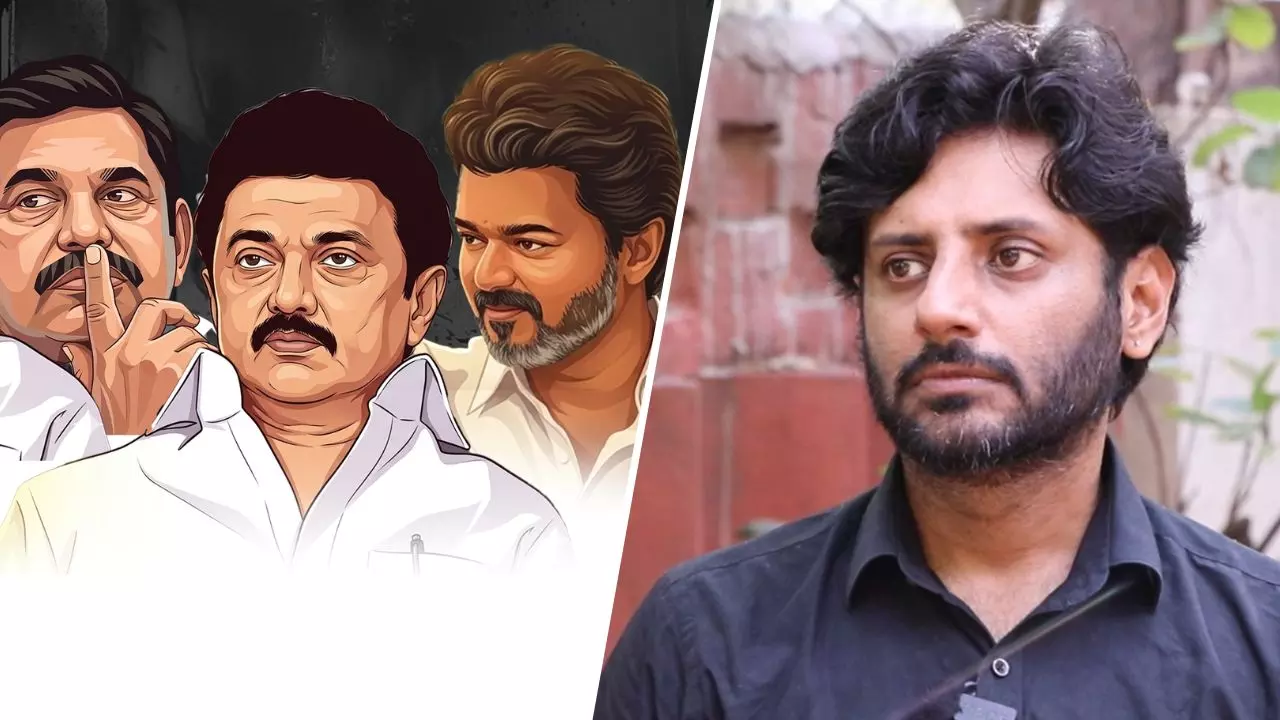
As for the others, the Naam Tamilar Katchi (TMK) has been in the fray for quite some time now and has steadily shown an increase in its vote share. The real question is TVK's strength, which everyone is anticipating.
That said, a four-cornered contest does not mean all four have an equal chance of winning, no one is suggesting that. It simply means the vote will be split. One party may walk away with 8 per cent, another with 15 per cent, one with 30 per cent, and another with 34 per cent. The real question is who gets what. As things stand, the order in terms of gaining more votes appears to be for DMK, AIADMK, TVK, and then for the NTK.
Though we talk about elections as being personality-driven, they’re still built on strong local leaders? Like Velu in Tiruvannamalai, KN Nehru in Trichy, you’ve pointed this out in your past poll surveys too. But, with TVK, we’re not seeing that layer yet, it feels like they’re going all in with Vijay as the main man. Do you think this kind of strategy actually works on the ground?
The party strength, when we speak about the AIADMK and DMK for that matter, lies in what you pointed out. Be it EV Velu in Tiruvannamalai or I. Periyaswamy in Athoor, in every district they have a local strongman. This holds true for the AIADMK as well, from SP Velumani to Thangamani to Vijayabaskar.
These are strongmen and women who add value to the party at the grassroots. At the same time, there is a central leadership with access to pan-Tamil Nadu voters. Strong grassroots combined with a pan-Tamil Nadu face is the key advantage these two parties enjoy.
In comparison, Tamilaga Vettri Kazhagam (TVK) is currently banking on Vijay. That said, they should be given the benefit of the doubt. They will take time to establish themselves, bring in more seasoned leaders, and allow their younger cadre to grow into established leadership.
After all, that is how the AIADMK and DMK also evolved. Given that TVK is only about two years old, there is still time for them to build that structure. But for now, they are up against titans like AIADMK and DMK, especially when it comes to specific constituencies.
Women make up nearly 51 pe cent of the electorate in Tamil Nadu, they are clearly a decisive bloc. Yet, there isn’t a single, dominant woman leader in the fray this time. Instead, parties like the DMK, AIADMK, and TVK are all actively trying to woo women voters through targeted promises and welfare messaging. From what you’ve seen on the ground criss-crossing the state, where do you sense the pulse of women voters is moving?
The fact that there are 1.2 million more women voters than men in Tamil Nadu is particularly interesting from a pollster’s perspective. The women’s vote is issue-based and certainly focussed on leadership, but it is also driven by the search for reliable leadership with an emotional connect. That is what we have sensed. Not every woman voter, but a large section tends to be emotionally connected.
This also explains why Tamil Nadu has often seen individual-centric decision-making in elections, from M Karunanidhi to MG Ramachandran, and later M Karunanidhi versus J Jayalalithaa. The women’s vote significantly favoured the AIADMK, largely because of Jayalalithaa as the face of the party. Her women-centric approach built a strong base among women voters, and there was no denying that.
After her demise, there was a vacuum, and the women’s vote did feel somewhat orphaned. Then came the announcement by superstar Rajinikanth, which generated excitement among women voters, but that did not materialise. Around the same time, there were figures like Kamal Haasan and, even earlier, Vijayakanth.
The women’s vote has consistently been drawn towards leadership they can emotionally relate to. The DMK, for long, faced a narrative of being a more male-oriented party, with perceptions around aggression and strong-arm politics, which kept some women voters at a distance. However, 2021 marked a shift. A number of clear, specific, women-focussed announcements, along with the absence of a figure like Jayalalithaa, created an opening.
The AIADMK lost a section of its women voters and did not fully regain them, while the DMK made significant inroads. The 2026 election will be crucial to study on three counts. First, whether the DMK has been able to retain that support. Second, whether the AIADMK is regaining and recovering its base. Third, the entry of Vijay as a newcomer. He is someone many have grown up watching on screen, even if they do not know him personally. There is a sense of familiarity and charm, and he is clearly making a dent in the women’s vote of both the AIADMK and the DMK. What that translates to in numbers remains to be seen.
Talking about women voters, there was initial buzz that TVK could attract significant support, especially after Vijay launched his campaign. However, with his divorce now in the spotlight, some feel that image may have taken a hit. Do you see any impact of this development on the ground, particularly among women voters?
Again, how much personal life and issues related to personal conduct are seriously considered by voters is something to watch. I do not think it has dented his image to a significant extent. Of course, there will be a segment of women voters who may now have second thoughts, no denying that.
But it is unlikely to prevent them from moving towards him, because Vijay and his party have already triggered excitement among women voters as well as young voters. They have set the ball rolling when it comes to Tamil Nadu 2026.
It was traditionally a two-cornered contest, with third and fourth players taking away smaller vote shares. Today, it is clearly a four-cornered fight, as mentioned earlier. Everyone is eyeing a certain vote share.
Vijay is attempting to make inroads into segments such as the Scheduled Caste vote, minority votes to some extent, along with women voters and youth voters. He is targeting a combination of different voter segments and is capable of drawing support from them.
The urban versus rural divide may also play a role in his case. When you look at such a broad spectrum of voters, not everyone is going to be swayed by negative personal news.
It seems like that there is a pro-incumbency wave sweeping across India, and that has been the broader trend. Do you see a similar pattern playing out here in Tamil Nadu as well? Whether it is a vote for Narendra Modi at the Centre, or in states like Assam, Kerala, or here in Tamil Nadu, what is technically happening is that voters are increasingly asking who can provide stability and continuity in governance.
Unless there is a strong, immediate issue that directly affects them and creates dissatisfaction, voters are often willing to continue with the existing system because it offers stability. That is a pattern we are seeing across the board. At the same time, the Opposition, whether at the central or state level, has not always been effective in presenting a strong and compelling narrative against incumbent governments.
If voters are to choose an alternative, that alternative has to excite them and present itself as capable. If it does not, there is little incentive to shift away from the incumbent. This is a broader pan-India trend we are witnessing.
Will Tamil Nadu be any different? It is still too early to say. If anyone is calling the 2026 election outcome in mid-March or end-March, it is premature. The state has not yet fully entered election mode. Perhaps in another week to ten days, we will begin to see clearer momentum, likely from early April.
Candidates will matter significantly in this election. Party and symbol alone will not decide outcomes. There is no clear statewide wave yet indicating whether a party will come to power, retain power, or whether a new force will emerge.
Alliance arithmetic will also be crucial. How effectively alliance partners of AIADMK transfer votes to the Two Leaves symbol, and how reciprocative that vote transfer is towards partners in the NDA, will matter a great deal. There is also the question of whether AIADMK voters, in constituencies where the party is not contesting, might shift towards other symbols or even towards Vijay, which could alter outcomes in specific seats.
Similarly, it remains to be seen whether the Congress cadre will work effectively for the DMK’s victory, and whether DMK cadre will reciprocate in Congress-contested seats. These dynamics will play a key role and need close observation.
So how do you see it? Both the alliances right now seem formidable, but there is some degree of bickering within the NDA, particularly when it comes to seat-sharing and related negotiations. The NDA is relatively stable. It is within the Secular Progressive Alliance (SPA) where friction between the Congress and the DMK becomes more relevant. For the general public, this does not matter as much. People are not going to say that because there were disagreements in early March, the alliance is weak. Voters largely do not factor that in.
For the cadre, however, it matters a great deal. In a constituency where the Congress is contesting as part of the SPA, the dynamics are different. As you pointed out, while it is broadly referred to as the INDIA alliance elsewhere, here it is still called the SPA, and that itself tells a story.
At the ground level, a DMK cadre member in a panchayat may think that if the Congress keeps winning that seat, they will eventually demand a share in local body positions in that constituency. That creates anxiety about their own political future. Many of them may feel that they have worked for two or three elections to secure victories for an ally, and now begin to question what lies ahead for them, especially those who are older and looking for political advancement.
This is where Vijay becomes relevant. As a pan-Tamil Nadu face, he can emerge as an option for those who are disgruntled within established party structures. Someone denied a seat in AIADMK might threaten to quit and join Vijay, and we have already seen instances of that. The same possibility exists within the SPA as well.
There are also instances from previous elections where outcomes have raised questions. Take Modakurichi, for example, where a BJP candidate defeated a DMK stalwart. Insiders often point to informal, under-the-surface understandings or decisions at the cadre level, where local workers may choose not to fully back an ally or even quietly shift support.
Such infighting, cross-voting, and lack of coordination within alliances are very real possibilities. These are the kinds of situations from which Vijay could potentially benefit. However, whether he is in a position to fully capitalise on this remains an open question.
You’re talking about what Vijay could have gained. There were, of course, several source-based reports in the media about Vijay potentially joining the National Democratic Alliance, and that Bharatiya Janata Party was interested. Now, with Vijay himself clarifying at the Iftar meet that he intends to go solo, and both the BJP and AIADMK also indicating that there are no such talks, that speculation has largely settled. Would it have changed the narrative? It would have given a huge boost to the cadre on both sides. On Vijay and TVK’s side, there are strong, resourceful individuals, but they are only a handful. Across 234 constituencies, managing every candidate, their resources, and coordinating it all through a central leadership that is just two years old is an arduous task. Efficient election management, campaign planning, and resource distribution at that scale is not easy.
For the AIADMK and the NDA, Vijay’s addition would have brought star value and a sense of optimism to the cadre. Right now, there is still some hesitation on the ground. Cadre want to defeat the DMK, but they are not fully convinced yet that they have the strength to do so this time. They are confident about the alliance coming together, but there is still doubt about whether they are ready to take on a DMK that is largely shouldering its alliance on its own.
In contrast, within the NDA, partners are operating more in parallel than as a single, cohesive unit. In that sense, Vijay and TVK joining the NDA would have made a significant difference, no denying that.
First, it would have strengthened perception. It would have projected the NDA as a formidable, united front against the incumbent. That perception itself could have triggered some level of anti-incumbency sentiment. Even if a strong anti-incumbency wave is not visible right now, such a development could have amplified it.
There are issue-based concerns against the government, no denying that. Whether there is a clear pro-incumbency wave is still uncertain. There is, however, a consideration among voters about continuity and stability.
This is why it is still important to wait. Over the next week to ten days, especially by around April 5th to 10th, the state should begin to show clearer indications of the direction in which the election is heading.
But can Vijay still join hands with the Bharatiya Janata Party despite calling the party his ideological enemy. Don’t you think this move would dent his party’s prospects in the state? I’m not going to comment on that, simply because my role is focussed on field research and related analysis. I can’t really comment on what politicians would say in such a situation, and I’m sure you and I both know how that works. There are no permanent enemies or permanent friends in politics, and those arguments would certainly come up.
With regard to TVK, what would likely happen is that there would be two or three days of explanation needed. But Vijay’s star value and his emotional connect with voters could help soften that narrative.
The messaging could simply be that if the goal is to defeat the DMK, then all forces need to come together and there is no other choice. What Vijay and TVK choose to do in the longer term can be decided later. For now, the pitch would be about unity.
Also, since you brought up alliances, there was a section within the Indian National Congress that was keen on a tie-up with TVK, with Praveen Chakravarty being one of the key figures pushing that idea. Was it a missed opportunity? That way, if you see, every political dispensation was, in one way or another, considering aligning with Vijay and TVK.
Parties that are now in the NDA had, prior to joining the NDA, held rounds of discussions with them. Even parties that have split into two factions, each segment was in talks with TVK. At the end of the day, it is a game.
In that game, you have a new, high star-value entrant, and naturally, others want to ride that euphoria. They also see greater opportunity, because elections are ultimately about convincing the voter. But that is where, perhaps, TVK may have missed an opportunity in not building alliances with several interesting players across the spectrum.
Even at their Vikravandi meeting, they created a stir by suggesting a power-sharing model. At that point, many believed it could shake up the political landscape in Tamil Nadu and lead to a strong alliance anchored by TVK, though it was unclear with whom.
However, from both ends of the political spectrum, parties were in touch with TVK. If anyone has missed out significantly, it may be TVK rather than the other parties.
We're closing in on the elections now. Whom do you think has the edge in Tamil Nadu in 2026?
The honest answer is that the primary Dravidian parties are likely to hold on to their vote banks, and the DMK, as an individual party, may not lose many votes. The AIADMK, on the other hand, still has some catching up to do.
When it comes to alliance arithmetic, the NDA is slightly better placed in terms of numbers, because the DMK is largely the sole vote-puller within the SPA.
At the same time, Vijay, with his appeal, could dent the minority vote to a certain extent, and he is also drawing support from women voters. That means both sides could see some erosion.
Not to confuse you, the straightforward answer is that we need another week. Once candidates are finalised and we know which party is contesting which constituency, we will have a clearer sense of who has the edge in the 2026 Tamil Nadu assembly elections.