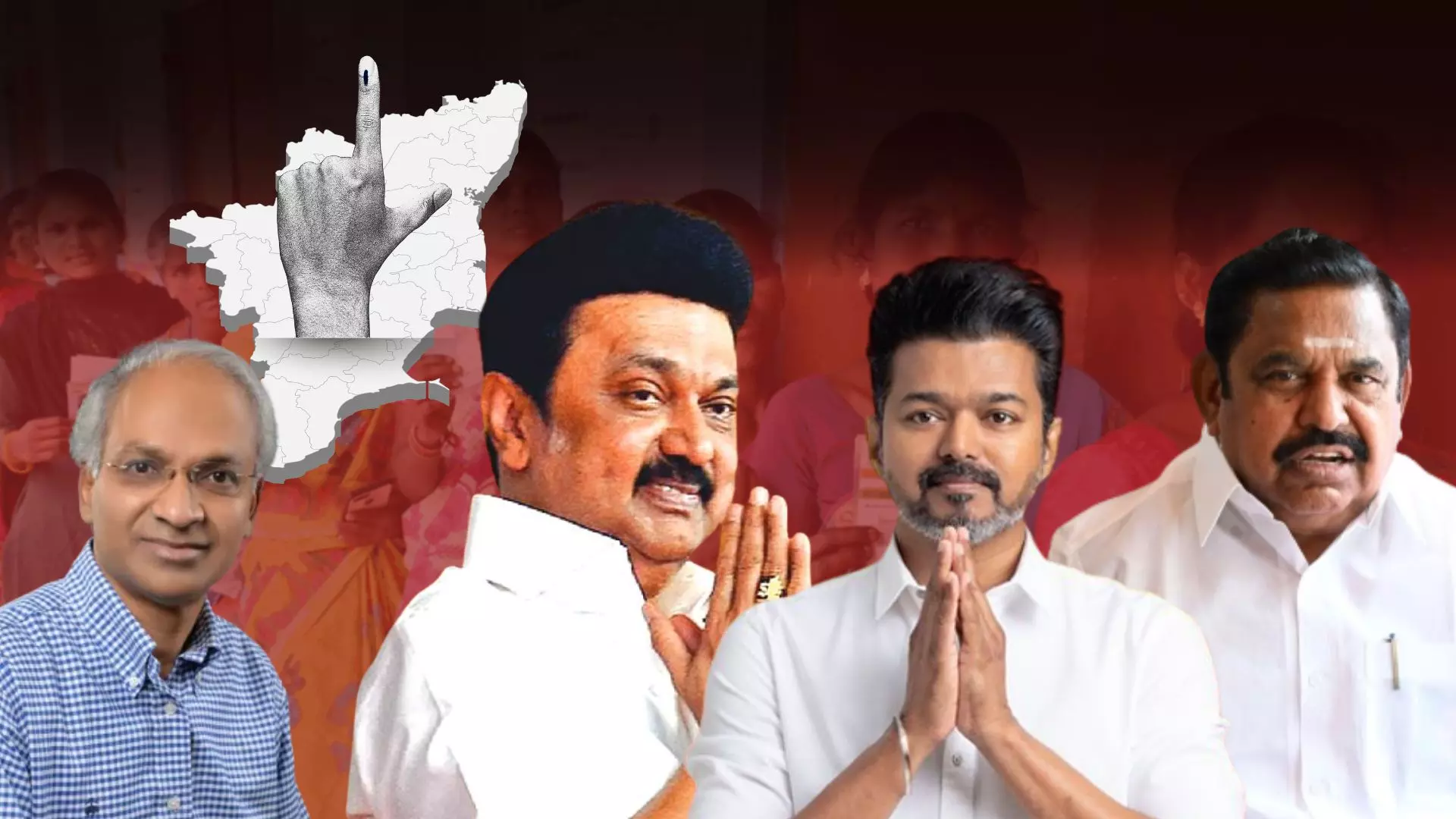
TN elections | DMK alliance has early edge, TVK may split votes: Political analyst Kannan
With the Election Commission (EC) announcing polling in Tamil Nadu on April 23 and counting on May 4, alliance negotiations and seat-sharing talks among major parties have intensified. Kannan says Vijay’s TVK entry could reshape 2026 TN election dynamics

Political analyst R. Kannan believes the DMK-led alliance currently holds an early advantage in the run-up to the 2026 Tamil Nadu Assembly elections, largely due to better preparation and early seat-sharing arrangements. At the same time, the emergence of Vijay and his party Tamilaga Vettri Kazhagam (TVK) could significantly alter the electoral dynamics, potentially splitting votes and reshaping traditional political alignments in the state.
With the Election Commission (EC) announcing polling in Tamil Nadu on April 23 and counting on May 4, alliance negotiations and seat-sharing talks among major parties have intensified.
Also read: Tamil Nadu elections 2026: 5 key issues likely to dominate poll campaigns
The Federal spoke to Kannan about the evolving political landscape, alliance arithmetic, and the potential impact of new entrants in the race.
How do you view the current political landscape in Tamil Nadu following the announcement of election dates? Which camp appears more organised?
I think the DMK-led alliance happens to have a head start when it comes to preparations—seat sharing, stitching alliances, and bringing more parties into the fold. It is a 24-party alliance, although the parties that really matter are the Congress, the Communist parties, and the Viduthalai Chiruthaigal Katchi (VCK).
Those parties are already there, and there are also a number of smaller parties that are part of the DMK alliance. On the other hand, we have the AIADMK-led NDA alliance, which seems to be a little unprepared as we discuss it at the moment.
Also read: After TVK’s denial, Palaniswami rules out alliance with Vijay’s party for TN polls
What impact does PMK's joining the NDA again have on the Opposition alliance?
The fact that Anbumani Ramadoss of the Pattali Makkal Katchi (PMK) has come back to the NDA fold along with the AIADMK is a bit of a boost in the arm for them. But I am not so sure there will be other parties that will join these alliances.
There is speculation about actor Vijay’s political moves. How do you see his role in this election?
Actor Vijay happens to keep us all guessing. There is much speculation that at the very end, he might throw his lot with the AIADMK–BJP alliance.
However, the presence of the Bharatiya Janata Party (BJP) seems to be a huge hurdle for him to make that leap, because he has always pronounced them as his ideological force.
If he ever decides to do that, then it would be a very serious contest between these two fronts, and everybody else will pale into insignificance, like Naam Tamilar Katchi (NTK). But I have a feeling that Naam Tamilar may not do as well as it did last time.
How do you view the DMK alliance after the seat-sharing negotiations with Congress?
I think the negotiations have left a little bit of a bitter taste, especially for the DMK, but I don’t think it will come in the way of cooperation.
Both parties know very well that they will have to work together at the field level to make this a winning combination.
There were very few people who really wanted to align with Vijay. The Tamil Nadu Congress Committee (TNCC) chief has repeatedly mentioned that there were no such discussions and that everyone was expressing personal opinions rather than the official position of the party.
Do you think Congress still depends heavily on its alliance with the DMK in Tamil Nadu?
Yes. The Congress essentially owes its presence in the Assembly to its alliance with the DMK. On its own, it is probably a shadow of its original self.
At the same time, both Dravidian parties have also lost some ground. They have lost ground to caste-based parties and Dalit parties.
Now we are seeing surging crowds at actor Vijay’s meetings. We do not know what these polls hold, but they are going to be very interesting. If Vijay joins the AIADMK-led front, or even if he contests alone, there could be a three-cornered contest.
Among the three major formations, I see Vijay’s TVK as the most unprepared at the moment because it is essentially just his party.
But does contesting alone also give Vijay more flexibility?
Yes, it gives him a lot of room. When you have many parties in an alliance, you must share seats and accommodate partners.
He can field candidates in all 234 constituencies. Candidate selection may already have been finalised internally. We do not know much because they do not say much, but I am of the opinion that all this must have been done and they will be able to announce candidates in a short period of time.
How do you assess seat-sharing negotiations in the NDA camp?
These committees are mostly for namesake—they are just a formal requirement. The real decisions are taken by the top leadership.
In the DMK camp, decisions are taken by the Chief Minister in consultation with senior leaders.
In the Congress camp earlier, there seemed to be some indecisiveness between the preferences of Rahul Gandhi and his mother, Sonia Gandhi. Finally, after a lot of back and forth, and after intervention by former finance minister P Chidambaram, things were sorted out.
What about seat distribution within the NDA alliance?
As far as the PMK goes, we understand that they might get around 18 seats, perhaps even 20 seats.
If they get 18 seats, then the BJP—which got 20 seats in the 2021 Assembly elections—may expect a little more this time. Their goal might be around 40 seats, similar to what the Congress initially wanted, representing each parliamentary constituency, including Puducherry.
If the BJP makes such a big demand, I do not think it will help the alliance much. They should understand the ground realities.
Is the BJP an advantage or disadvantage for the AIADMK alliance in Tamil Nadu?
The BJP is actually a bit of a liability for the AIADMK. Minority voters, especially Muslims, have completely deserted this alliance.
We do not know about other minorities—they might be ambivalent because of the BJP’s presence. So in a sense, the BJP becomes a burden for the AIADMK.
Of course, the BJP is very resourceful because it is the party in power at the Centre. That support can be useful. But when it comes to vote strength, only a small cross-section of people support them. Last time they won just four seats, so they should keep expectations realistic.
How do you see AIADMK leader Edappadi Palaniswami handling alliance pressures?
I am sure Edappadi K Palaniswami will handle these demands as he sees fit. He has already stood his ground on certain demands earlier.
Also, the presence of TTV Dhinakaran in the alliance is a bit of a boost.
However, we are largely extrapolating from the 2021 election results. In the 2024 parliamentary elections, these alliances were different. So we have to work with old numbers, but the ground reality has changed.
How do you evaluate the DMK government’s position going into the election?
There is a bit of momentum on the DMK side because it is the ruling party.
Despite anti-incumbency in some areas and allegations of corruption or governance issues, many welfare schemes have been very popular—especially among women voters.
But it is not entirely clear whether women will stand by the DMK or whether some of them might vote for Vijay’s party in the absence of J Jayalalithaa. So the situation is still unclear. This election is going to be very interesting.
Do you think TVK will split votes in traditional DMK or AIADMK strongholds?
Yes, something similar happened in 2006 when Vijayakanth contested alone. He won only one seat in Virudhachalam, but he spoiled the AIADMK’s chances in nearly 80 constituencies.
The same thing might repeat now. In my view, Vijay is more likely to dent the AIADMK vote bank than the DMK vote bank, though some analysts think otherwise.
Beyond alliances, what could be the deciding factor in this election?
Welfare schemes will play an important role. But every party has promised to continue them and even improve them.
So a section of voters may want a third alternative, and for those voters, Vijay could be an attractive proposition.
Whenever a new party comes to power, there is a social churn. When the DMK first came to power, a new set of families from modest backgrounds moved up. Similarly, when the AIADMK came to power, another new section of society experienced upward mobility.
If Vijay performs very well, a similar churn could happen again, allowing sections of society that have not yet moved up to gain that opportunity.
(The content above has been transcribed from video using a fine-tuned AI model. To ensure accuracy, quality, and editorial integrity, we employ a Human-In-The-Loop (HITL) process. While AI assists in creating the initial draft, our experienced editorial team carefully reviews, edits, and refines the content before publication. At The Federal, we combine the efficiency of AI with the expertise of human editors to deliver reliable and insightful journalism.)