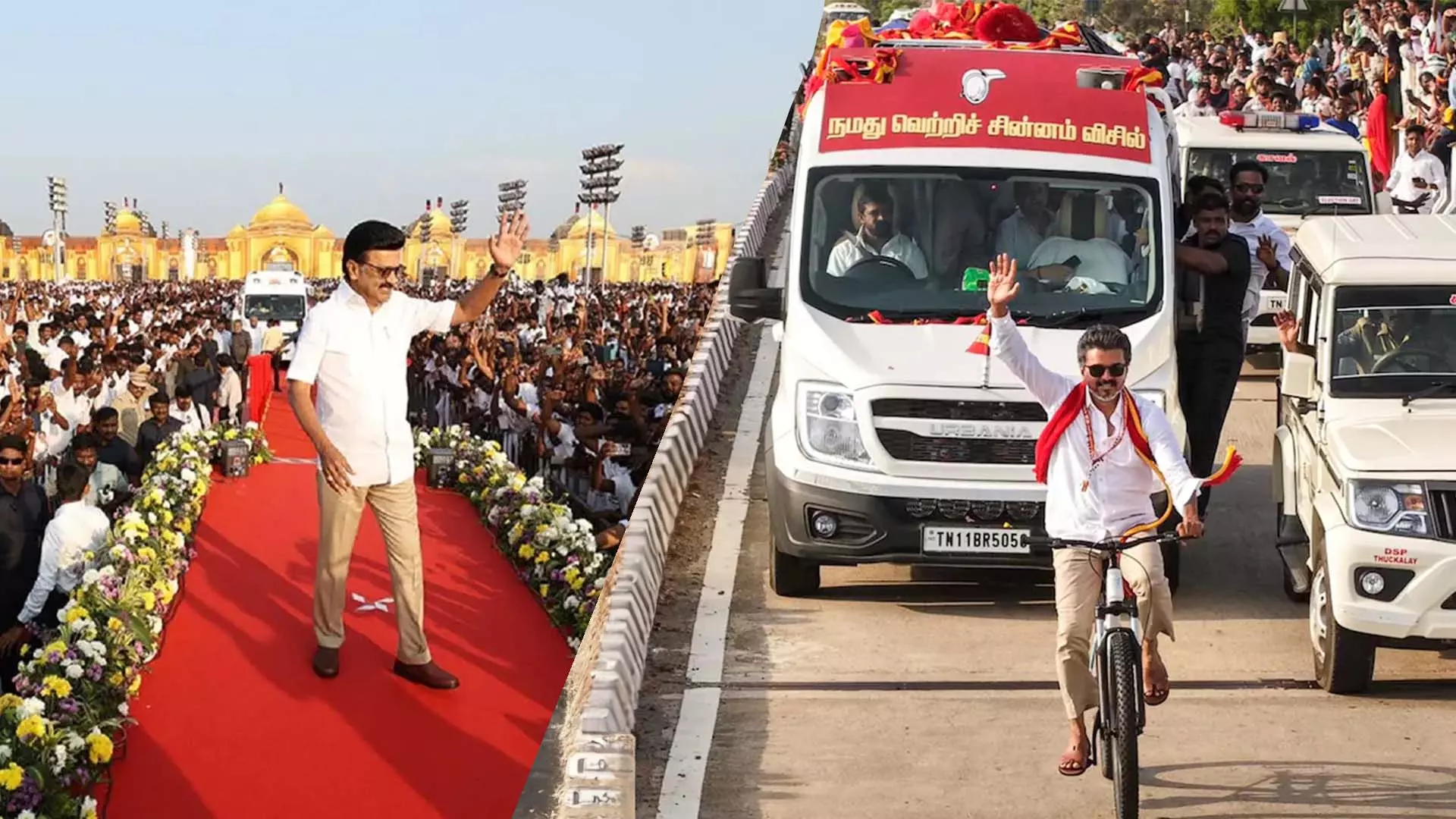
How TN poll campaign turned performative in battle to attract Gen Z voters
From viral reels to flamboyant roadshows, leaders embraced Gen Z-style campaigning. Did optics outweigh substance in the 2026 election?

Tamil Nadu’s 2026 election campaign wasn’t just political — it was performative. From viral gestures to social media-friendly moments, leaders across parties transformed campaigning into a visual spectacle aimed at younger voters.
At the centre of this shift was actor-turned-politician Vijay, whose entry with the TVK introduced a new style of political engagement. His rallies resembled film releases, complete with punch dialogues, dramatic gestures, and highly shareable moments.
Politics wasn’t just about speeches anymore. It was about moments people could film, share, and remix, the narrative highlights, capturing the shift towards a content-driven campaign style.
Vijay’s presence brought what traditional parties lacked — organic youth fandom. Simple acts, like riding a bicycle through crowds, quickly turned into viral content, setting a new template for political outreach.
Viral politics
This transformation forced established leaders to adapt. Tamil Nadu’s political class, traditionally older, began experimenting with ways to connect with a younger, digital-first audience.
Chief Minister MK Stalin, for instance, incorporated more relatable visuals into his campaign. He accepted shawls from cadres mid-walk, took auto rides, and even stopped to engage in everyday activities like crushing sugarcane at roadside stalls.
Also Read: 'One of the worst elections TN has seen': Activist flags massive cash flow
These were not random acts but carefully-crafted moments designed to be shared online. Relatability was political currency.
Performance shift
Campaigns across parties began resembling entertainment platforms. Leaders experimented with music, performances, and interactive moments to engage crowds.
Seeman sang during campaign events, while both Stalin and Vijay used music and rhythm as tools of connection. Campaign stages became spaces not just for speeches, but for performance.
This marked a clear departure from traditional campaigning, where rhetoric and policy speeches dominated. Instead, emotional and visual engagement took centre stage.
Selfie culture
Another defining feature was the rise of selfie-driven politics. Leaders actively encouraged crowd interaction, pausing rallies to take photos and videos with supporters.
Udhayanidhi Stalin posed for selfies with cadres and children, while many politicians ensured their events were documented in real time. Dedicated filming teams followed campaign trails, capturing content for social media platforms.
Also Read: Who holds the edge in TN and West Bengal elections amid high turnout? | Capital Beat
Today’s voter doesn’t just attend rallies, they document them. There was a marked shift in Tamil Nadu from passive participation to active digital engagement.
Optics matter
Visual symbolism became a key campaign strategy. Leaders used everyday actions to communicate accessibility and relatability.
Vijay’s viral cycle ride was mirrored by Stalin’s auto journeys. BJP leaders like Tamilisai Soundararajan and Vanathi Srinivasan were seen taking bike rides, reinforcing the message of being grounded and approachable.
Even small gestures — waves, smiles, and finger hearts — were carefully deployed as part of a broader visual narrative. Politics, in this election, fully embraced the language of social media.
Youth connect
Reaching first-time voters became a priority. Leaders tailored their messages to appeal directly to younger audiences.
AIADMK leader Edappadi K Palaniswami, in his final appeal, highlighted policies like the “all-pass system” during COVID-19, positioning himself as someone who had safeguarded students’ futures.
Also Read: Tamil Nadu polls: 'Vijay’s TVK may get 25 pc votes, boost DMK's chances'
This targeted outreach reflected a growing recognition of young voters as a decisive bloc, capable of influencing electoral outcomes.
Big question
The 2026 election marked a turning point. Campaigns became shorter, sharper, and more visually-driven, designed to fit into 30-second reels.
Leaders sang, smiled, posed, waved — all to fit into a 30-second reel.
Also Read: From TVK surge to SIR row: Key forces shaping Tamil Nadu and West Bengal elections
Yet, beneath the spectacle lies a critical question: will Gen Z voters choose based on viral appeal or political vision?
One thing is certain — Tamil Nadu politics has entered a new era, where every vote may begin with a viral moment.
(The content above has been transcribed from video using a fine-tuned AI model. To ensure accuracy, quality, and editorial integrity, we employ a Human-In-The-Loop (HITL) process. While AI assists in creating the initial draft, our experienced editorial team carefully reviews, edits, and refines the content before publication. At The Federal, we combine the efficiency of AI with the expertise of human editors to deliver reliable and insightful journalism.)