Who holds the edge in TN and West Bengal elections amid high turnout? | Capital Beat
Experts flag Vijay’s debut, intense West Bengal contest, alliance shifts and voter roll concerns as key factors shaping uncertain election outcomes

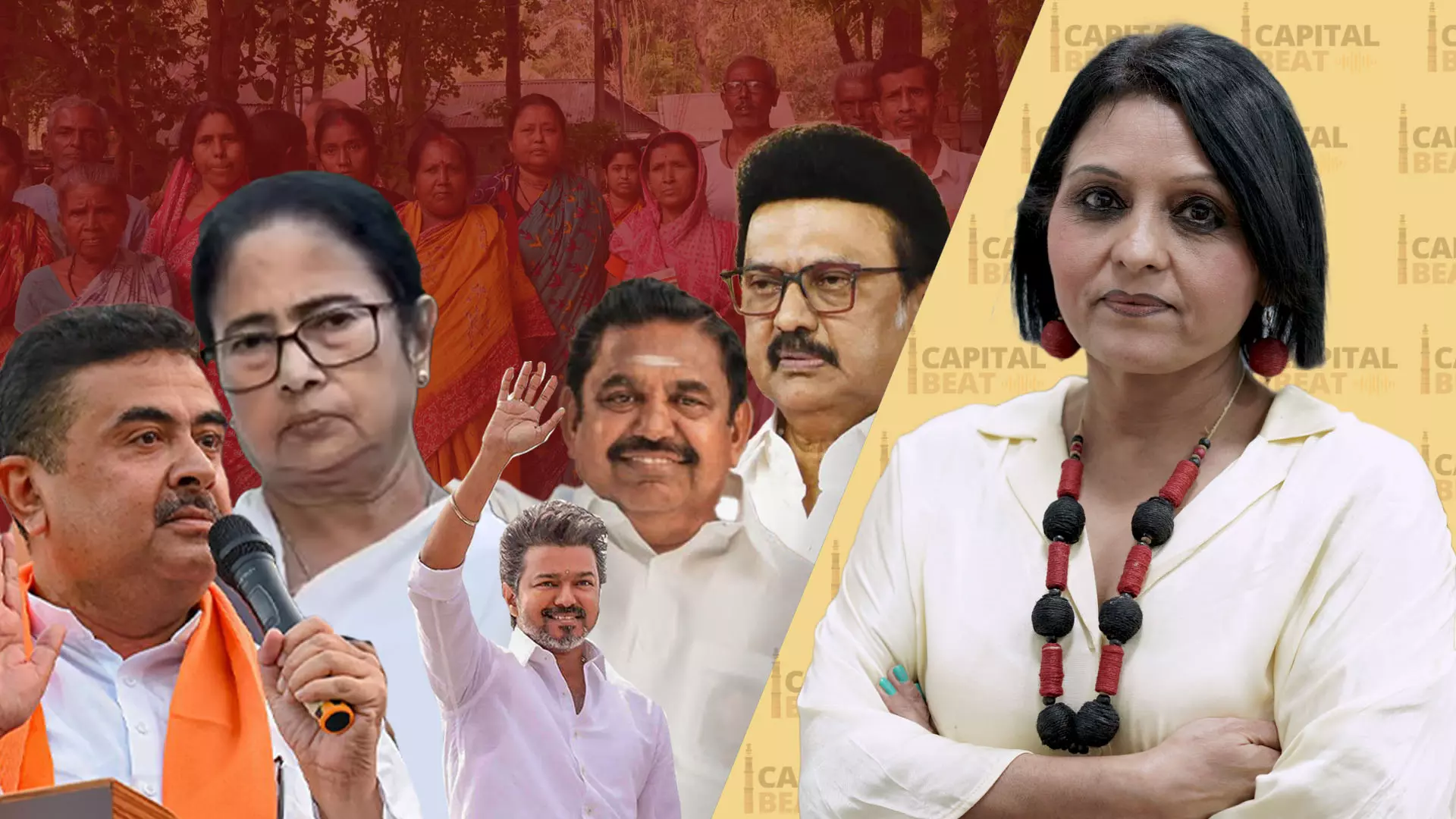
“Both parties seem to be fighting with their backs to the wall… as though there is no future after this,” observed senior journalist Shikha Mukherjee, underlining the intensity of the West Bengal elections. As Tamil Nadu completed single-phase voting and West Bengal wrapped up the first phase, uncertainty loomed over both states. The Federal spoke to Mukherjee and political analyst R Kannan to unpack voter turnout trends, disruptions, alliances, and the critical X factors shaping these high-stakes elections.
High turnout
Tamil Nadu’s 234 constituencies voted in a single phase, while more than half of West Bengal’s 294 seats went to polls in the first phase, with the rest scheduled for April 29. Early voter turnout figures suggested strong participation in both states.
By 5 pm, Tamil Nadu recorded over 82% turnout, while West Bengal saw an even higher 90%. Both panelists noted that the early hours witnessed particularly strong participation, with voters queuing up in large numbers soon after polling began.
Also read | Tamil Nadu polls: 'Vijay’s TVK may get 25 pc votes, boost DMK's chances'
Mukherjee pointed out that in West Bengal, political messaging played a role in encouraging early voting. “The message from all political parties was go out and vote early,” she said, adding that heat conditions and concerns over voter list discrepancies may have also pushed people to vote sooner.
Polling disruptions
Despite the high turnout, the day was not without glitches. In West Bengal’s Murshidabad district, voting at a booth in Raghunathganj Girls’ School was delayed due to an EVM malfunction, triggering voter anger over the lack of immediate replacement.
A similar issue was reported in Tamil Nadu’s Duvipuram, where a control unit malfunction disrupted voting at Booth 295. However, both panelists noted that these disruptions did not significantly derail the overall polling process.
Mukherjee described the overall conduct as “quite remarkable,” especially considering concerns around voter deletions and administrative challenges. She noted that despite underlying issues, polling largely proceeded smoothly.
Tamil Nadu contest
The electoral contest in Tamil Nadu pits the DMK-led Secular Democratic Alliance against the AIADMK-led NDA. A major factor this time is actor Vijay’s party, TVK, making its electoral debut.
Kannan described the election as “highly energised” and “unpredictable,” largely due to Vijay’s entry. “He enjoys immense popularity and drew unprecedented crowds,” he said, adding that while the party lacks organisational strength, its mass appeal cannot be ignored.
He also highlighted the scale of young voters, noting that a significant portion of the electorate is under 30. “At least every other person in that group could opt for Vijay,” Kannan said, suggesting that youth support could be a decisive factor.
Vijay factor
Kannan identified Vijay as the central X factor in Tamil Nadu, but stressed that his impact is complex. “He will dent both DMK and AIADMK votes,” he said.
According to him, Vijay could attract minority and Dalit voters who traditionally lean towards the DMK, while also pulling some support away from AIADMK voters. This dual impact makes it difficult to predict which party he will hurt more.
Also read | DMK confident of Kongu sweep: Senthil Balaji spells out the plan
He drew parallels with actor Vijayakanth’s 2006 electoral impact, where vote splitting influenced outcomes across multiple constituencies. However, he cautioned that unless TVK crosses a certain vote share threshold, converting popularity into seats will remain a challenge.
Alliance dynamics
On alliances, Kannan was blunt about the AIADMK-BJP partnership. “There was no sheen to be lost,” he said, calling it a “mill around the AIADMK’s neck.”
He described the alliance as a “marriage of convenience,” necessary to counter the broad coalition led by the DMK. However, he noted that minority voters are likely to drift away from AIADMK due to this alliance, potentially benefiting Vijay.
Interestingly, Kannan downplayed the impact of national issues like delimitation in Tamil Nadu, stating that local governance, candidate selection, and law and order remain more significant factors in shaping voter decisions.
Battleground Bengal
In West Bengal, Mukherjee highlighted the extraordinary intensity of the contest. “We thought intensity peaked in 2021 and 2024, but this time it has gone even further,” she said.
She described the election as deeply competitive, with all major parties fighting aggressively. High voter turnout, she suggested, reflects strong public engagement and a determination among voters to express their choices.
Also read | From land crusade heart, Nandigram emerges as Hindutva hub in Bengal | Ground Report
Mukherjee emphasised that voter participation itself is a key indicator. “People are delivering a verdict of their own choice,” she said, framing turnout as a reflection of democratic assertion.
Hidden factors
Mukherjee identified several X factors in West Bengal beyond the dominant narratives. One key trend, she said, is the potential revival of the Left-Congress alliance in certain pockets.
Another factor is the emergence of smaller players like the Indian Secular Front, which could influence vote shares in select constituencies. “Even one or two seats can make a difference,” she noted.
She also pointed to shifting narratives around migration and identity, suggesting that economic concerns have been overshadowed by debates on citizenship and infiltration. These evolving issues add layers of unpredictability to the electoral outcome.
SIR concerns
A major concern in West Bengal has been voter deletions and discrepancies in electoral rolls. Mukherjee called the situation “shocking,” noting that many voters have been left out of the process.
However, she also observed that this has not led to widespread disruption at polling booths. “People are waiting to see what happens after the election,” she said, indicating a cautious response from affected voters.
She warned that the scale of exclusions raises serious questions about electoral integrity. “How can you leave lakhs of people out?” she asked, highlighting the broader implications for democracy.
Uncertain outcomes
Both panelists agreed that predicting outcomes remains difficult. Kannan maintained that the DMK currently holds an edge in Tamil Nadu but cautioned that “anything could happen.”
Also read | Bengal polls: Farmers’ distress in Malda turns into political ‘hot potato’ for TMC
He reiterated that the election’s unpredictability stems from multiple variables, especially the impact of new entrants like Vijay. Mukherjee echoed this sentiment for West Bengal, refusing to hazard a guess on which party holds the advantage.
As the discussion concluded, the consensus was clear: high voter turnout, new political players, and unresolved controversies have made both Tamil Nadu and West Bengal elections highly unpredictable.
The content above has been transcribed from video using a fine-tuned AI model. To ensure accuracy, quality, and editorial integrity, we employ a Human-In-The-Loop (HITL) process. While AI assists in creating the initial draft, our experienced editorial team carefully reviews, edits, and refines the content before publication. At The Federal, we combine the efficiency of AI with the expertise of human editors to deliver reliable and insightful journalism.