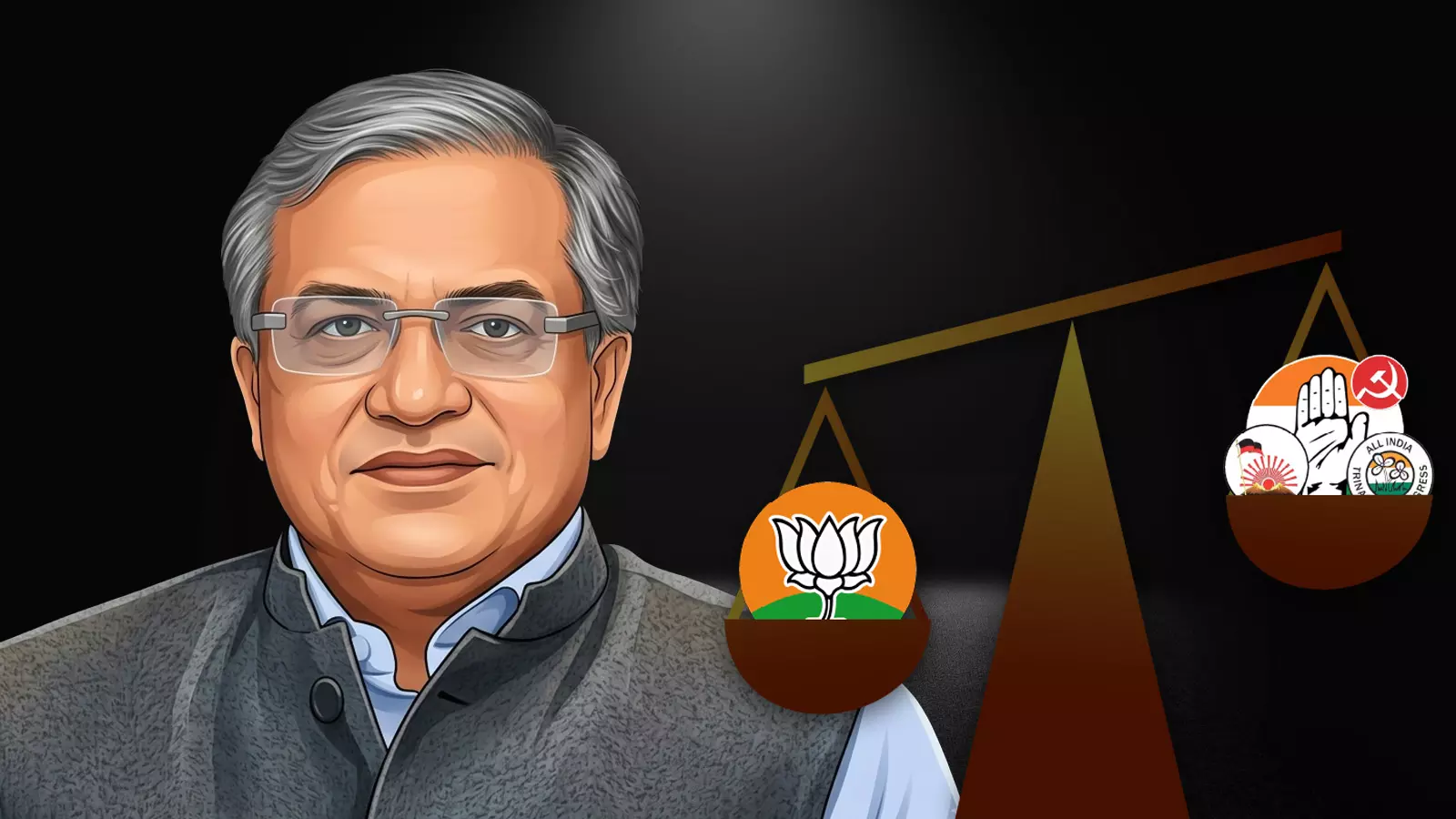
Why 2026 Assembly polls were about Opposition vs BJP plus CEC Gyanesh Kumar
CEC Kumar’s tenure has been marked by mass disenfranchisement, Bengal‑focused crackdowns, and overt partisanship, raising questions on institutional neutrality

Going by the trends so far, the 2026 assembly polls seem set for one of the biggest upsets Indian politics has ever seen. The BJP-NDA seems to have breached the Bengal fortress while holding on to its seats of power in Assam and Puducherry. Yet, these elections will go down as a dark chapter in Indian history when Opposition parties in power at the state level, especially West Bengal, fought not only the BJP at the Centre but also the Gyanesh Kumar-led Election Commission, tooth and nail.
Individually, Chief Election Commissioner (CEC) Kumar will find himself in the record books for very unenviable reasons. Opposition leaders such as the Congress’s Jairam Ramesh have called his tenure an “absolute disgrace”, accusing him of doing the “bidding” of Prime Minister Narendra Modi and Home Minister Amit Shah.
Indeed, it would be hard to explain his actions otherwise, especially against the Mamata Banerjee-led Trinamool Congress in West Bengal, even though the EC repeatedly claimed neutrality.
A dubious exercise all round
It was under Kumar’s watch that the Election Commission (EC) decided to go for a Special Intensive Revision (SIR) of voter rolls merely months before elections in some of India’s most densely populated states such as Bihar, West Bengal, and Kerala. The resultant chaos was predictable but nowhere was the diabolical design more glaring than in Bengal.
Also read: West Bengal election 2026: The many firsts emerging from early trends
Unabashedly, the EC slashed millions of voters at an unprecedented level from the electoral rolls on specious grounds. Every state lost a few million voters in the SIR exercise—2.89 crore in Uttar Pradesh, 74 lakh in Tamil Nadu, 68 lakh in Gujarat, 34 lakh in Madhya Pradesh, 31 lakh in Rajasthan, 24 lakh in Chhattisgarh, and 9 lakh in Kerala. But West Bengal stuck out like a sore thumb with its 91 lakh voter deletions because, first, these comprised a disproportionate number of Muslims. Second, over 27 lakh cases remained unresolved even as the state went to polls in two phases on April 23 and 29, effectively meaning that lakhs of possibly legitimate voters were simply not allowed to exercise their franchise because the EC chose to conduct a mammoth exercise with little time and resources at its disposal, for reasons no one quite understood.
Even worse, these voters were left out of the rolls under the dubious pretext of “logical discrepancy”, which included frivolous issues such as age difference with parents and spelling differences such as Mukhopadhyay or Mukherjee, which mean the same thing. This led observers to comment that it seemed the EC had been handed a list of the number of people to exclude and it then came up with ridiculous procedures to justify it later.
No pretence of impartiality
That is not all. Gyanesh Kumar will also go down as the only CEC in the history of independent India under whom the EC directly attacked a political party, without bothering to even put on a mask of impartiality. As the TMC refused to give up its fight against the arbitrary and unfair deletion of voters in the garb of SIR and the seemingly partisan role of the EC to favour the BJP, Kumar’s unsavoury behaviour with them deserves a special mention in itself.
A meeting between the CEC and a TMC delegation that had gone to meet him with their objections lasted all of seven minutes, and ended with Kumar allegedly telling them to “get lost”. As the leaders made the interaction public, the EC posted on its official X handle a direct attack on the party, pointedly accusing it of voter intimidation and other poll malpractices in the past while asserting that the 2026 elections would be free of such evils. Such a direct attack by the EC towards a political party was hitherto unheard of.
Also read: EC orders full repoll in Falta; what are its implications? | Capital Beat
That was just the climax though. Throughout the election campaign, complaints of overt attempts by the EC to “rein in” the TMC repeatedly kept cropping up. Top bureaucrats and police officials were transferred across the state at an unprecedented scale—483 versus only 23 transferred in the three other poll-bound states of Tamil Nadu, Kerala, and Assam combined.
Only TMC MLAs and local leaders were selectively named as troublemakers, while orders were issued to place them under preventive detention ahead of polling, only to be stayed by the Calcutta High Court on at least two occasions. Dubious orders such as placing a blanket ban on bikers for 48 hours in the name of security were also struck down by the court. Bengal was turned into a veritable fortress, with more than 2 lakh central forces personnel descending upon the state.
Not one but two notices of motion for removal
As the TMC looked to initiate proceedings for removing Kumar as the CEC, the Opposition INDIA bloc rallied behind it. And thus Kumar became the only CEC in the history of independent India, so far, against whom a notice of a motion for removal was instituted by the Opposition—not once but twice—on grounds of “brazenly partisan conduct” and “proven misbehaviour”.
The first notice, filed by 193 Opposition MPs in both Houses of Parliament in March, was rejected by Rajya Sabha Chairman CP Radhakrishnan and Lok Sabha Speaker Om Birla. On the second notice, submitted by 73 Opposition MPs in the Rajya Sabha on April 24, a decision is still pending.
Also read: Bengal repolling: Who benefits, TMC or BJP? | Capital Beat
The second notice alleged “partisan asymmetry” by the CEC in enforcing the Model Code of Conduct. Specifically, it cited the EC’s failure to act on complaints regarding Prime Minister Modi’s April 18 address on Doordarshan where he openly bashed Opposition parties by name, while swiftly targeting Opposition figures like Mallikarjun Kharge with show-cause notices.
Why Gyanesh Kumar stands out
It’s not that all past CECs have had a smooth ride. TN Seshan in the Nineties and James Michael Lyngdoh in the early-2000s also faced intense political backlash, but Kumar’s case is fundamentally different from theirs. Seshan earned the wrath of several political leaders, particularly RJD chief Lalu Prasad, for acting “too independently”. And he is still remembered as the CEC who gave the poll panel more teeth and ensured that it functioned with complete independence from the Executive.
Lyngdoh was targeted by none other than Narendra Modi, then chief minister of Gujarat, for declining his request for holding early elections in Gujarat, months after the 2002 communal riots. Modi had insinuated that Lyngdoh did not allow the elections to be held as he was a Christian and was acting under instructions from then Congress president Sonia Gandhi. The Supreme Court upheld Lyngdoh’s decision, and a reprimand from then Prime Minister Atal Bihari Vajpayee forced Modi to back down from attacking Lyngdoh.
Also read: Bengal poll row deepens with EVM complaints; how was it possible despite record forces?
Kumar’s tenure, in contrast, has seen all-round condemnation by the Opposition, civil society groups, public intellectuals, and at times even courts for his high-handedness, enabling mass disenfranchisement of bona-fide voters and for what many in the Opposition call “turning the Election Commission into the election department of the BJP”.
Recently, in a telling comment, West Bengal BJP leader Suvendu Adhikari said in an interview, "The EC has done its job. Now, the sanatandharmis in Bengal have to do theirs." And they did, it seems.