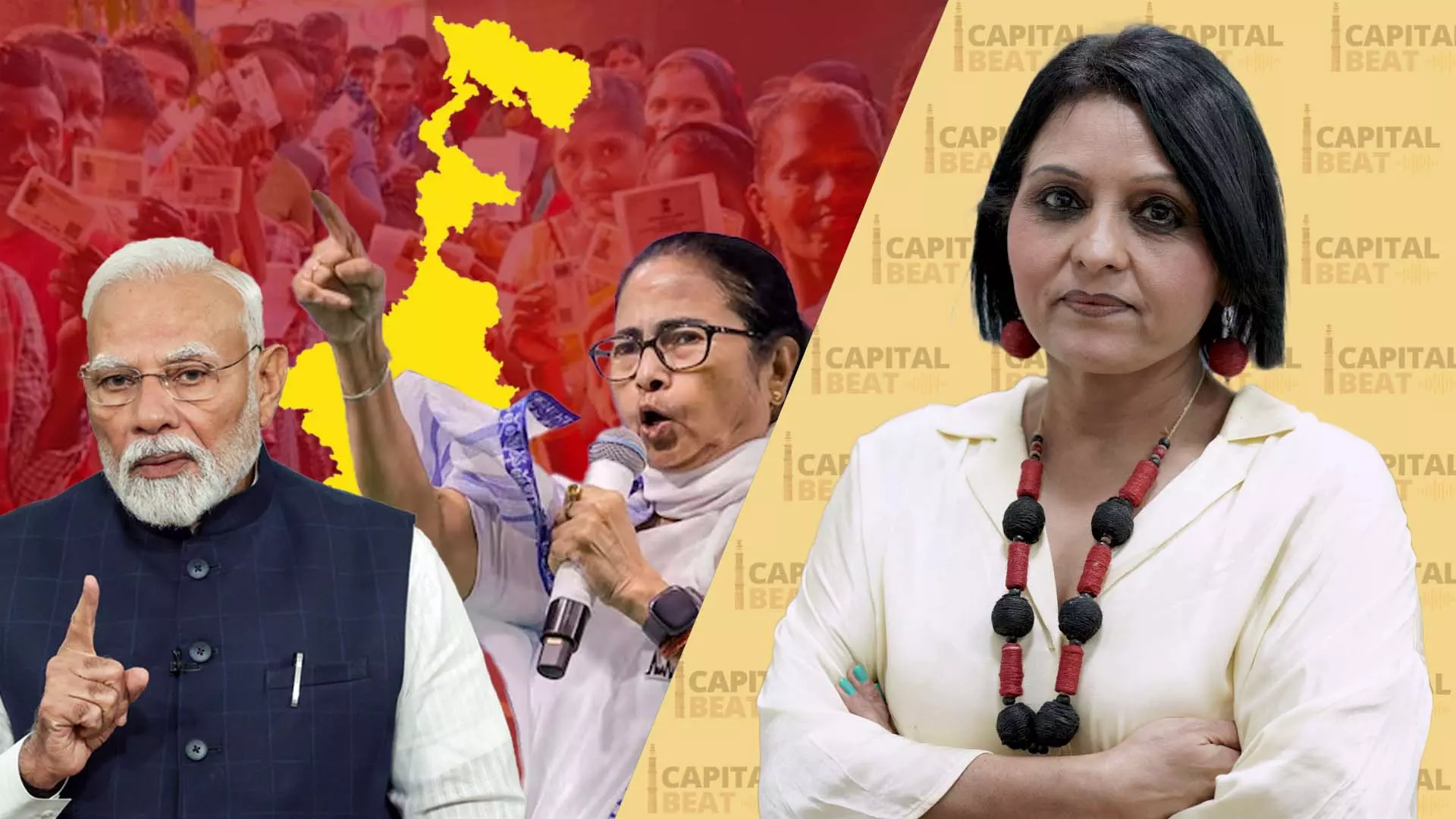
Bengal repolling: Who benefits, TMC or BJP? | Capital Beat
West Bengal repoll sparks questions on security, trust deficit, and electoral impact

In today's (May 2) Capital Beat episode, senior journalist Shikha Mukherjee and The Federal’s Samir Purkayastha examined the implications of repolling in select West Bengal constituencies, focusing on security deployment, allegations of irregularities, and the broader question of institutional trust.
The discussion centred on whether the repoll in South 24 Parganas and subsequent developments could influence the electoral balance between the Trinamool Congress (TMC) and the Bharatiya Janata Party (BJP).
Repolling was conducted in 15 polling stations across Magrahat Paschim and Diamond Harbour constituencies following complaints of irregularities during the second phase of Assembly elections. Voting began at 7 a.m. on Saturday (May 2) and concluded at 6 p.m., with additional security measures implemented to ensure order and transparency.
Also read: TMC to win over 200 seats: Mamata tells party workers, rejects exit polls
The Election Commission (EC) deployed 165 additional counting observers and 77 police observers to oversee security arrangements around counting centres. The move was positioned as an effort to ensure that counting proceedings are conducted in a secure and transparent manner.
Repoll scale and speculation
Mukherjee highlighted the limited scale of the repoll, stating, “There is polling, a repoll happening in 15 booths. Now, 15 booths is a very small number.” She noted that the number of affected booths within constituencies remained marginal in the overall electoral context.
She described the election environment as marked by speculation and rumours, stating, “This election has been unprecedented in terms of the kind of rumours, speculation and conspiracy theories that have been going around.” She added that narratives around manipulation had gained traction beyond political circles.
Mukherjee outlined perceptions surrounding the repoll process, stating, “The speculation and the conspiracy theory is that this is another EC in cahoots with the BJP mechanism to juggle the margins and decrease the Trinamool's chances of winning.” She indicated that such claims were being discussed widely among ordinary voters.
Security deployment and voter anxiety
Addressing the increased deployment of forces, Mukherjee drew comparisons with past conflict regions. “We have seen security forces with semi-automatic weapons… not in West Bengal… but yes in Kashmir,” she said, placing the current election environment in a broader national context.
She added, “It’s almost as though West Bengal today is terrorist country,” describing the scale of central force deployment. The reference was made in the context of heightened security presence at polling stations, strong rooms, and counting centres.
Mukherjee characterised the situation as unprecedented in scale, stating, “This is way beyond that”, in comparison to earlier elections with heavy deployment. She linked the presence of large numbers of forces to a perception of heightened risk and preparedness.
Impact on electoral outcomes
Purkayastha stated that the repoll was unlikely to significantly alter electoral outcomes. “I don’t think repoll will make much difference,” he said, citing the political profile of the constituencies involved.
He described Diamond Harbour as “definitely a TMC stronghold” and noted that Magrahat, under the Jayanagar parliamentary segment, also favoured the ruling party. “These are TMC strongholds in any case,” he said.
Purkayastha pointed to voter turnout trends, noting a decline compared to earlier polling. “Till 3:00 p.m., the Election Commission said voter turnout was around 70 to 72 per cent,” he said, indicating a drop from previous figures.
Timing and voter inconvenience
Purkayastha raised concerns about the timing of the repoll announcement. “Polling was over on (April) 29, and they announced repoll only yesterday,” he said, highlighting the short notice provided to voters.
He noted the demographic profile of the affected areas, stating, “These are very rural constituencies and full of migrant workers.” He added that many voters had already returned to work after the initial polling date.
“Without giving them enough notice, if you order a repoll then obviously it puts lots of voters into inconvenience,” he said, pointing to logistical challenges faced by the electorate.
Allegations and institutional response
Purkayastha questioned the delay in addressing allegations of EVM tampering. “If the EVM was tampered, Election Commission should have noticed it on the polling day itself,” he said.
He added, “After deploying so many observers… they couldn’t secure even the polls,” raising concerns about the effectiveness of existing monitoring mechanisms.
He highlighted competing allegations from both major parties, saying, “Along with the TMC, even BJP has come up with a slew of allegations against the strong room being open.” He described the situation as reflecting a broader institutional challenge.
Trust deficit in election process
Purkayastha framed the issue as a crisis of confidence, stating, “We have an umpire. Now nobody is believing him.” He described this as a “serious concern” in the context of electoral integrity.
He added, “There is already huge trust deficit on the Election Commission”, and said that ongoing developments were “compounding those deficits”. The remarks reflected concerns about public perception of neutrality.
Mukherjee echoed the concern and said that “no process in the election is any more transparent or trustworthy”. She described this as “the most astonishing thing” observed during the current election cycle.
SC order and legal questions
The discussion also addressed the Supreme Court’s decision on the TMC’s plea challenging an EC circular on counting personnel. The court stated that no further order was necessary and upheld the Commission’s authority.
Purkayastha described the legal position, stating, “Conduct of elections… is purely a prerogative of the commission.” He noted that similar positions had been upheld by the Calcutta High Court.
He added that the identity of counting officials would not significantly affect outcomes. “Who are the officials won’t make much difference because all the political parties’ counting agents should be there,” he said.
Questions on personnel and neutrality
Mukherjee raised concerns about the nature of personnel deployed. “Why did you bring officers from the central public sector organisations?” she asked, highlighting apprehensions about perceived neutrality.
She said, “The kind of personnel who are deployed… need to be trusted on all sides and need to be seen to be above partiality.” The remarks focused on the importance of perception in maintaining institutional credibility.
Mukherjee added that concerns were not limited to a single party. “The Election Commission is not being seen as playing fair… not even by the BJP,” she said, indicating a broader political consensus on the issue.
Escalating tensions ahead of counting
Mukherjee described the evolving situation as unpredictable. “Everything is so unexpected,” she said, referring to developments leading up to counting day on Monday (May 4).
She added, “We can expect both sides to do something to keep the tension spiralling,” indicating continued political activity and heightened contestation.
Purkayastha pointed to emerging developments, including FIRs and demands for additional repolls. “There might be a repoll tomorrow also,” he said, reflecting uncertainty around further EC decisions.
(The content above has been transcribed from video using a fine-tuned AI model. To ensure accuracy, quality, and editorial integrity, we employ a Human-In-The-Loop (HITL) process. While AI assists in creating the initial draft, our experienced editorial team carefully reviews, edits, and refines the content before publication. At The Federal, we combine the efficiency of AI with the expertise of human editors to deliver reliable and insightful journalism.)