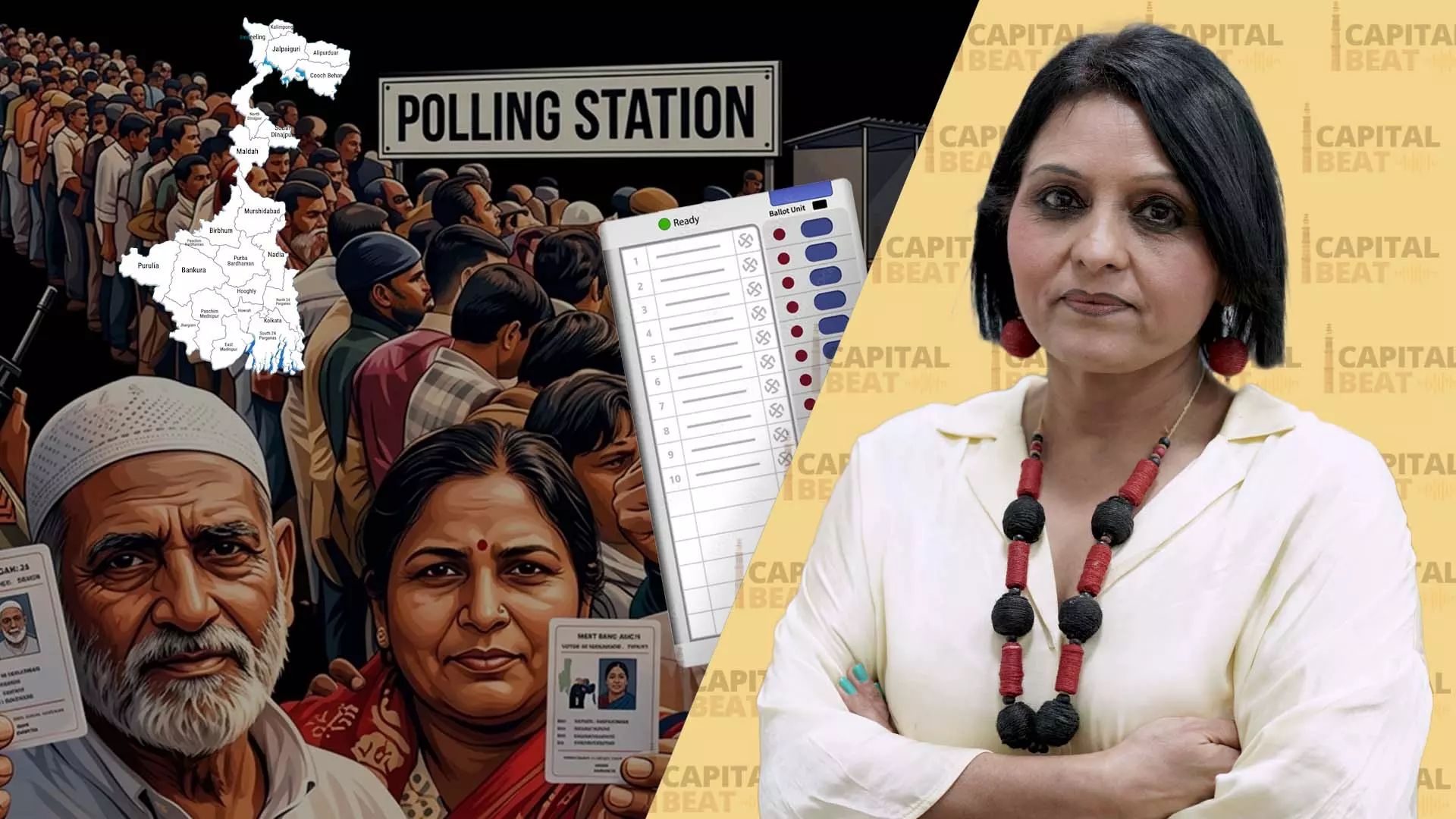
Bengal poll row deepens with EVM complaints; how was it possible despite record forces?
77 complaints from Bengal spark repoll debate; how was it possible to tamper with EVMs with such a large number of paramilitary forces being around?

“Even after deploying massive forces, how could EVM tampering happen?”—this question dominated a the discussion in this episode of Capital Beat, as allegations surrounding West Bengal’s polling process intensified.
With 77 complaints reaching the Election Commission, the debate over electoral integrity has taken centre stage. Anchor Neelu Vyas spoke to TMC spokesperson Shubhankar Bhattacharya and The Federal’s senior journalist Samir K Purkayastha to unpack the controversy, the likelihood of a repoll, and the political implications of recent developments.
Complaint politics
The complaints—primarily from constituencies such as Falta, Diamond Harbour, Magrahat, and Bajbaj—have triggered scrutiny. Officials confirmed that at least 23 cases have prima facie merit, raising the possibility of repolling in select booths.
Bhattacharya alleged that the focus on BJP complaints has overshadowed concerns raised by other parties. He claimed that multiple complaints from the Trinamool Congress and other opposition groups have not received adequate attention.
According to him, this selective spotlight raises questions about institutional neutrality. He argued that narratives are being shaped around complaints made by the BJP, while others remain largely unreported in national discourse.
Also read: Are exit polls losing the plot amid rising uncertainty? | Talking Sense With Srini
Bhattacharya further accused the Election Commission of bias, suggesting that decisions on repolling could be influenced by political considerations rather than procedural fairness.
Allegations escalate
Responding to allegations of electoral malpractice, including claims of symbol tampering and voter influence, Bhattacharya dismissed the accusations against TMC. He pointed to the heavy deployment of central forces and administrative reshuffles as evidence that the system was already tilted.
“If such large-scale security arrangements were in place, how could these incidents occur?” he asked, questioning the credibility of the complaints.
He also raised concerns about the conduct of security personnel, alleging that some may have attempted to influence voters during identity checks—an act he said violates election norms.
EC under scrutiny
Purkayastha offered a broader perspective, noting that the complaints—largely from the BJP—also reflect a lack of confidence in the Election Commission itself.
He highlighted that many of these complaints originate from areas under the parliamentary constituency of Abhishek Banerjee, particularly Diamond Harbour, which has been a focal point throughout the election.
Also read: Today’s Chanakya exit poll: BJP wins in Assam, Bengal; TVK surprise in TN; Kerala close fight
“The bigger question is not just about neutrality, but efficiency,” he said, pointing out that extensive surveillance measures such as CCTV monitoring and body cameras were in place.
If tampering did occur, he added, it raises serious concerns about how such breaches went undetected.
Violence concerns
Beyond EVM-related allegations, Purkayastha flagged incidents of violence reported during and after polling. Both BJP and TMC have accused each other of targeting party workers.
He questioned the effectiveness of deploying over two lakh security personnel if such incidents could not be prevented.
The presence of central forces, instead of reassuring voters, has become another point of contention, with accusations of inaction and bias emerging from both sides.
Legal recourse
Bhattacharya indicated that TMC’s primary course of action has been to approach the judiciary. He said the party has repeatedly knocked on the doors of the High Court and Supreme Court to seek intervention.
Also read: Mamata on exit polls: ‘BJP’s final game to reassure share market; keep calm’
However, he expressed frustration over what he described as inadequate responses, arguing that legal avenues have not provided timely relief during the election process.
According to him, the lack of acknowledgment of complaints at the administrative level forces parties to escalate matters legally, complicating the process further.
Bail controversy
Another development adding to the political debate is the bail granted to IPAC director Vinish Chandal in a money-laundering case, shortly after polling concluded.
Bhattacharya suggested that the timing raises questions, linking it to a broader pattern of investigative actions coinciding with elections.
He argued that such developments contribute to a perception that institutional mechanisms are being used selectively during politically sensitive periods.
Pattern debate
Purkayastha echoed this sentiment, describing the timing of Chandal’s arrest and release as “suspicious.” He noted that similar patterns have been observed in past cases, where enforcement agencies become active before elections and recede afterwards.
Also read: After BJP, TMC alleges tampering as EVM row hits post-poll Bengal; Mamata rushes
He cited instances where high-profile cases saw limited progress over time, suggesting that the intent behind such actions may be more political than legal.
“This is not an isolated incident,” he said, adding that the trend undermines public trust in institutions.
Repoll decision
On the possibility of a repoll, Purkayastha clarified that any such exercise must take place before the counting of votes. He indicated that at least some booths could see repolling, given the number of complaints filed.
He also revealed that the Election Commission is expected to take a final decision soon, possibly by the same night, after reviewing all submissions.
The outcome, he said, will be crucial in determining the credibility of the electoral process and addressing the concerns raised by various stakeholders.
Waiting for clarity
As West Bengal awaits the Election Commission’s decision, the controversy surrounding EVM complaints and the broader electoral process continues to intensify.
Also read: Delhi court grants bail to I-PAC co-founder Vinesh Chandel in Bengal coal scam case
With both sides raising serious allegations and institutional credibility under scrutiny, the coming hours could prove decisive in shaping the narrative of this election.
(The content above has been transcribed from video using a fine-tuned AI model. To ensure accuracy, quality, and editorial integrity, we employ a Human-In-The-Loop (HITL) process. While AI assists in creating the initial draft, our experienced editorial team carefully reviews, edits, and refines the content before publication. At The Federal, we combine the efficiency of AI with the expertise of human editors to deliver reliable and insightful journalism.)