



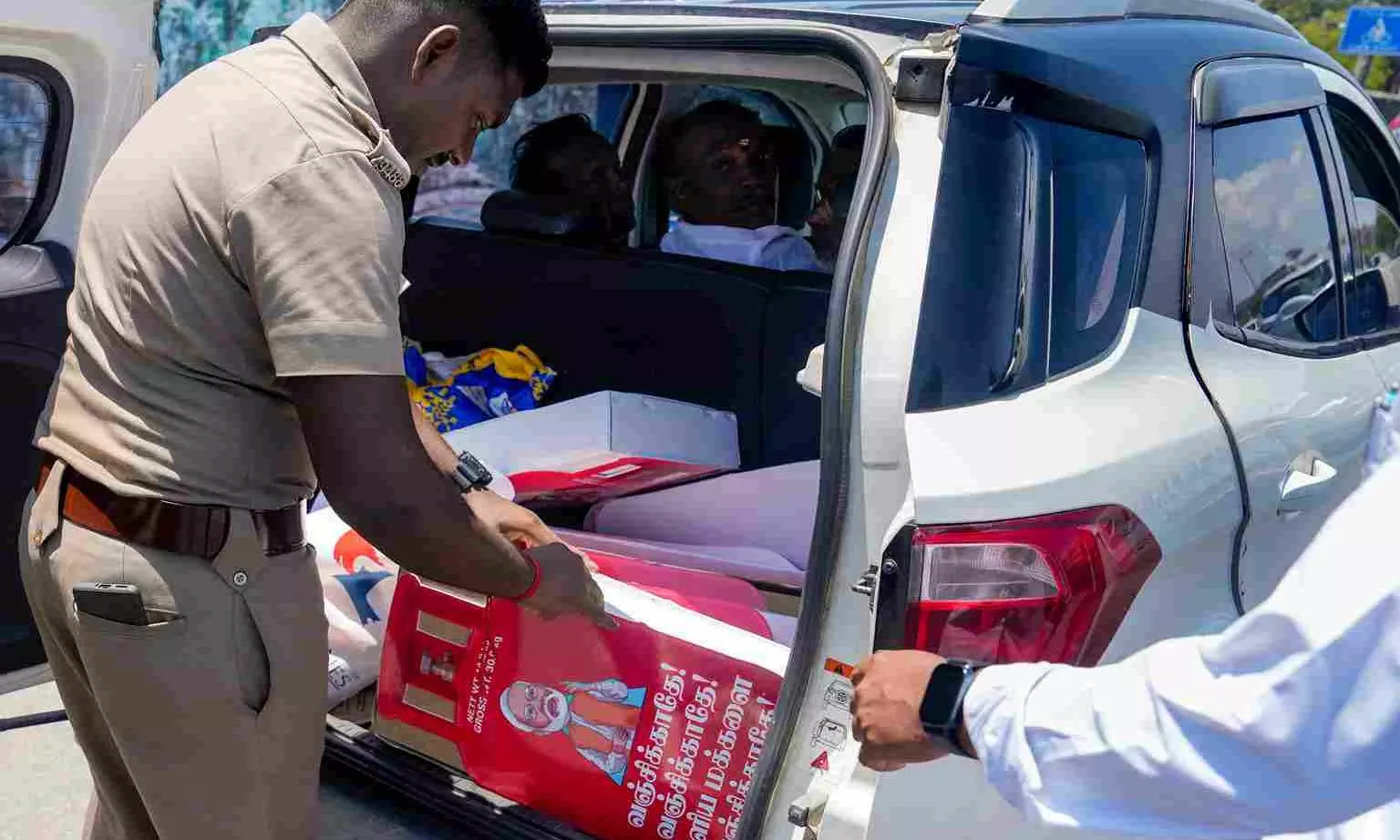
The EC's Static Surveillance Team members conduct a security check for cash and valuables ahead of the Tamil Nadu Assembly elections, in Chennai. File photo: PTI
TN's traders, farmers, ordinary people bear brunt of election cash crackdown
With cash limit stuck at Rs 50,000, small businesses, cattle markets and hospital-bound patients are paying the price for the state's cash-for-votes culture

Nandhini was already anxious when her family set out on the Palladam-Udumalai road at Sittambalam, in Tamil Nadu's Tiruppur district. Her elderly mother needed urgent medical attention at a Coimbatore hospital, and the family had arranged ₹2 lakh in cash to cover the treatment. They never made it past the flying squad checkpoint.
Enforcement officers seized the entire amount, pending verification of its source. Nandhini broke down at the checkpoint, her explanations dismissed. The cash was confiscated — and with it, the family's ability to seek timely medical care.
This family's ordeal is not an isolated one. Since the Model Code of Conduct (MCC) kicked in on March 15, flying squads have fanned out across Tamil Nadu — and it is small traders, farmers and ordinary citizens who are increasingly caught in the crossfire.
Tough limits
Under Election Commission (EC) guidelines, individuals may carry up to ₹50,000 in cash without documentation. Anything above that requires proof of source and purpose — bank withdrawal receipts, invoices, business records, medical bills or wedding invitations.
Those who cannot produce the paperwork on the spot risk having the excess cash seized and deposited in government treasuries. Goods valued over ₹10,000 face similar scrutiny, while seizures exceeding ₹10 lakh are referred to the Income Tax Department.
In just 3 days after MCC kicked in, authorities seized cash, liquor, narcotics, precious metals, and freebies worth ₹23.28 crore in Tamil Nadu.
Chief Electoral Officer Archana Patnaik has firmly stated that no changes to the cash limits are forthcoming. Addressing the media in Chennai, she clarified, "If people have documents, any amount is allowed. But they should have proper documents and produce them."
She emphasised that the rules apply uniformly to the public, traders, political representatives, and candidates alike, with even digital transactions under surveillance to prevent voter inducements.
Also read: TN Assembly elections: Vijay declares TVK to go solo
Enforcement has been aggressive. Over 4,200 teams including 2,106 flying squads and an equal number of static surveillance units, are deployed statewide.
As of March 18, authorities have seized cash, liquor, narcotics, precious metals, and freebies worth ₹23.28 crore in just days since the MCC took effect. Earlier figures showed ₹1.26 crore seized within the first 20 hours, escalating rapidly with reports of ₹42.65 crore in some updates.
Traders' woes mount
Incidents similar to the Sittambalam one have evoked strong public sympathy and criticism of the enforcement's insensitivity.
Small traders and vegetable vendors say daily procurement often exceeds the limit, leading to fears of seizure and reluctance to transport goods or cash.
When action is taken to curb election malpractices, people claim the public is being harassed. How should this be understood: N Gopalaswami, former CEC
Cattle markets in areas like Pollachi stand deserted, as sellers from neighbouring Kerala want to avoid the risk of seizure, as documentation is cumbersome. Farmers are delaying fertiliser purchases or sowing due to cash restrictions, while wedding families return empty-handed after failing to buy gold for traditional items like mangalsutras.
Appeals to EC
Traders' associations have made a formal appeal to the EC. AM Vikramaraja, president of the Tamilnadu Vanigar Sangankalin Peravai (Federation of Tamil Nadu Traders' Associations), met Patnaik and submitted a petition urging that traders be allowed to carry cash or goods up to ₹5 lakh without harassment, particularly exempting food articles and commercial items.
Also read: TN Assembly elections: DMK allots 5 seats to CPI, trims 2021 tally
Other groups, including the Tamil Nadu Foodgrains Merchants Association, have demanded an increase in the limit to ₹2 lakh, arguing that the current ₹50,000 threshold, unchanged for years, fails to account for inflation and rising business costs.
Vikramaraja condemned specific seizures as overreach and warned of potential protests if relief is not granted.
TN's freebie culture
While small traders and the public decry the hardships caused by the rigid cash limits and intensified roadside checks, former Chief Election Commissioner N Gopalaswami defended the stringent measures as essential. In his view, these steps are necessary to combat a pervasive culture of voter inducements unique to the state.
In an interview with The Federal, Gopalaswami said Tamil Nadu's electoral landscape is marred by rampant distribution of inducements, including household items like plates and vessels, gold coins, anklets, nose rings, and other jewellery often used as bribes to sway voters. "Such disgraceful practices are not seen to this kind of extent in any other state during elections," he said.
He questioned the origins of the massive funds used to meet these distributions, implying deep-rooted unaccounted money flows from political parties and candidates. The former CEC stressed that flying squads must rigorously conduct checks and seize cash or items lacking proper bills/receipts to prevent such malpractices.
Call for stern action
"Why hasn't the Election Commission been able to stop political parties and candidates from heavily distributing items to secure votes?" asked Gopalaswami. Pointing out the irony in public criticism, he said: "When action is taken to curb these malpractices, people claim the public is being harassed. How should this be understood?"
"During election time, the people know very well what needs to be done. This should not be politicised," he advised, calling for public understanding of the EC's role in ensuring free and fair polls.
Also read: Vijay faces fresh trouble as TVK leader Aadhav Arjuna’s comment infuriates Rajini fans
Gopalswami also spoke on the contentious ₹50,000 cash-carrying threshold, a limit unchanged for years and now drawing ire from traders' associations, who are seeking hikes to ₹2 lakh or even ₹5 lakh. "The maximum cash one can carry is ₹50,000, as decided by the Election Commission. If the Commission wishes, it can increase it," he noted.
Tamil Nadu under lens
Gopalaswami's comments reinforce the EC's stance that robust enforcement, though inconvenient, is indispensable in a state where cash-for-votes has been normalised. Historically, Tamil Nadu has featured prominently in seizures, reflecting its political culture of wooing voters with cash and other lures.
For instance, in 2024, state-wise data from the EC showed Tamil Nadu had ₹460.85 crore in total seizures during elections, ranking it third nationally behind Rajasthan (₹778 crore) and Gujarat (₹605 crore).
People can appeal to district grievance committees or special appellate bodies to recover their seized goods or cash. A committee comprising the project director, district treasury officer, and others, review claims with supporting documents like receipts or bank statements.
Similar processes apply statewide through district election offices.
